
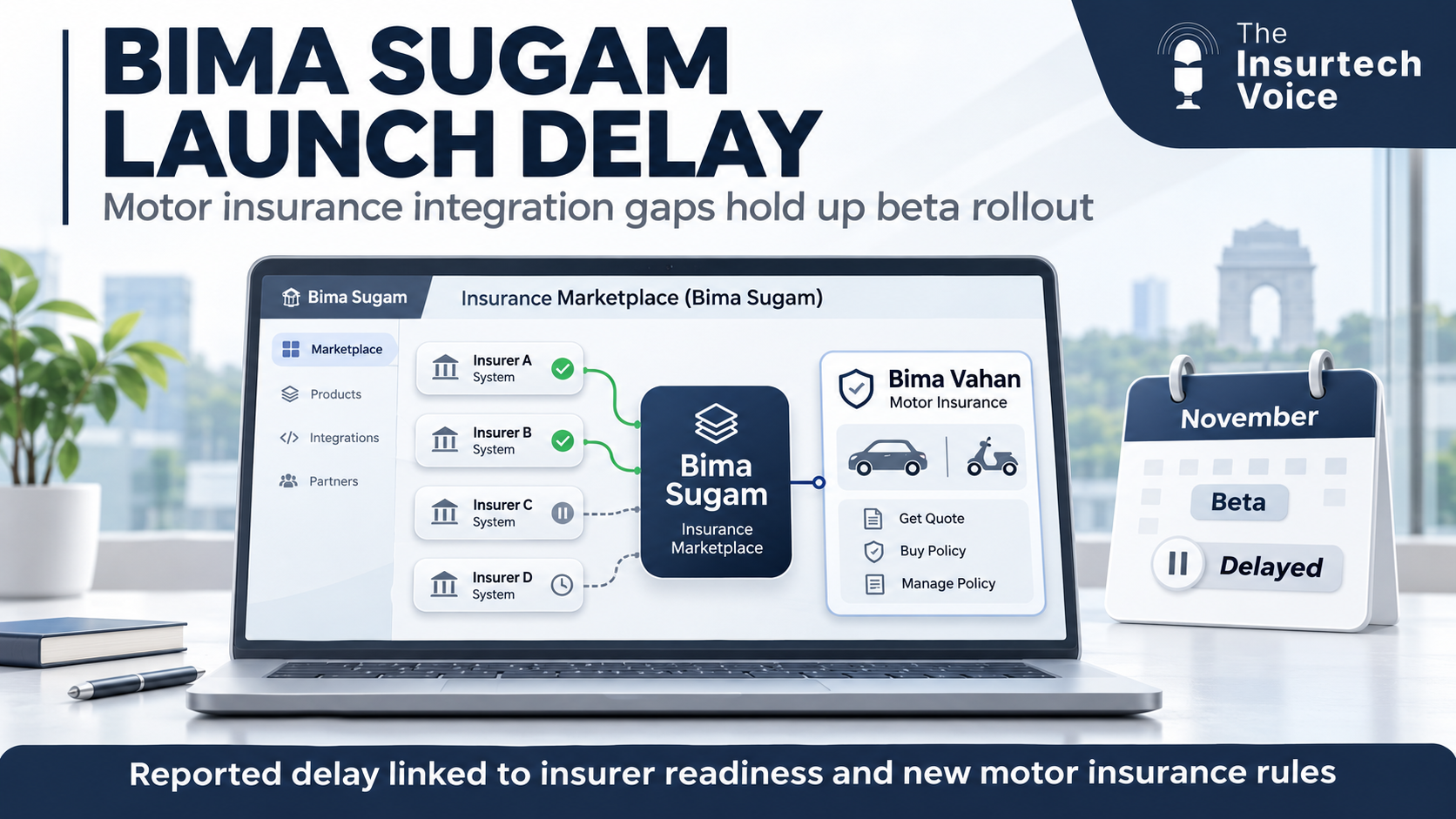
Nine general insurers had reportedly completed integration for new private-car insurance, but that was not enough to get Bima Sugam's first motor insurance offering off the ground. Bima Vahan, which was expected to begin its beta rollout on 23 November 2026, has been postponed following a review of the products available on the platform.
Business Standard reported on 24 November that gaps in insurer readiness and preparations for the revised motor insurance rules had contributed to the decision. The delay raises an important question for India's proposed insurance marketplace: how much of the insurance buying journey can it actually support when it opens to customers?
Key Takeaways
- Bima Vahan's planned November beta launch has reportedly been postponed.
- Nine general insurers have completed integration for new private-car policies, according to media reports.
- Integration work remains outstanding across several other motor insurance products.
- IRDAI's four-layer motor insurance framework takes effect on 15 December 2026.
- The proposed beta was limited to new vehicles; renewals were not yet included.
What is Bima Sugam and how is it different from Bima Vahan?
Bima Sugam is India's proposed electronic marketplace for insurance, while Bima Vahan is its motor insurance offering. The wider marketplace is intended to bring life, health and general insurance services together on a common digital platform.
Under the Bima Sugam regulations published in the Gazette of India in March 2024, the platform is designed as digital public infrastructure. Its role extends beyond selling policies to supporting policy administration, claims and complaints. The regulations provide for an insurer-owned, not-for-profit company in which no single shareholder has control.
For customers, the idea is straightforward: instead of visiting separate insurers' websites, they could access products and insurance services through a common platform. The proposed November beta, however, concerned motor insurance rather than the entire marketplace.
How has the Bima Sugam launch timeline changed?
The November postponement follows several earlier launch expectations that did not materialise. The project has been under discussion since 2022, with the regulatory framework introduced in March 2024.
| Period | Development |
|---|---|
| 2022 | Bima Sugam first proposed |
| March 2024 | Insurance marketplace regulations notified |
| June 2026 | IRDAI chairman indicated initial products could launch by September-end |
| September 2026 | November rollout expectation reported by Moneycontrol |
| 23 November 2026 | Planned Bima Vahan beta did not proceed |
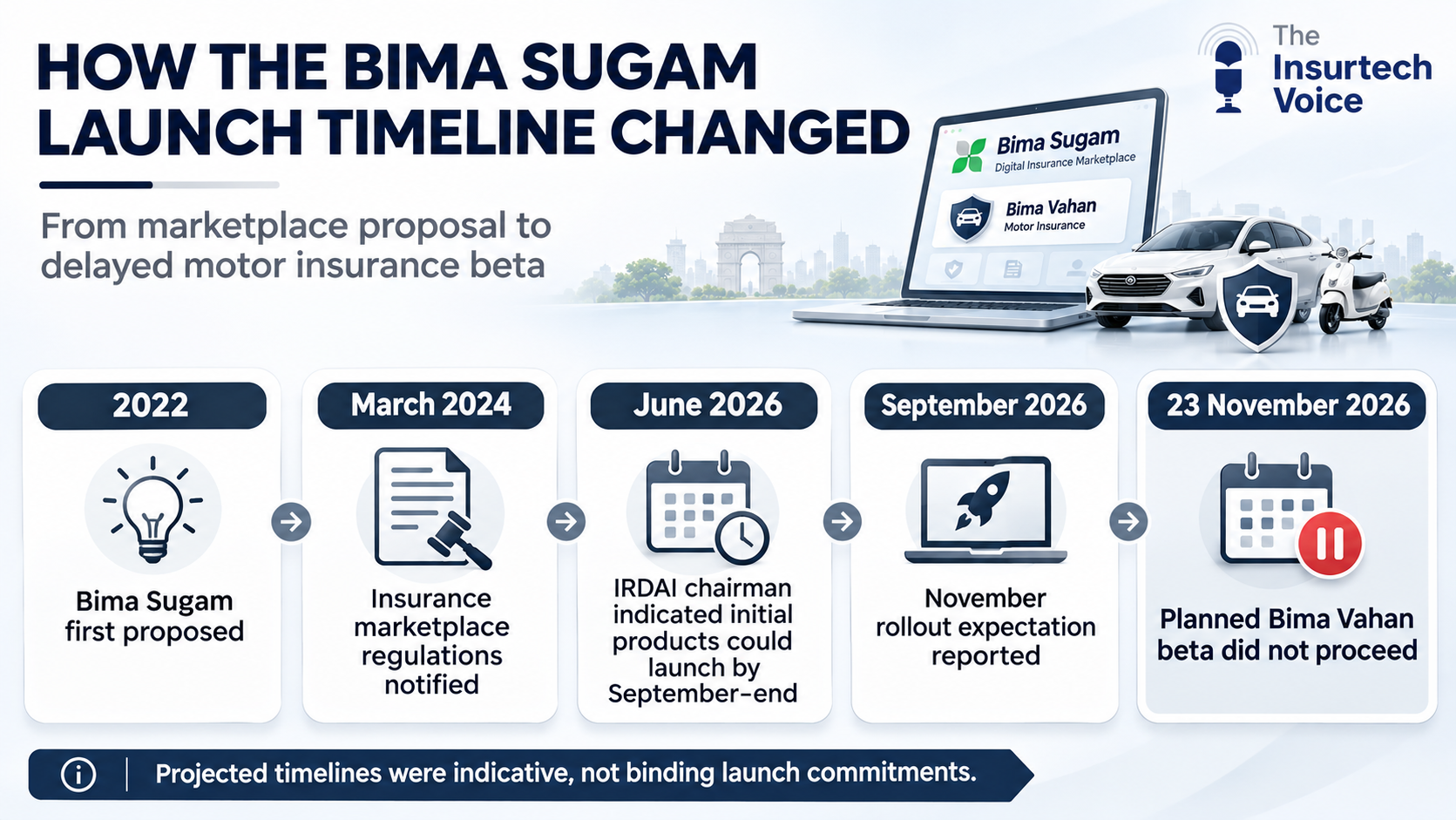
The June launch expectation and September update were projected timelines, not binding launch commitments.
Why has the Bima Sugam beta launch been postponed?
Insurers have reached different stages of readiness across motor insurance products. A connection that works for private-car cover may not yet support two-wheelers or standalone third-party policies.
The Insurance Reporter reported that the postponement followed discussions with IRDAI, with December identified as the next readiness milestone.
Which motor insurance products still need integration?
New private-car insurance is the most advanced category in the reported beta preparations.
| Motor insurance product | Reported integration status |
|---|---|
| New private-car policies | Nine general insurers integrated |
| New two-wheeler policies | Integration gaps remain among participants |
| Standalone third-party policies | Not available from some participants |
| Applicable long-term policies | Some integrations remain outstanding |
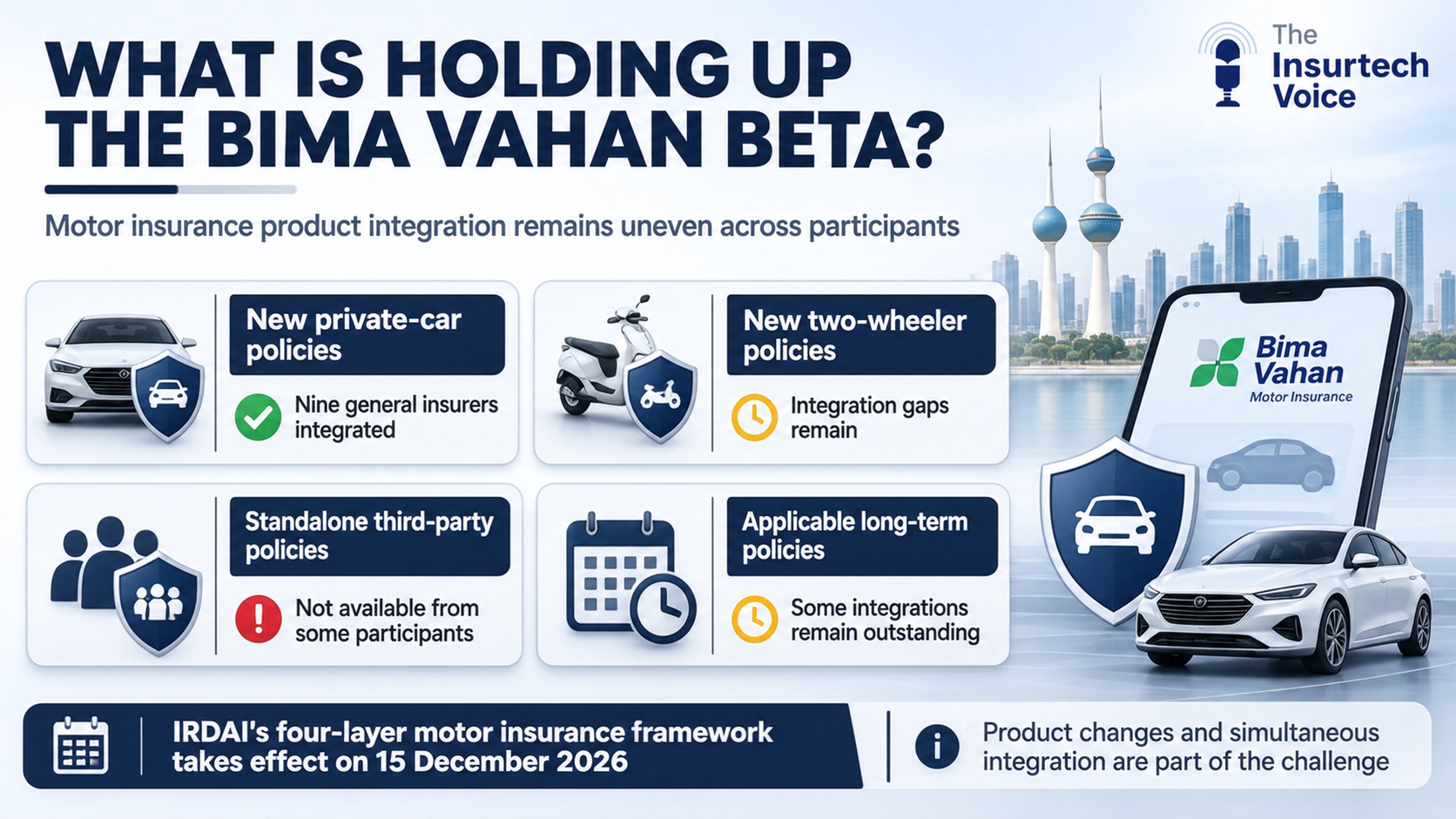
A standalone third-party policy covers liability to others rather than damage to the insured vehicle itself. Long-term motor policies also have different coverage-duration requirements. The marketplace needs to account for these differences when presenting products and issuing policies.
Which insurers were expected to participate, and what would customers be able to buy?
Business Standard identified SBI General, ICICI Lombard, HDFC ERGO, New India Assurance, Zuno, Zurich Kotak, Shriram General, IndusInd General and Go Digit as the nine expected participants. That does not mean each was ready to offer every product.
The intended beta covered own-damage and third-party insurance for new vehicles. Existing vehicles and renewals were outside the initial scope, according to the report. A customer looking to renew a three-year-old car's insurance would therefore not have had the same access as someone buying a new car.
How do the new motor insurance rules affect the launch?
IRDAI's four-layer motor insurance framework requires insurers to update their products and complete the corresponding Bima Sugam integration by 15 December 2026. This adds another requirement to the work already underway for the marketplace.
Paragraphs 9 and 10 of IRDAI's circular dated 2 November 2026 set out the effective date and simultaneous integration requirement.
The revised structure separates third-party liability, liability to occupants, personal accident protection and damage to the insured vehicle. Insurers must also account for changes to customer option forms and policy documentation. We explain the mandatory and optional components in our earlier coverage of the IRDAI four-layer motor insurance framework.
For insurers that have already configured products for the marketplace, the new rules may mean revisiting those configurations and testing them again. Getting a product online is only part of the job; the policy issued at the end of the purchase must also meet the applicable requirements.
Why is technical integration so important for Bima Sugam?
The marketplace needs reliable connections to insurers’ systems for quotations, coverage selection and policy issuance.
Take the example of someone buying insurance for a new scooter. The marketplace would need to send the relevant customer and vehicle details to an insurer, receive a premium quote and communicate the customer's coverage selections. After payment, the insurer would need to generate the correct policy documents.
If the insurer's system cannot process a particular product or coverage option, the purchase could stop halfway through. The customer might see a quote but be unable to complete the transaction.
This example illustrates why product-level integration matters. It does not describe Bima Sugam's actual technical architecture or suggest that a particular insurer has experienced these problems.
What does the delay mean for insurers and distributors? (Our Analysis)
The delay exposes a practical challenge for insurers and distributors: a marketplace can be ready to accept customers before its participating insurers are ready to complete every type of purchase.
For a motor insurer, connecting its quotation system is only one step. Product teams need to configure the coverage options, compliance teams need to approve the documents, and technology teams need to test the journey through to policy issuance. If a regulatory change affects the product during that process, some of the work may need to be repeated.
For distributors, the breadth of the offering matters just as much as the launch date. A marketplace with limited insurer participation or missing product categories may offer customers fewer meaningful comparisons. Pricing and product presentation are also part of the wider debate, as discussed in our coverage of IRDAI's remarks on dynamic pricing in insurance.
For customers, existing authorised channels remain available for buying and renewing motor insurance. There is no reason to postpone an upcoming renewal while waiting for Bima Vahan.
Is December the new Bima Sugam launch date?
No revised launch date has been confirmed in the reporting reviewed. Business Standard reported a possible rollout towards the end of December.
The 15 December deadline concerns implementation of the new motor insurance framework and the corresponding integration. It should not be mistaken for a confirmed public launch date.
The next useful update will be the confirmed list of products and insurers available to customers when the beta opens. Launch dates for life and health insurance have not been established in the reports reviewed.
Editorial note: This article was prepared with AI-assisted drafting using regulatory documents and media reports. The postponement is media-reported rather than confirmed through a new IRDAI notification. The technical example and industry analysis are editorial explanations. This article is informational and does not constitute insurance advice.
Frequently asked questions
- Why has the Bima Sugam launch been delayed?
- Media reports on 24 November 2026 attribute the delay to incomplete insurer integrations for several motor insurance products and preparations for the new four-layer motor insurance framework.
- What is Bima Vahan?
- Bima Vahan is the motor insurance offering of the proposed Bima Sugam marketplace. Its beta rollout was reportedly scheduled for 23 November 2026 but was deferred.
- How many insurers were ready for the Bima Sugam beta launch?
- Nine general insurers were reportedly integrated for new private-car insurance. This does not mean all nine were ready for every motor insurance category.
- Which motor insurance integrations are still pending?
- Reports identify gaps among participating insurers in new two-wheeler cover, standalone third-party insurance and applicable long-term policies. Renewal and older-vehicle journeys were also reportedly outside the initial offering.
- Will Bima Sugam launch in December 2026?
- December is a reported readiness milestone and a possible rollout window, not a confirmed launch date. No revised official date was identified in the reporting reviewed on 25 November 2026.
- How does IRDAI's four-layer motor insurance framework affect Bima Sugam?
- IRDAI's circular requires insurers to implement the new motor policy structure from 15 December 2026 and complete the corresponding Bima Sugam integration simultaneously. This deadline is not itself confirmation of the beta launch date.
- Can customers buy motor insurance while Bima Sugam is delayed?
- Yes. Customers can continue using existing authorised insurance distribution channels. The marketplace delay does not remove existing motor insurance requirements.
- Will Bima Sugam also offer life and health insurance?
- The marketplace is intended to serve the wider insurance sector, including life, health and general insurance. The reports reviewed do not establish launch dates for its life and health offerings.
Sources
Primary sources
- Gazette of India: IRDAI (Bima Sugam - Insurance Electronic Marketplace) Regulations, 2024, 20 March 2024.
- IRDAI: Four-Layer Motor Insurance Structure, 2 November 2026 (regulatory document hosted by a third party).
Reporting and analysis
- Business Standard: Bima Sugam Launch Deferred Amid Insurer Readiness Gaps, 24 November 2026.
- The Insurance Reporter: Bima Sugam Launch Postponed Again After IRDAI Discussions, 24 November 2026.
Historical context
The InsurTech Voice · An Initiative by Insurnest