

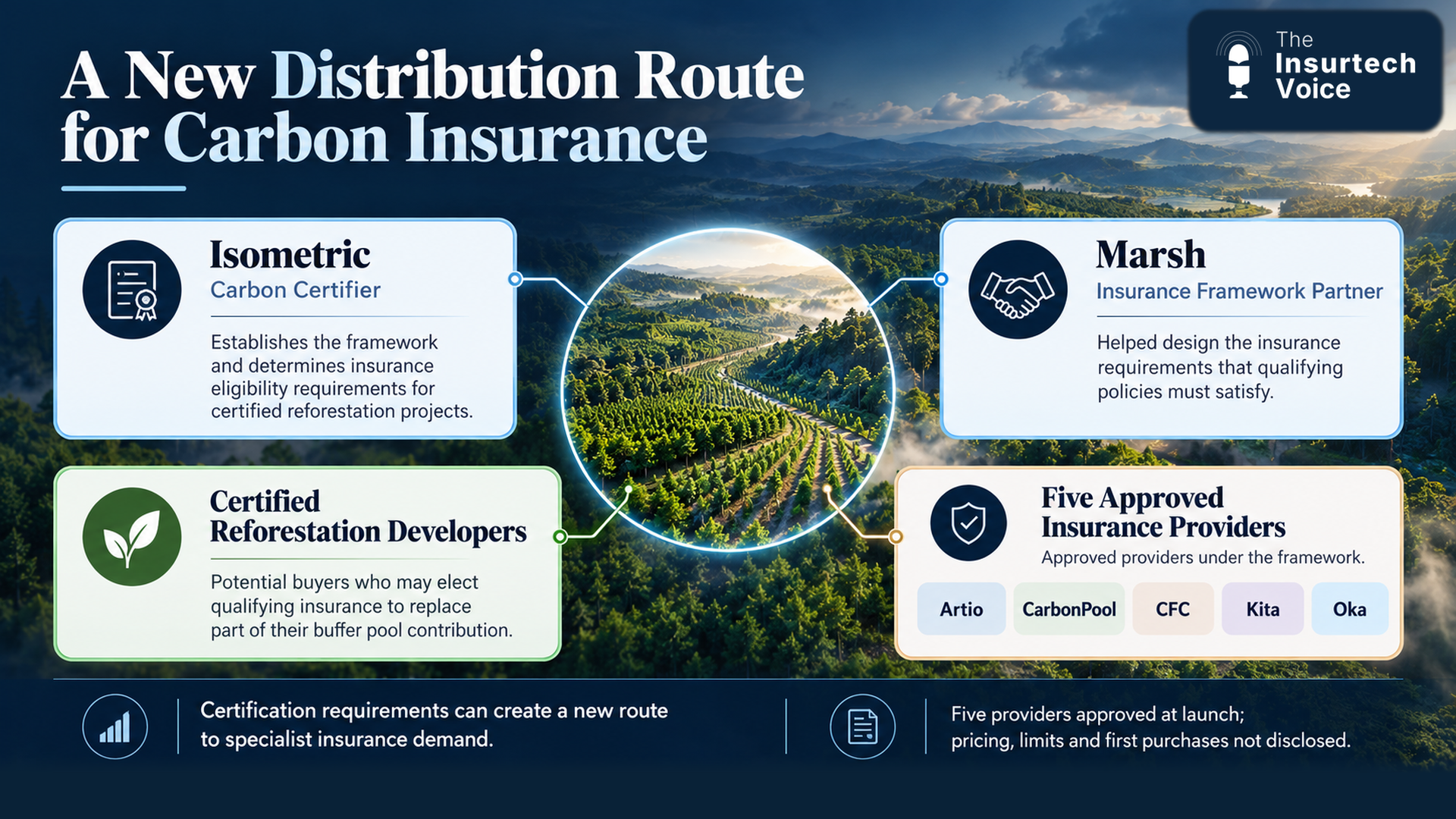
Reforestation developers have had to hold back part of every batch of carbon credits in case their trees burn or die. On 20 October 2026, carbon removal certifier Isometric gave them another option: an insurance framework, developed with global broker Marsh, that lets certified reforestation projects use approved insurance in place of a portion of those held-back credits. Five specialist providers can now offer the cover: Artio, CarbonPool, CFC, Kita and Oka.
The change matters most in a project's first years. Young forests have stored little carbon, revenue is thin, and every certificate held in reserve is one the developer can't sell. Replacing some of that reserve with an insurance policy frees certificates for sale when cash is tightest. What Isometric hasn't said yet is how big that portion can be, or what the cover will cost.
Isometric reforestation insurance framework at a glance
| Detail | Information |
|---|---|
| Certifier | Isometric |
| Insurance partner | Marsh (Marsh Risk, FINPRO UK) |
| Announced | 20 October 2026 |
| Eligible projects | Isometric-certified reforestation projects |
| Approved insurers | Artio, CarbonPool, CFC, Kita, Oka |
| What insurance can replace | Part of a project's buffer pool contribution |
| Not yet disclosed | Pricing, coverage limits, eligibility thresholds, maximum share of buffer replaced |
Editorial note: Based on Isometric's announcement of 20 October 2026, as reported by the outlets listed below, together with Isometric's published protocols. Drafted with AI assistance and reviewed by The InsurTech Voice editorial team; for information only, not insurance or investment advice.
What is Isometric's reforestation insurance framework?
It is a set of rules from Isometric that defines when an insurance policy can stand in for part of a reforestation project's buffer pool contribution. Marsh helped design the insurance requirements, the approved insurers write the policies, and Isometric decides what qualifies.
"Reforestation developers now have the option to reduce their buffer pool contributions," said Lukas May, Isometric's chief commercial officer. The buffer pool itself stays in place. Insurance sits alongside it, as an extra layer that a developer can choose to use.
Mombak, a Brazilian reforestation developer, welcomed it. Its vice president of finance, Bruno Figueiredo, called the framework a step towards a more mature carbon market, one that borrows proven risk-management tools from established insurance markets.
The framework also reverses one of Isometric's own rules: its published reforestation protocol said insurance could not be used to shrink a project's buffer pool contribution.
How buffer pools handle carbon reversal risk
A carbon reversal happens when carbon that a project removed from the atmosphere is released again. For a forest, that usually means fire, disease or pests. Wildfire and other natural catastrophes are costly risks across the insurance market: insured catastrophe losses reached US$42 billion in the first half of 2026 alone, as our coverage of Swiss Re's 2026 catastrophe estimates shows.
Carbon registries manage this with a buffer pool. Each time a project is issued certificates, a share goes into a shared reserve. If a reversal happens, certificates from the reserve are cancelled to cover the lost carbon, so the certificates already sold to buyers stay whole.
Under Isometric's reforestation protocol, a project's contribution comes either from a flat rate or from a risk assessment, in which each category of risk adds between 2.5% and 10%.
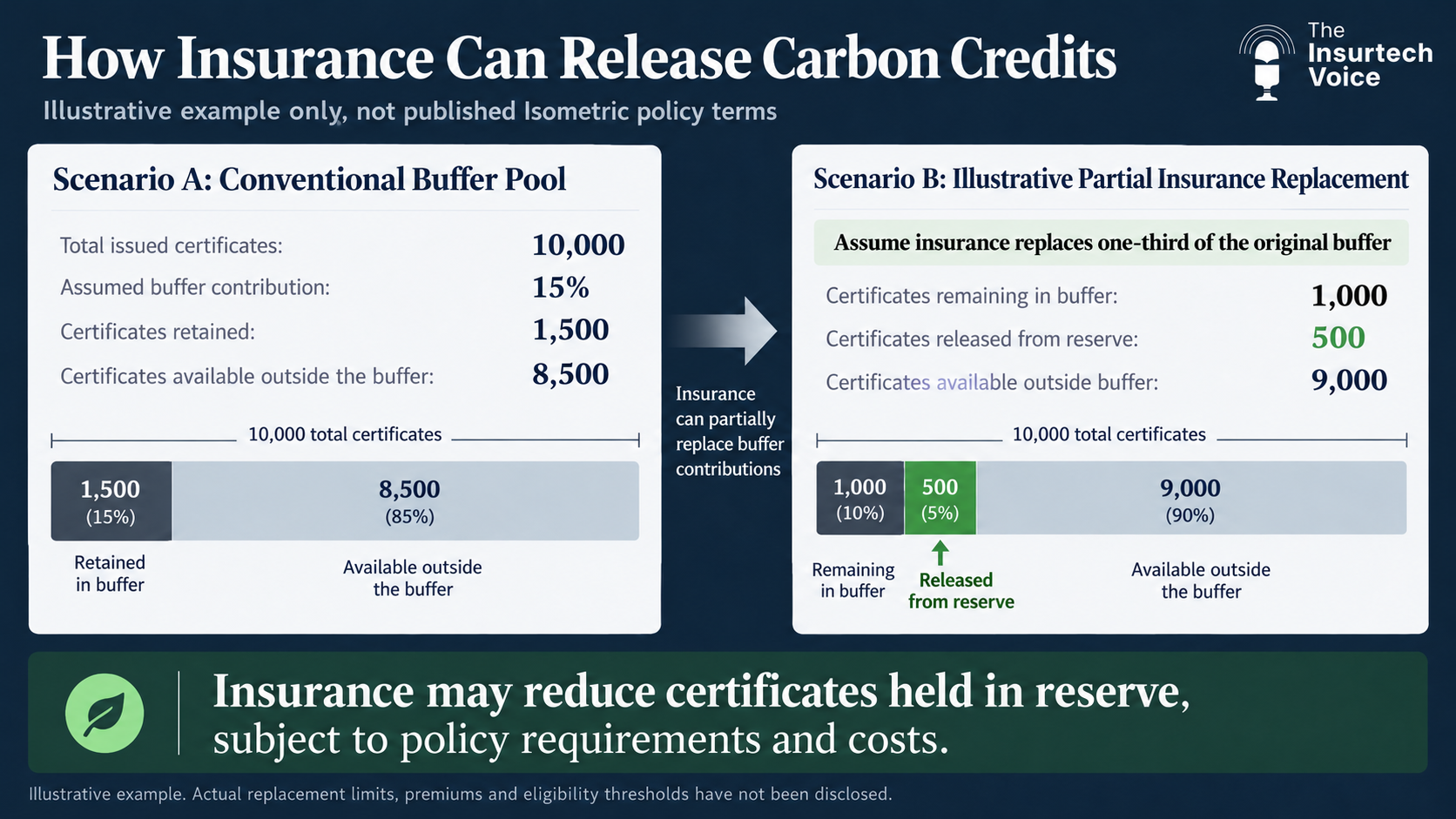
To see why insurance helps, take a simple example with hypothetical numbers. A project issued 10,000 certificates with a 15% buffer rate holds back 1,500 of them. If insurance could replace a third of that buffer, another 500 certificates would be free to sell.
Which insurers are approved?
Isometric approved five providers at launch, and other insurers can apply to join over time. Four of them, Artio, CarbonPool, Kita and Oka, are specialists built around carbon credit risk; CarbonPool, for example, was founded in Zurich in 2023. The fifth, CFC, is an established specialist insurer.
CFC has done this before. In 2025, Marsh placed a carbon credit delivery policy underwritten by CFC for US developer Chestnut Carbon. The lenders behind a US$210 million project finance facility led by J.P. Morgan required that insurance before releasing the money.
Part of a bigger shift in carbon insurance
The move has been coming for a while. Isometric's own Standard had already flagged insurance as a possible future alternative to buffer contributions. It has also tried the idea elsewhere: with broker Howden, it lets developers of credits for CORSIA, the international aviation industry's offsetting scheme, use an approved insurance policy in place of a buffer contribution, covering the risk that a host country withdraws its approval of the credits.
Insurers and other certifiers are heading the same way. CarbonPool has told the UN body overseeing the Paris Agreement's new carbon market that standard buffer rates are often set at arbitrary levels, and that insurance could eventually replace buffer pools altogether. Kita has signed a letter of intent with another certifier, the Ecosystem Restoration Standard, to insure near-term delivery risk within its buffer pool.
For Marsh, the framework fits a stated strategy of building carbon insurance into the core infrastructure of carbon markets, which it says should give buyers, lenders and investors more confidence. It is also the second time in October 2026 that the broker has stepped into a debate about how insurance should respond to a newer type of risk, after its CEO warned insurers that blanket AI exclusions could leave clients uncovered.
For insurers and brokers, the most interesting part is the distribution model. When a registry writes insurance into its certification rules, every project it certifies becomes a potential buyer, and the registry's requirements effectively set the minimum standard for the product.
What we still don't know
Isometric has not disclosed insurance pricing, coverage limits, eligibility thresholds or an implementation date. It also hasn't said how much of a project's buffer contribution insurance can replace, and no developer has yet been named as buying cover.
Those gaps matter, because the whole case for the framework is financial. A developer will only buy cover if the premium costs less than the value of the certificates it frees up. Until the numbers are public, nobody outside the deal can say whether that holds for a typical project.
What happens next?
Isometric-certified reforestation developers can now approach the approved insurers for cover that meets the framework's requirements. Isometric says it is also considering extending the approach to other carbon removal pathways, though no decision has been announced.
The developments to watch:
- First policies. Which developers buy cover first, and how much of their buffer they replace.
- Pricing and terms. Whether Isometric or the insurers publish more detail on costs, limits and eligibility.
- More insurers. Whether other carriers apply to join the approved list.
- Other pathways. Whether the framework extends beyond reforestation.
Stay Ahead of Insurance Industry News
Follow The InsurTech Voice for specialty insurance, climate risk, emerging insurance products and global market developments. Subscribe to The InsurTech Voice
Frequently asked questions
- What is the Isometric Marsh reforestation insurance framework?
- It is a set of requirements from carbon certifier Isometric, developed with insurance broker Marsh, that lets Isometric-certified reforestation projects use approved insurance in place of part of their carbon credit buffer pool contributions. It was announced on 20 October 2026.
- When did Isometric launch its reforestation insurance framework?
- Isometric announced the reforestation insurance framework on 20 October 2026, with five insurance providers approved at launch.
- What is a carbon credit buffer pool?
- A buffer pool is a shared reserve of carbon removal certificates. Projects contribute a share of the certificates they are issued, and if stored carbon is later lost, certificates from the reserve are cancelled to cover it, so buyers' certificates are unaffected.
- What is carbon reversal risk?
- Carbon reversal risk is the chance that carbon removed from the atmosphere is later released again. For reforestation, the main causes are events such as wildfire, disease and pests that kill or damage trees.
- Which insurers are approved under the Isometric framework?
- Five providers were approved at launch: Artio, CarbonPool, CFC, Kita and Oka. Other insurers can apply to be added over time.
- What role did Marsh play in the Isometric insurance partnership?
- Marsh, through its Marsh Risk FINPRO UK practice, helped Isometric develop the insurance requirements that policies must meet. Marsh describes the work as part of its strategy to build carbon insurance into core carbon market infrastructure.
- How much of the buffer pool can insurance replace?
- Isometric has not published a figure. It also has not disclosed insurance pricing, coverage limits or eligibility thresholds, so the financial benefit for any project is not yet known.
- Will the Isometric carbon insurance framework expand beyond reforestation?
- Possibly. Isometric says it is considering extending the insurance approach to other carbon removal pathways, but no expansion has been announced.
Sources
Primary sources
- Isometric: Reforestation Protocol v1.2, buffer pool requirements
- Isometric: Isometric Standard v2.1, future recognition of insurance for reversal risk
- UNFCCC: CarbonPool submission to the Article 6.4 Supervisory Body on removals
- UNFCCC: CarbonPool response to the Article 6.4 Supervisory Body call for input
Reporting and analysis
- Reinsurance News, 23 October 2026: Five insurers approved under carbon insurance framework developed by Isometric and Marsh (carries Isometric's full statement and quotes)
- OneStopESG: Isometric and Marsh launch carbon removal insurance to reduce reforestation buffer contributions
- ESG News: Isometric approves five insurers for reforestation carbon credit protection
- Carbon Herald: Isometric opens carbon reversal insurance to certified reforestation projects
- ESG Post: Isometric and Howden launch insurance RFP for CORSIA credits
- The Insurer: Kita to develop insurance for early-stage carbon buffer pool delivery risk with ERS
- LSE Grantham Research Institute: Chestnut Carbon carbon credit insurance
- CB Insights: CarbonPool company profile
The InsurTech Voice · An Initiative by Insurnest