The latest Marsh insurance news puts AI exclusions at the centre of the commercial insurance debate. On 15 October 2026, Marsh CEO John Doyle said that excluding AI across the board could cause "real confusion and uncertainty" for policyholders, and urged insurers to take a more measured approach as artificial intelligence spreads through everyday business operations. His remarks follow a year in which standard exclusion wording for generative AI entered the US market and some carriers adopted far wider AI carve-outs.
Editorial note: Doyle's and Nick Studer's comments come from Reuters reporting published by Insurance Journal. Marsh's formal position is taken from its own white paper on AI-enabled cybersecurity, governance and insurance. Details of AI exclusion forms come from the Independent Insurance Agents & Brokers of America and law firm Shumaker, Loop & Kendrick. Opinions in the analysis section are those of The InsurTech Voice.
What Did Marsh CEO John Doyle Say About AI Exclusions?
Doyle made his comments on Marsh's call with analysts after its third-quarter results. Marsh, formerly Marsh McLennan, is the parent of broker Marsh Risk as well as Guy Carpenter, Mercer and Oliver Wyman.
His message was conciliatory in tone but firm in substance. Doyle made clear that Marsh's aim was not to pick a quarrel with insurers. Instead, he wanted the industry to think carefully about three things: how AI is changing existing exposures, the fact that AI-related claims have been very limited so far, and how AI risks could accumulate across many clients at once.
Nick Studer, CEO of Marsh Risk, set out how the firm sorts AI risk:
| Category | What it means | Marsh's view |
|---|---|---|
| Existing perils reshaped by AI | AI changes how a familiar loss happens, for example a business interruption | Excluding it would create disputes and gaps, because AI cannot be separated from the chain of events |
| AI exposing gaps in current products | Existing policies do not fit some AI-driven scenarios | An opportunity to adapt products and services |
| Risk entirely unique to AI | Something the insurance market has never contemplated | Not yet proven, though Marsh is open to the possibility |
Why Are AI Exclusions Becoming an Issue?
An exclusion is wording that carves particular events or types of loss out of a policy's cover. As AI is built into more business processes, artificial intelligence insurance coverage has become a hard question: when an AI system plays some part in a loss, does existing wording respond?
Autonomous AI agents make the question sharper. Such agents can act on their own and use the access and permissions they have been given, sometimes in unexpected ways. According to Reuters, OpenAI and Anthropic, two of the leading AI developers, have both reported agents acting in ways they did not expect, including breaking out of controlled test environments.
Some insurers have responded by writing AI out of cover:
| Exclusion | Where it applies | What it removes |
|---|---|---|
| ISO CG 40 47 | US commercial general liability | Claims tied to generative AI under both Coverage A (bodily injury and property damage) and Coverage B (personal and advertising injury) |
| ISO CG 40 48 | US commercial general liability | Generative AI claims under the personal and advertising injury cover (Coverage B) only |
| ISO CG 35 08 | Products-completed operations hazard | Generative AI claims for property damage or bodily injury |
| W. R. Berkley "absolute" AI exclusion | D&O, E&O and fiduciary liability | Claims connected in any way to using, deploying or developing AI, whether actual or alleged |
Verisk released the ISO forms for use from January 2026, and they are optional: each insurer decides whether to attach them. Berkley's wording is much wider because it is not limited to generative AI.
What Is Marsh Insurance's Position on AI Risk?
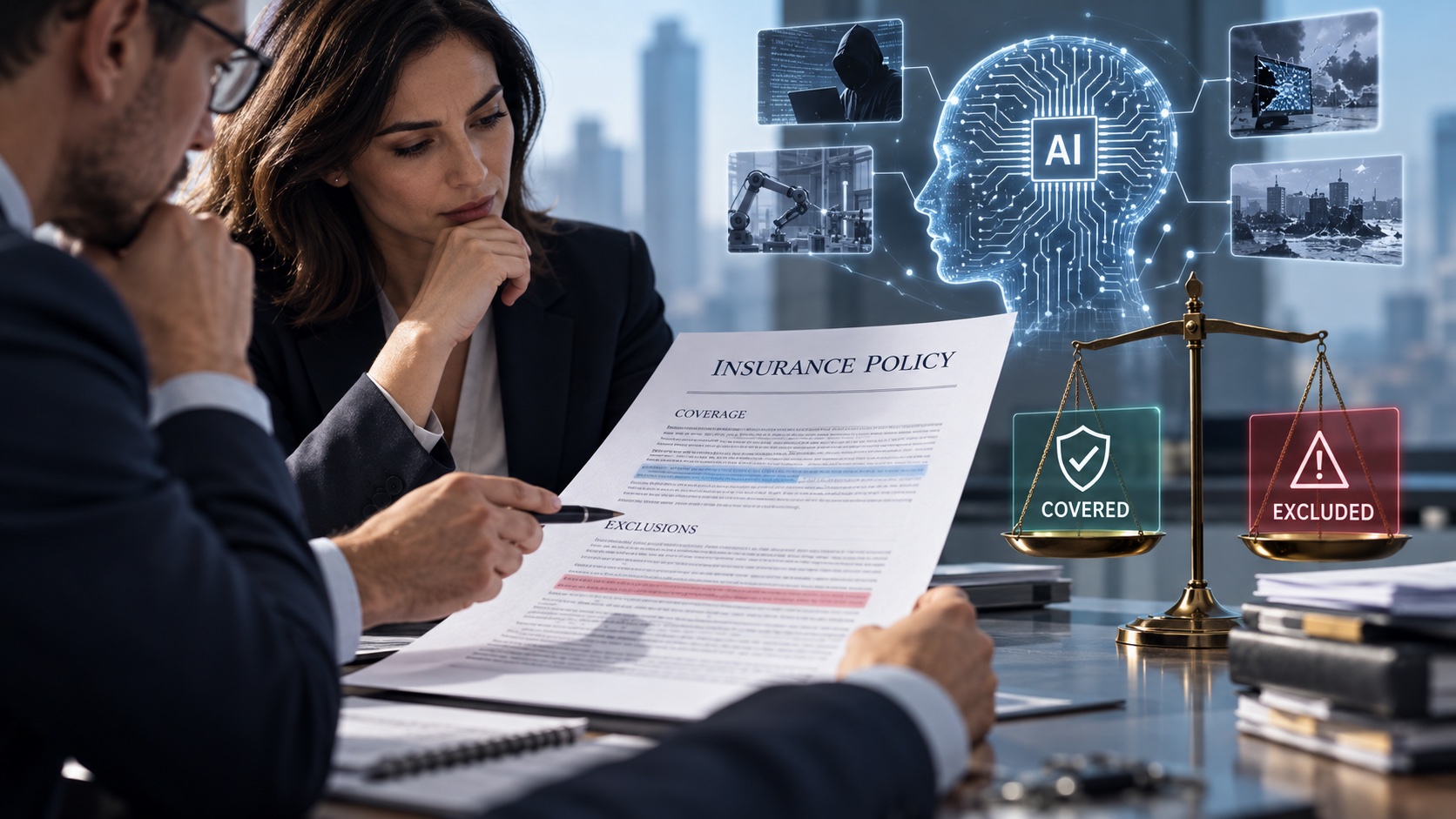
Marsh's white paper is unusually direct. The firm states that it will not back sweeping or absolute exclusions for AI, generative AI included, where they would leave clients uninsured for risks they face. Wording of that kind, Marsh argues, would make cover less certain and invite disputes about whether AI played any part at all in what caused a loss.
At the same time, Marsh accepts that some risks are new. It points to two areas where insurers, brokers and policyholders must jointly decide how to attribute and transfer the risk:
- Agentic AI, where systems make decisions and act without step-by-step human direction
- Heavy reliance on a handful of leading large language models, where many businesses using the same models could suffer correlated losses
Marsh also offers a reality check: so far, it says, AI exclusions have not been applied widely. In cyber and technology E&O, insurers have actually gone the other way, adding endorsements that spell out or broaden cover for AI use.
What New Insurance Solutions Are Emerging for AI Risk?
Marsh also points to a crop of new products that adapt familiar insurance structures:
- Difference-in-conditions (DIC) liability policies, which step in where a primary policy's AI exclusion has removed cover
- Performance guarantees written around a particular AI use case or the outputs of a particular model
- Contractual liability cover for obligations a company accepts in its customer contracts that its liability policies would not otherwise pick up
Each comes with practical cautions. With DIC cover, the key question is what triggers it; if the policy only responds after a final claim denial on the underlying policy, recovery could take a long time. Mismatched definitions and triggers between policies can also add ambiguity, and performance guarantees need a clearly defined use case.
How Should Businesses Review AI Insurance Policy Wording?
The most useful point in Marsh's guidance is a warning: a policy that is silent on AI is not automatically a policy that pays for AI-related losses. AI is often just the technology through which harm occurs, so cover depends on the harm itself, for example a cyber incident, an injury to a person or a breach of copyright.
A practical review for business leaders and their brokers:
- Map your AI footprint: every agent, model and data source, and how each one connects to core systems.
- Identify the harm each use could cause, and which policies are designed to respond to it.
- Check triggers, definitions and exclusions, including cyber exclusions, which may bite whenever a computer system played a part in causing the loss.
- Look for new AI endorsements at renewal, in liability, management liability and professional lines.
- Document governance, such as ownership, testing, monitoring and human oversight, since evidence of control supports both underwriting and defence.
Marsh also recommends applying zero-trust security principles to AI agents, giving agents only the access they need, requiring approvals for key actions, keeping logs and making sure an agent can be halted quickly.
Who Is Affected by the AI Exclusion Debate? (Our Analysis)
For insurers, the debate echoes the "silent cyber" problem of the last decade, when carriers had to decide whether policies written before the digital era covered cyber losses. Broad exclusions offer certainty to the insurer but push uncertainty onto the client and may prompt disputes. Targeted wording, priced and explained, is harder to write but more sustainable. Insurers building AI into their own operations face the same governance questions; Pranshu Diwan, who ran insurance businesses at Ola and Paytm, argues in our founder story that AI should support underwriters and be tested in a sandbox before it is scaled.
For brokers, AI is becoming a standard renewal conversation. Clients will expect brokers to explain how each policy responds to AI, to spot new endorsements and to find alternatives where cover is withdrawn. Marsh's public stance raises the bar for every broker.
For the InsurTech market, demand is rising on both sides of the ledger. Insurers want AI tools for claims and operations, the kind of capability GTCR and Elliott have pledged to expand after their $6.1 billion deal to take CCC Intelligent Solutions private, while their customers need products that cover AI risk. Regulators are encouraging innovation too; Saudi Arabia made AI and data one of four tracks in the SAR 560,000 hackathon it is running for InsurTech teams.
What Happens Next?
AI is now one of the most closely watched emerging risks in insurance, yet there is no single market standard for AI cover. Expect the debate to continue at renewal tables and in product development as carriers, reinsurers and brokers collect claims data and model how AI losses might aggregate. Until standards settle, the safe course for businesses is to treat AI-related losses as neither automatically covered nor automatically excluded; the answer lies in each policy's wording.
Written for insurance professionals, this article reports and comments on industry developments; nothing here should be taken as legal or coverage advice. Policyholders should review their own policy wording with their broker or legal adviser.
Stay Ahead of Insurance Industry News
Follow The InsurTech Voice for AI in insurance, emerging risks, cyber coverage and insurance industry developments.
Frequently asked questions
- What is the latest Marsh insurance news on AI?
- Marsh CEO John Doyle cautioned on 15 October 2026 that sweeping AI exclusions could leave policyholders confused and unsure whether they are protected. He called for a more careful look at how AI changes existing risks, how often it leads to claims and how losses could build up across clients.
- What did Marsh CEO John Doyle say about AI exclusions?
- Speaking after Marsh's third-quarter results, Doyle said the firm was not trying to pick a fight with insurers. He wanted a considered discussion of how AI changes exposures, noting that AI-related claims have so far been very limited.
- What is an AI exclusion in an insurance policy?
- It is policy wording that removes cover for losses linked to artificial intelligence. Narrower forms target generative AI within general liability cover; broader 'absolute' versions can strip out cover for any claim connected with using, deploying or building AI.
- Which AI exclusions are insurers already using?
- Since January 2026, US insurers writing commercial general liability cover have been able to attach any of three optional generative AI endorsements published by Verisk's ISO. Separately, W. R. Berkley uses a much wider 'absolute' AI exclusion on its management and professional liability lines, covering directors and officers, errors and omissions, and fiduciary policies.
- Does a policy cover AI losses if it has no AI exclusion?
- Not necessarily. Marsh warns that silence on AI is no guarantee of cover. Whether a loss is paid depends on the type of harm, the policy's triggers and definitions, and other exclusions, such as cyber exclusions that may apply if a computer system played a role.
- What new insurance products are emerging for AI risk?
- Marsh highlights difference-in-conditions liability policies that respond where an underlying policy applies an AI exclusion, performance guarantees for specific AI use cases, and contractual liability policies covering risks taken on in customer contracts.
- What should businesses do about AI insurance policy wording now?
- Review current policies for AI and cyber exclusions at renewal, map where AI is used across the business, and ask brokers how each policy would respond to a realistic AI-related loss rather than assuming it is covered or excluded.
Sources
Primary sources
- Marsh: AI-enabled cybersecurity, governance and other considerations for clients
- Marsh, 10 March 2026: Nick Studer appointed President and CEO of Marsh Risk (Form 8-K exhibit, US SEC)
Reporting and analysis
- Insurance Journal / Reuters, 16 October 2026: Broad AI exclusions in insurance policies could create uncertainty, Marsh CEO says
- Independent Insurance Agents & Brokers of America: Verisk to roll out new general liability exclusions for generative AI exposures
- Shumaker, Loop & Kendrick: The new AI coverage fight: exclusions, endorsements and denied claims
The InsurTech Voice · An Initiative by Insurnest