
The man in one line
Pranshu Diwan sits exactly where technology, data and business meet in insurance. Across almost two decades he has been a credit-card data analyst, a consultant, a founding team member of a health insurer, a two-time startup founder, and the insurance business head at two of India’s biggest consumer platforms, Ola and Paytm. An alumnus of IIT Bombay and IIM Calcutta, he describes his own arc simply: he started on “the machine learning side, the data side of things,” and slowly found himself pulled all the way over to “the business side of things.”
Beginnings: a data mind before “AI” was a buzzword
Straight out of undergraduate college he joined Capital One, working alongside statisticians and data engineers to turn numbers into decisions: credit-line models that set each customer’s limit, and response-propensity models that predicted who would say yes. This was 2008. Models were hand-built in SAS and SQL and could take months to fit. There he absorbed an idea he still repeats, “unit of one”: do not build one model for a hundred people, build a sharper model for a smaller segment, then smaller still, until your risk prediction is as granular as a single person.
At HSBC, on private-label credit cards and direct-mail campaigns, the discipline got obsessive. Every mailer had a cost, so you optimized for response and risk at once, and even the color, the font, and the lead offer measurably moved the outcome. The lasting lesson: the math was never the hard part. Applying it to a real business problem was.
The first taste of insurance
At the consulting firm Essex Lake Group, he ran his first insurance project, for MetLife. It planted a conviction he still holds: insurance at its core is a data algorithm, a probabilistic engine predicting your chance of a crash or a hospital stay. “Actuaries were the first data scientists in the world.”
“Actuaries were the first data scientists in the world.”
The pivot: from data guy to business builder
After an MBA at IIM Calcutta, he joined Aditya Birla Health Insurance as employee number nine, part of the founding team, a full year before launch. He worked on digitization and sales digitization, built an app for advisers, led the non-traditional (affinity) distribution channel, and finally headed analytics.
This is where he changed. He learned how a sale actually happens, its psychology, and “the kick of getting revenue.” The data person realized business ran on the same instincts he loved: hypotheses, A/B tests, fast iteration. “I just found myself in business over a certain period of time.”
The founder years: GoPlannr and Fyntune
His first company, GoPlannr, used tech to turn housewives and senior citizens into local insurance planners: an app with a recommendation engine, marketing tools, training, instant payment links, and plan bundling tailored per customer. He also built Fyntune, infrastructure that let a brick-and-mortar broker stand up a PolicyBazaar-style website and an agent app, with a CRM and tele-calling built on top. In short: digital rails for small, offline insurance businesses.
Ola and Paytm: insurance at platform scale
At Ola he led the insurance business, “Ola Insure” inside Ola Financial Services, where A/B testing was a way of life. His favorite example: offer flight insurance to someone booking an Ola to the airport, test 15, 25, 35 rupees, and find where revenue maximizes. Then he joined Paytm as Chief Business Officer to lead its insurance broking business, taking the same distribution-first playbook to a payments giant.
Now: building in insurance again, with AI as the engine
After Paytm, Pranshu returned to what he clearly loves: building. He is again setting out to create something new in insurance, this time with AI at the center, around ideas like embedded, parametric micro-covers for merchants, one-tap shop insurance at low price and low acquisition cost.
His thesis is sharp. Insurance is the “poor country cousin” of financial services, where innovation arrives late: high cost-to-serve, un-personalized products, static pricing (your motor premium depends on your car, not how you drive). AI can fix the two highest-ROI areas, distribution and claims: dynamic, conversational, multilingual selling that reads Tamil, Malayalam or Odia without a separate team per language; and claims that process a photo of the damage in microseconds, catch the low-ticket fraud humans skip, and pay the honest claim instantly. He pictures a “swarm of agents,” each expert at one task, and an insurer built by twenty to thirty people that still reaches a thousand crore.
He is no hype man. AI should augment the underwriter, not replace them, because the human still knows which features matter. Systems will make mistakes for two to three years, must be sandbox-tested, checked for hidden bias (his cautionary tale: a model that used pincode as a predictor, blind to the fact that pincode can proxy for socioeconomic background), and rolled out to one percent before scaling to a hundred. His yardstick: AI “just needs to beat the human,” because even humans are never a hundred percent right.
The person behind the thesis
One human moment says a lot: his daughter asked a chatbot to write a story about her favorite dragon and then make a coloring page, and it did both. “That is insane,” he says, still delighted by the tools. He no longer writes product requirement documents by hand, and once had a full pitch dashboard built by a tool mid-flight, ready before he landed.
Pranshu’s story is of a data scientist who kept following the harder, more interesting question, from the math of a model to the meaning of a business, and who now sees the tools he waited two decades for finally arriving. As he puts it: the technology is here, the accuracy is good enough, the smart people are building. “Thinking is the limit.”
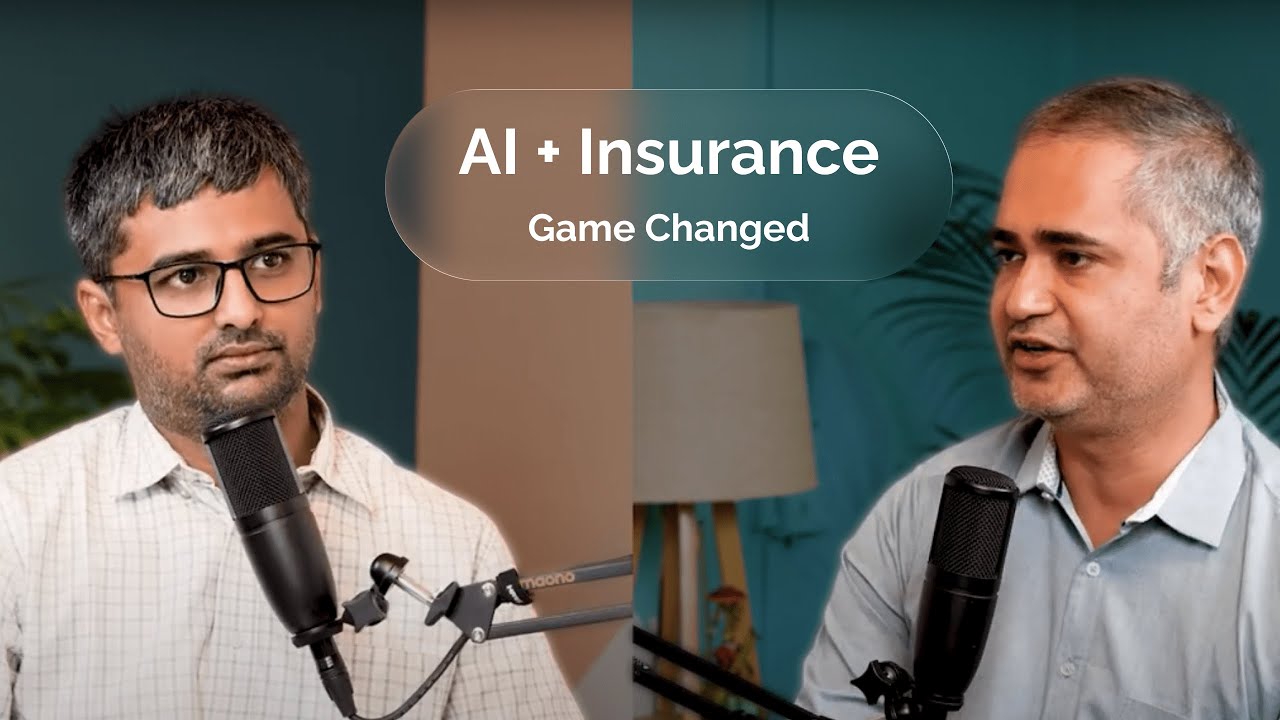
As told on The InsurTech Voice podcast · An Initiative by Insurnest
Comments
Join the conversation. No account needed. Your comment appears right away.
Comments