
The CA who wanted to build, not audit
Mahavir is a Chartered Accountant by qualification, but he never enjoyed it. He found the work passive, and he had always wanted to be in business. Coming from a Marwadi family, he grew up surrounded by people who built wealth through enterprise, while his own father had spent his entire career as an employee. That contrast left him with a persistent entrepreneurial itch, and a growing boredom with chartered accountancy. So when the first real chance to build something came along, he took it.
A retail-first bet at 25
In 2005 to 2006, at just 25 years old, Mahavir teamed up with a couple of people he had worked with before and started an insurance broking company. The twist: at the time, broking firms focused almost entirely on large corporate clients. Mahavir’s group wanted to bring that same sophisticated, professional service to ordinary individual customers, and to deliver it through technology and online.
The country’s first online insurance comparison site
In 2007 they launched what was the first online insurance comparison website in India, even before PolicyBazaar existed. It did well, earned good fanfare, and was covered favorably by the media. But a series of events that he prefers not to dwell on meant the venture did not pan out in the long run, and he eventually left the company.
Learning the trade at Marsh
After that, Mahavir moved into established broking firms that wanted to build out digital practices. One of them was Marsh, the largest insurance broking company in the world and in India, where he spent around a year and a half building the digital practice.
The Coverfox years
Around that time he met the founders of Coverfox, and the team excited him: fiercely tech and product driven, fresh in their thinking, holding a license and backed by a venture capitalist. He jumped in. The roughly five and a half years he spent at Coverfox were, by his own account, among the most exciting and educational of his career.
He had the freedom to experiment heavily because the team shared his obsession with customer centricity. He first led health, then built the claims practice, especially the car insurance claims operation that became Aqua, an end-to-end service where Coverfox would pick up the car, do the survey, get it repaired, and deliver it back. It was a genuine vertical integration into car insurance, not just selling policies but owning the claim experience. Coverfox was the first company in India to offer this kind of end-to-end journey rather than mere aggregation, and it introduced the clean user experience the industry now takes for granted. He credits the team, particularly Varun, who went on to found Acko, and Devendra Rane.
The insight that changed everything
Those experiments taught him how customers really behave. Car and bike insurance, he found, were effectively commodities, fungible products much like buying a branded USB stick, where a fair price and a recognizable company name were enough. Health and life insurance behaved completely differently. No matter how good the comparisons or the people on the phone, conversions stayed stubbornly low, around 3 percent.
The problem was trust. Customers could not make sense of the listings, a single search might surface 90 health plans, impossible to compare, and the call-center agents they then turned to often did not know enough to be trusted advisers. Unlike a car, a health policy is a high-stakes, emotionally sensitive purchase: a premium of 25,000 to 30,000 rupees a year, committed to the same insurer for 30 or 40 years. He compares it to choosing a chartered accountant to file your taxes: you can go cheap, but the seasoned expert is the one you want when the inquiry actually arrives.
In insurance it is the youngest minds without old habits, and the experienced ones willing to learn again, who have the biggest opportunity.
Building Beshak: trust as a product
Both gaps, the information problem and the trust problem, were left unsolved by every aggregator, and that is where Beshak was born. Beshak fuses two solutions. First, it gives customers the most independent, in-depth information to make decisions on their own. Second, for those still overwhelmed, it offers a curated, screened community of high-quality insurance experts who handhold the customer all the way through to claims.
It is an indigenous model with no real equivalent anywhere in the world. Built from first principles, Beshak’s technology generates a research-backed prescription that matches the customer’s profile to the right products, coverage, and riders, and only then does the human adviser step in to provide assurance, accountability, and support right through the claim.
A model designed not to break trust
To make sure customers are never misled, Beshak put hard constraints on itself. It refuses to take money from insurance companies, so its advice stays unbiased, and it keeps the service free for customers, because he found that Indians are still not ready to pay for fee-based advice. Instead, like a managed marketplace, it earns from the supply side: advisers pay a platform fee plus transaction-based charges in exchange for the ability to serve customers across the entire country rather than just their own pin code.
The advisers Beshak onboards are people with a reputation at stake, typically with years of practice and an office, who treat claims as their real work and keep their phones on at 2 in the morning. Technology backs them up, from AI-driven matching and monitoring to an AI bot that answers and escalates calls when an adviser is unavailable. The result, he says, is conversions roughly six times what he saw at Coverfox, because the trust problem is finally solved.
In his own words
Looking ahead, Mahavir argues that the cost of building in insurance is collapsing thanks to AI, so the future will belong less to big capital and more to fresh imagination. His advice: keep your baggage aside, think anew, and remember that in insurance it is the youngest minds without old habits, and the experienced ones willing to learn again, who have the biggest opportunity.
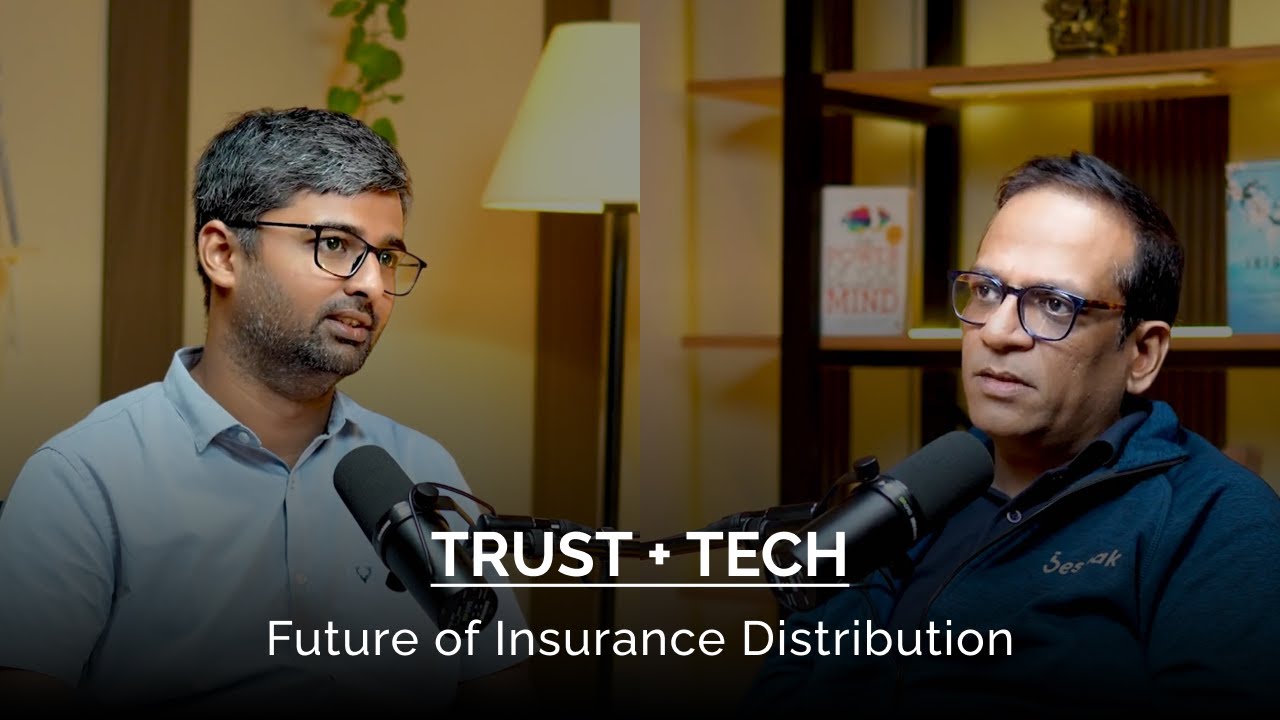
As told on The InsurTech Voice podcast · An Initiative by Insurnest
Comments
Join the conversation. No account needed. Your comment appears right away.
Comments