
The engineer who fell back in love with maths
Sumit started out as an Information and Communication Technology engineer, graduating from DA-IICT. Code was his training, but maths was his first love. In the third year of his course he took an optional paper called Methods of Optimization, essentially operations research, and that one class rekindled an interest in applied mathematics that had been sitting dormant. He went looking for ways to do math-focused work while still in college, found nothing relevant, and so took the job offered to him through campus placements at a tech company. The itch never went away.
A magazine article that changed everything
While still working in tech, he read a magazine article on actuarial science as a profession, and it just clicked. Applied maths, no need to go back to college (which he did not want to do), and a reputation for being brutally hard to qualify. He was 21, had just found his mojo again, and figured: what could possibly be too difficult? This was around 2006 to 2007, a time when there were only about 200 actuaries in all of India, so almost nobody knew the profession even existed.
The lucky mentor and the friend’s phone call
Two things lined up. First, a mentor at his tech company happened to have a tech background but had also worked in insurance, so he actually knew what actuaries were and pointed Sumit toward it. Second, around the same time, a friend who had joined a life insurance company’s IT team as a business analyst called to ask if Sumit wanted in. By then Sumit had figured out that actuaries typically work inside insurance, so he saw it as a natural bridge. He switched jobs and moved into the IT function of a life insurance company.
The slow climb to qualification
He began writing actuarial exams while working in IT. Every time he cleared one, he would go knock on the actuarial team’s door and remind them of his interest. The internal transition took about three years; by the time he crossed over he had cleared 6 of the 15 exams. Once he was actually on the actuarial side, things got much easier, because now he was applying exactly what he was studying. It took another six to seven years to fully qualify. Across this stretch he worked at the same life insurance company and later with a reinsurer, building roughly 18 years in the industry overall.
Going out on his own
About eight years ago, around 2017, Sumit struck out independently. Today he runs two businesses. The first is an actuarial consulting practice focused on insurtech, with clients across the globe; he has even applied his skills outside insurance, including a stint with a gaming company, where the underlying probability maths is strikingly similar and the house always wins. The second is ProtectMeWell, an API-first, comprehensive financial-planning engine sold as B2B SaaS, licensing its APIs to insurance brokers, insurance companies, and wealth advisors.
It came down to a simple formula, the interest in maths, things falling in place, and a dash of luck.
The personal pain that became ProtectMeWell
The startup came straight out of his own life. When he went independent in 2017, his employer-provided medical cover was about to disappear, and his wife was pregnant. He needed the right health product at the right size and found there was no easy, independent way to figure that out. He even called a product head at an insurer who spent an hour teaching him how to evaluate a medical insurance product, and at the end Sumit still asked: so which one should I buy?
That moment, the realization that people need an actionable answer and not just theory, planted the seed. Later, trying to size his own retirement corpus, he again found no clean answer. His logic: if someone like him, who understands the maths cold, did not have an easy answer, most people had no chance. So he built a hyper-personalized engine that sizes term, health, critical illness, disability, home cover, and retirement corpus from first principles, all internally consistent. It launched as direct-to-consumer, but since people resisted paying for unbiased advice, he pivoted to licensing the APIs to the firms that actually sell financial products.
The author
A couple of months before this interview, Sumit also published a book called Ring of Fire, on the FIRE movement (Financial Independence, Retire Early). His core argument: retiring early is not necessarily a good idea, and FIRE should be seen as a journey rather than a destination, a journey where you increasingly do more of what you love and less of what you do not.
In his own words
The whole arc came down to a simple formula: the interest in maths, things falling in place, and a dash of luck.
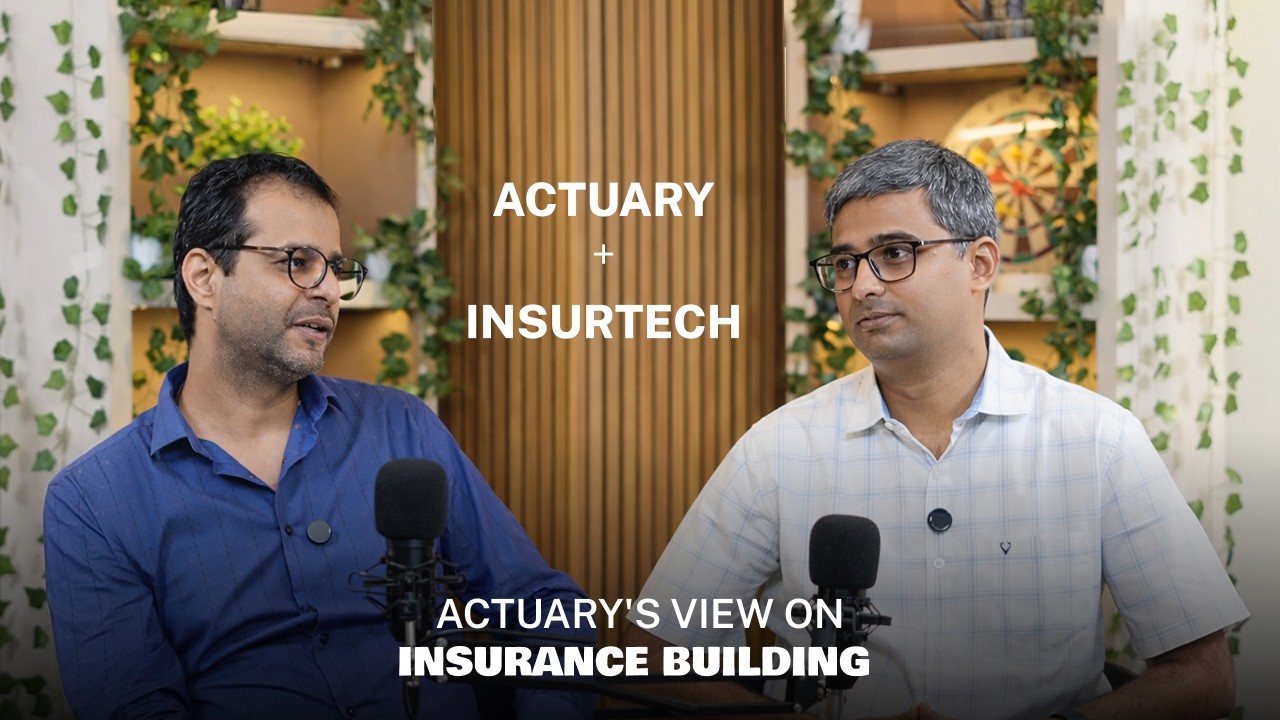
As told on The InsurTech Voice podcast · An Initiative by Insurnest
Comments
Join the conversation. No account needed. Your comment appears right away.
Comments