
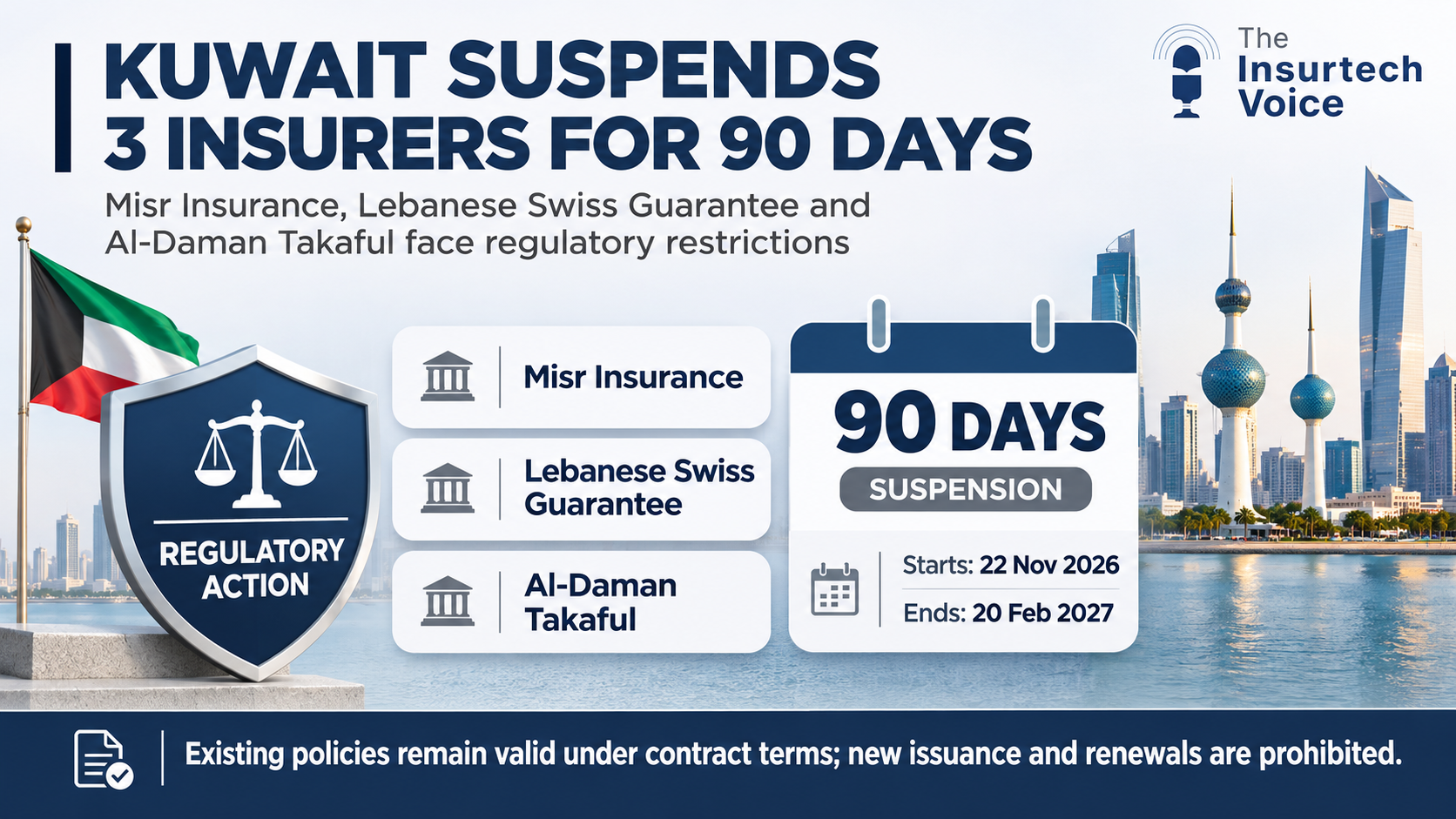
Kuwait's Insurance Regulatory Unit (IRU) suspended three insurance companies for 90 days on 22 November 2026 after identifying violations involving compulsory motor insurance, credit-rating requirements and Islamic insurance governance.
The affected companies are Misr Insurance Company, Lebanese Swiss Guarantee Company and Al-Daman Takaful Insurance Company. None can issue, renew or extend insurance policies while its suspension remains in force.
For customers, the important distinction is that existing policies are not automatically cancelled. The insurers remain responsible for their contractual obligations, including eligible claims. Customers whose policies expire during the suspension may need to find alternative coverage.
Key Takeaways
- Three insurers face separate enforcement actions under Kuwait's Insurance Regulation Law No. 125 of 2019.
- The regulator identified different violations at each company, following formal warnings issued on 9 or 10 November.
- The restrictions apply to all insurance activities, subject to protections for existing contracts.
- Existing policyholders retain their contractual rights, but new policies and renewals are prohibited.
- The initial suspension ends on 20 February 2027 and can be extended if violations remain unresolved.
What has Kuwait's insurance regulator announced?
The IRU issued three separate suspension orders after finding regulatory non-compliance and determining that policyholders' rights were at risk.
All three decisions cite clauses 3 and 6 of Article 52 of Law No. 125 of 2019. They also reference the regulator's Higher Committee meeting on 3 November 2026.
| Insurance company | Decision number | Regulatory concern | Warning date |
|---|---|---|---|
| Misr Insurance | 65 of 2026 | Compulsory insurance pricing, issuance and QR codes | 9 November |
| Lebanese Swiss Guarantee | 64 of 2026 | Credit-rating and reporting requirements | 9 November |
| Al-Daman Takaful | 63 of 2026 | Sharia compliance and investment concerns | 10 November |
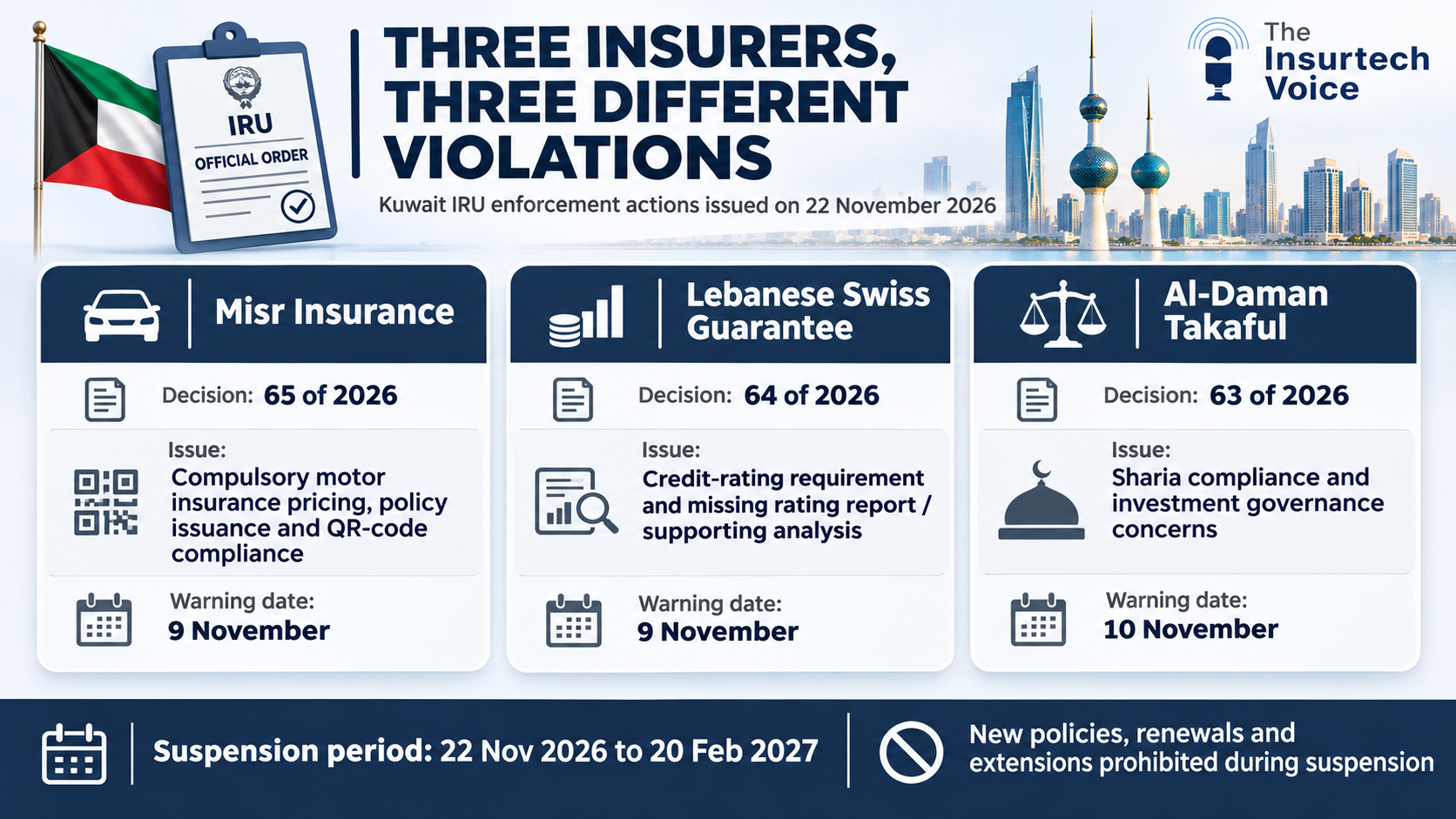
Although the penalties have the same duration, the underlying violations differ. The regulator's official publications provide the framework for following subsequent enforcement decisions.
Why was Misr Insurance suspended in Kuwait?
Misr Insurance failed to comply with compulsory insurance pricing, policy issuance and mandatory QR code requirements, according to IRU Decision No. 65 of 2026.
Motor insurance pricing and policy documents
The order references Decision No. 19 of 2025 and its amendment, Decision No. 28 of 2025, governing compulsory insurance issuance. Such rules matter because motorists must maintain the legally prescribed coverage, rather than choosing whether to purchase it.
The regulator also identified missing QR code compliance. Digital verification can help establish whether a certificate corresponds to an issued policy, reducing reliance on printed documents alone.
The decision does not establish that fraudulent certificates were issued or specify whether customers were overcharged or undercharged. Although the identified violations concern compulsory insurance, the restrictions are not limited to motor business.
Why was Lebanese Swiss Guarantee suspended?
Lebanese Swiss Guarantee failed to comply with mandatory credit-rating requirements and did not provide the regulator with the required rating report and supporting analysis, according to IRU Decision No. 64 of 2026.
The order cites Decision No. 1 of 2026, which requires insurance and reinsurance companies to obtain credit ratings.
Credit ratings assess creditworthiness, while insurance-specific financial strength ratings evaluate an insurer's capacity to meet its insurance obligations. Supporting reports help explain factors such as capital, financial performance and risk exposure.
This information matters because insurers collect premiums before many of their future claims become payable. Our coverage of AM Best's GIG Gulf rating affirmation explains how financial strength assessments work in the regional insurance market.
The suspension is not evidence of a confirmed inability to pay claims. The decision establishes regulatory non-compliance, not insolvency.
Why was Al-Daman Takaful suspended?
Al-Daman Takaful faced enforcement action over Sharia non-compliance and material real-estate and participation investments reported among shareholder and policyholder assets, according to IRU Decision No. 63 of 2026.
Sharia compliance
Takaful is a form of Islamic insurance based on mutual assistance. Participants contribute to a common fund used to compensate eligible members for covered losses.
The regulator cited Article 107 of the executive regulations, which requires takaful operators to follow Islamic Sharia principles. The decision does not identify the specific transactions or practices behind this violation.
Investment governance
The separate investment concern relates to material amounts recorded in the company's financial statements. Investment governance matters because insurers need to balance returns with access to funds for claims and other obligations.
For takaful operators, the management of participant and shareholder funds is also important. The IRU did not quantify the investments or establish that they had generated losses. It determined that the identified matters placed policyholders' rights at risk.
What does the 90-day suspension mean for policyholders?
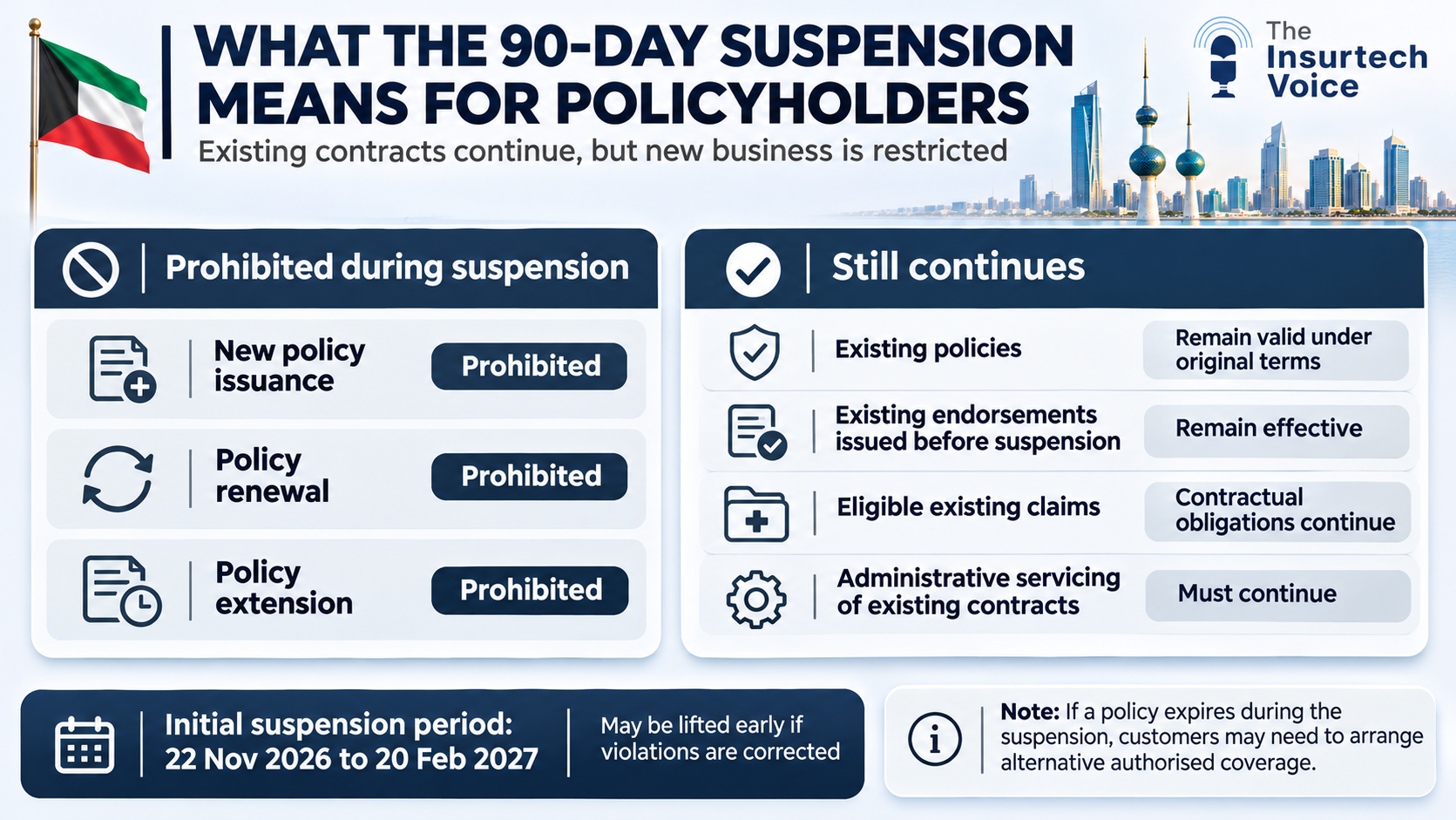
Existing policies retain their contractual protections, but customers cannot obtain new or renewed coverage from the suspended insurers while the restrictions apply.
Articles 2 and 4 of the three orders distinguish prohibited new business from continuing obligations under earlier contracts.
| Insurance activity | During suspension |
|---|---|
| New policy issuance | Prohibited |
| Policy renewal or extension | Prohibited |
| Previously issued policies and endorsements | Remain effective under their terms |
| Eligible existing claims | Contractual obligations continue |
| Administrative servicing of existing contracts | Must continue |
Customers with pending claims should follow the existing claims procedure and retain their policy documents and correspondence. Individual claim eligibility remains subject to policy conditions.
Illustrative example: A motor insurance policy issued before the suspension expires on 15 December 2026. Its existing protection continues according to its terms until expiry, but the suspended insurer cannot renew it unless the regulator lifts the restriction. The customer should arrange alternative authorised coverage if needed before expiry.
This distinction is especially important for compulsory insurance, where a gap in coverage may have legal and financial consequences.
Can Kuwait lift or extend the suspensions?
The IRU can lift an individual suspension early through a formal decision if the insurer corrects the identified violations. Article 1 of each order also provides for another similar suspension period if violations remain unresolved.
The scheduled end date of 20 February 2027 is therefore not an unconditional guarantee that all three insurers will resume business. Their return may depend on separate corrective actions and regulatory decisions.
What does this mean for the GCC insurance industry?
The enforcement actions show how weaknesses in pricing controls, financial reporting and investment governance can directly interrupt an insurer's ability to accept new business.
For brokers and corporate buyers, the immediate priority is identifying upcoming renewals and reviewing alternative placement options. Replacing every active policy is not automatically required by these orders.
For insurers, the cases illustrate why compliance must extend beyond legal departments. Underwriting teams need compliant pricing and issuance controls, finance teams need timely rating submissions, and takaful operators need appropriate investment oversight.
Technology can support these responsibilities through automated document checks, pricing validation, regulatory reporting alerts and auditable approval processes. These are possible operational measures, not additional technology requirements imposed by the IRU.
The action also provides context for wider regional regulatory developments, including Saudi Arabia's phased local reinsurance requirements, although that initiative addresses a different regulatory issue.
What has not been disclosed, and what happens next?
The orders do not quantify affected policyholders, outstanding claims, the financial impact of pricing violations or the value of the identified investments. They do not establish bankruptcy or permanent licence cancellation.
The next development to monitor is whether each company corrects its violations and receives permission to resume business. Customers approaching renewal should check the latest regulator notices rather than assume that restrictions will automatically expire.
Frequently asked questions
- Which insurance companies have been suspended in Kuwait?
- Kuwait's Insurance Regulatory Unit suspended Misr Insurance Company, Lebanese Swiss Guarantee Company and Al-Daman Takaful Insurance Company through Decisions Nos. 65, 64 and 63 of 2026, issued on 22 November 2026.
- How long is the Kuwait insurance companies suspension?
- The initial suspension lasts 90 days, from 22 November 2026 to 20 February 2027. It can continue for another similar period if the affected companies fail to correct their regulatory violations.
- Why was Misr Insurance suspended in Kuwait?
- Misr Insurance was suspended for failing to comply with regulatory requirements governing compulsory motor insurance pricing, policy issuance and mandatory QR codes on insurance documents.
- Why was Lebanese Swiss Guarantee suspended?
- Lebanese Swiss Guarantee failed to comply with mandatory credit-rating requirements and did not provide Kuwait's Insurance Regulatory Unit with the required rating report and accompanying analysis.
- Why was Al-Daman Takaful Insurance suspended?
- The regulator identified non-compliance with Islamic Sharia requirements and concerns involving material real-estate and participation investments recorded among shareholder and policyholder assets in the company's financial statements.
- Are existing insurance policies cancelled during the suspension?
- No. Insurance policies and endorsements issued before the suspension remain valid according to their original contractual terms and validity periods. The insurers must continue fulfilling their existing legal and contractual obligations.
- Can suspended insurance companies in Kuwait settle claims?
- Yes. The suspension does not remove the insurers' existing contractual obligations, including the settlement of eligible insurance claims, subject to applicable policy terms and legal requirements.
- Can policyholders renew insurance policies during the suspension?
- No. The three affected insurers cannot issue new insurance policies, renew existing policies or extend policy validity while the suspension remains in effect. Customers approaching expiry may need to arrange coverage with another authorised insurer.
- Can Kuwait lift the insurance suspension before 90 days?
- Yes. Kuwait's Insurance Regulatory Unit can issue a formal decision lifting an insurer's suspension before the initial 90-day period ends if the company corrects the identified regulatory violations.
- Does the suspension mean the three insurance companies are insolvent?
- No. The official decisions identify regulatory violations and impose temporary restrictions on insurance activities. They do not establish that the affected companies are insolvent or bankrupt.
Sources
Primary regulatory sources (22 November 2026):
- IRU Decision No. 65: Misr Insurance.
- IRU Decision No. 64: Lebanese Swiss Guarantee.
- IRU Decision No. 63: Al-Daman Takaful.
Editorial note: This article draws on the original Arabic regulatory orders, with AI-assisted drafting and English interpretation. Industry implications are editorial analysis. This is informational coverage, not legal or financial advice. Policyholders should consult their insurer or the IRU about individual claims and coverage.
The InsurTech Voice · An Initiative by Insurnest