
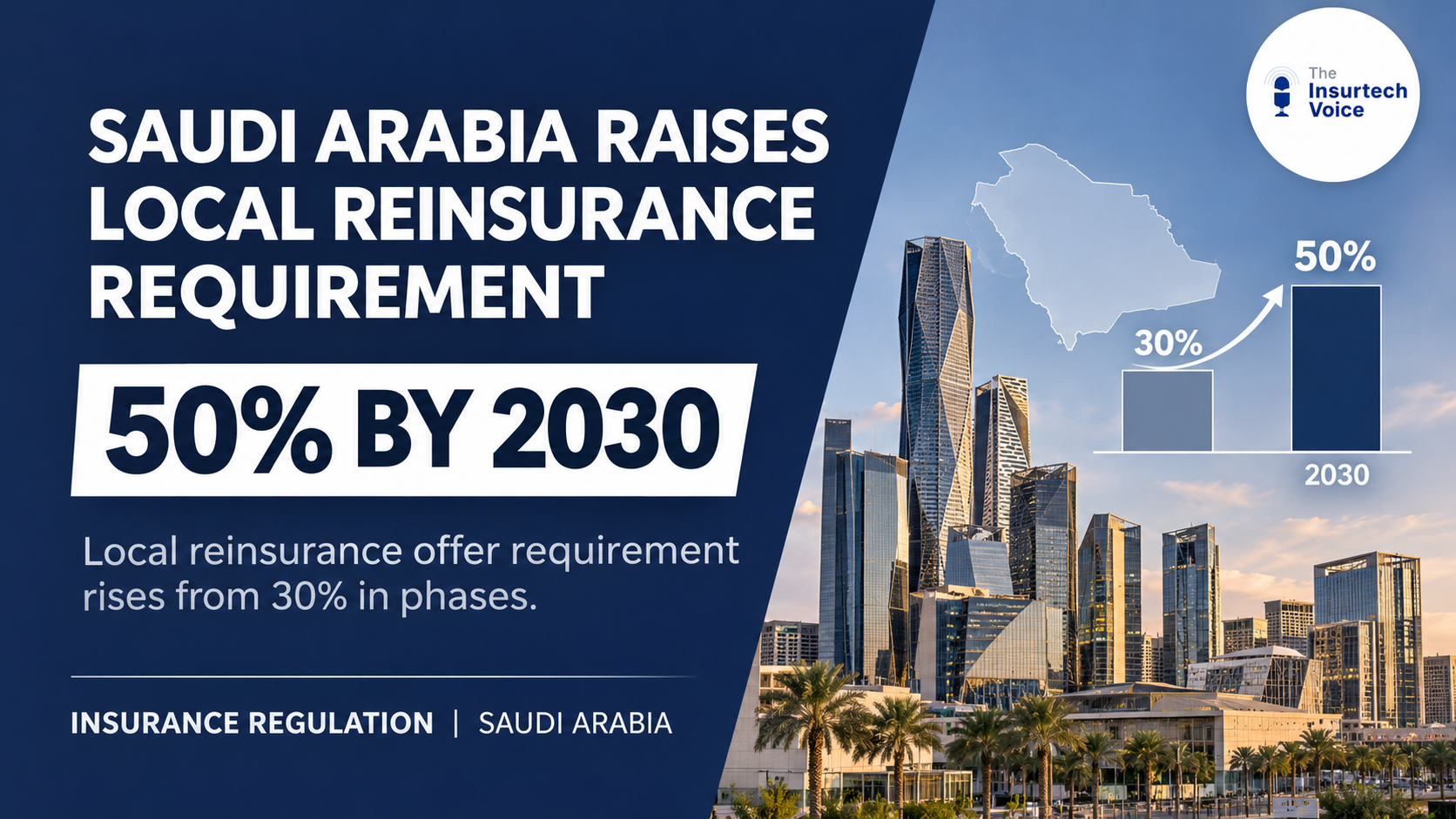
Saudi insurers will have to offer half of their ceded reinsurance premiums to the local market by 2030, up from 30% today. The change is being phased in from 2027, giving domestic reinsurers the first opportunity to consider more business before insurers complete their reinsurance placements.
The Insurance Authority issued the directive on 15 November 2026, and Saudi Re disclosed the timetable on 16 November. The key distinction is that insurers must offer the prescribed share locally. This is not the same as guaranteeing that local reinsurers will accept, or ultimately retain, that share.
Key takeaways
- 2027–2030: The local-offer requirement rises by five percentage points a year, reaching 50% in 2030.
- For insurers: Reinsurance placement teams need to account for local first-refusal rights, particularly around renewals and documentation.
- For reinsurers: More opportunities will be offered domestically, but actual premium growth depends on underwriting appetite, capacity and risk selection.
What has changed under the Saudi Arabia local reinsurance mandate?
The new Saudi Insurance Authority reinsurance rules establish a four-year schedule for raising the minimum share of ceded reinsurance premiums offered to domestic reinsurers.
| Period | Minimum share offered to local reinsurers | Change from current level |
|---|---|---|
| Current requirement | 30% | — |
| 2027 | 35% | +5 percentage points |
| 2028 | 40% | +10 percentage points |
| 2029 | 45% | +15 percentage points |
| 2030 | 50% | +20 percentage points |
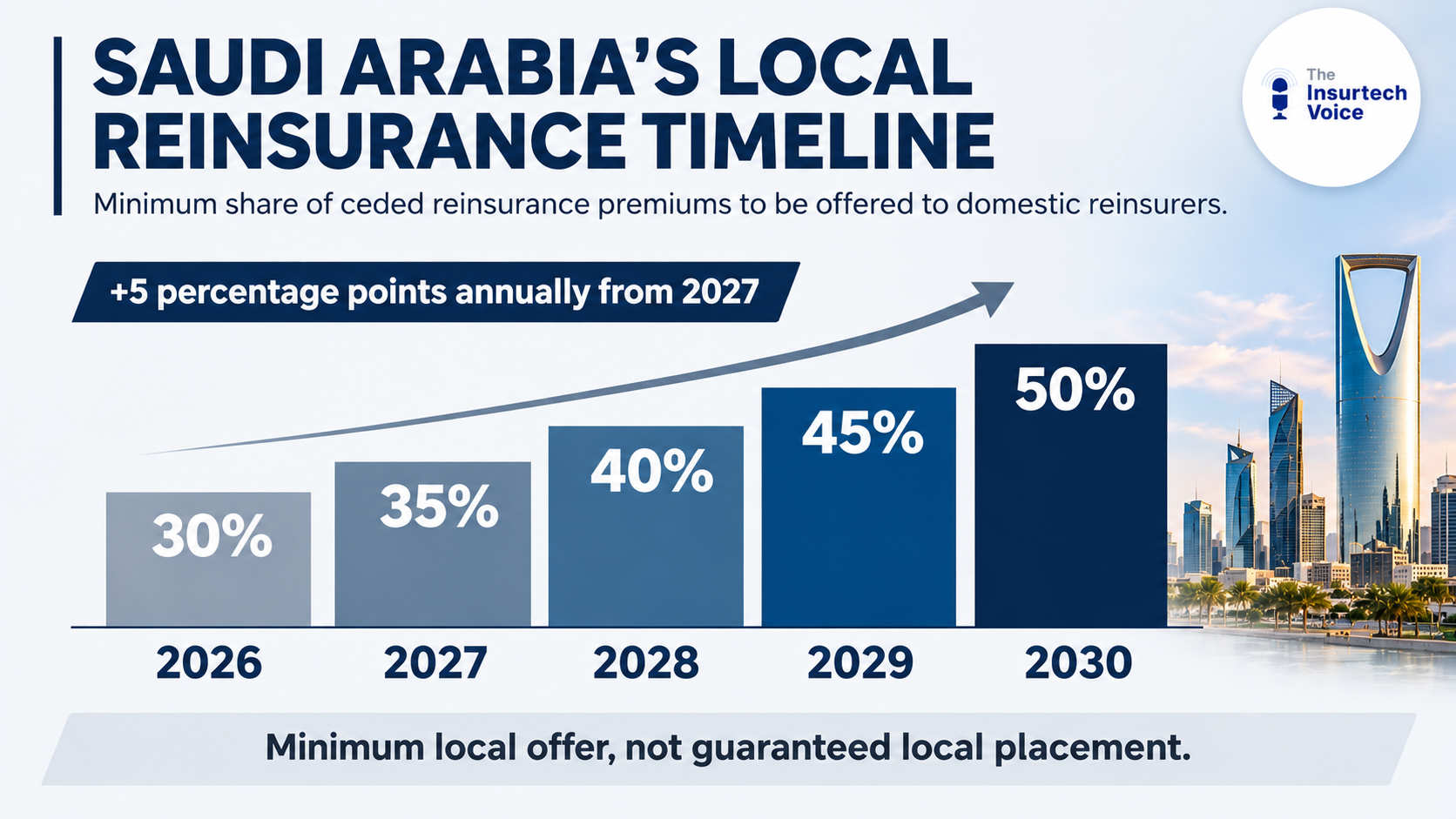
The Saudi reinsurance cession ratio is therefore increasing in stages, rather than jumping immediately to 50%. Local reinsurance companies retain a right of first refusal over the relevant business offered to them.
The distinction matters. A requirement to offer 50% locally does not, by itself, establish that 50% will be accepted or retained in Saudi Arabia. The outcome will depend on which risks local reinsurers are prepared and permitted to write, and on the circular's implementation conditions.
What does the 50% rule mean for an insurer's reinsurance programme?
Consider an insurer arranging SAR 20 million in ceded reinsurance premiums in 2030. Under a simplified illustration of the announced 50% requirement, it would need to offer SAR 10 million of that reinsurance premium to the local market.
| Illustrative 2030 reinsurance arrangement | Amount |
|---|---|
| Total ceded reinsurance premium | SAR 20 million |
| Minimum amount offered locally at 50% | SAR 10 million |
| Other share of the programme | SAR 10 million |
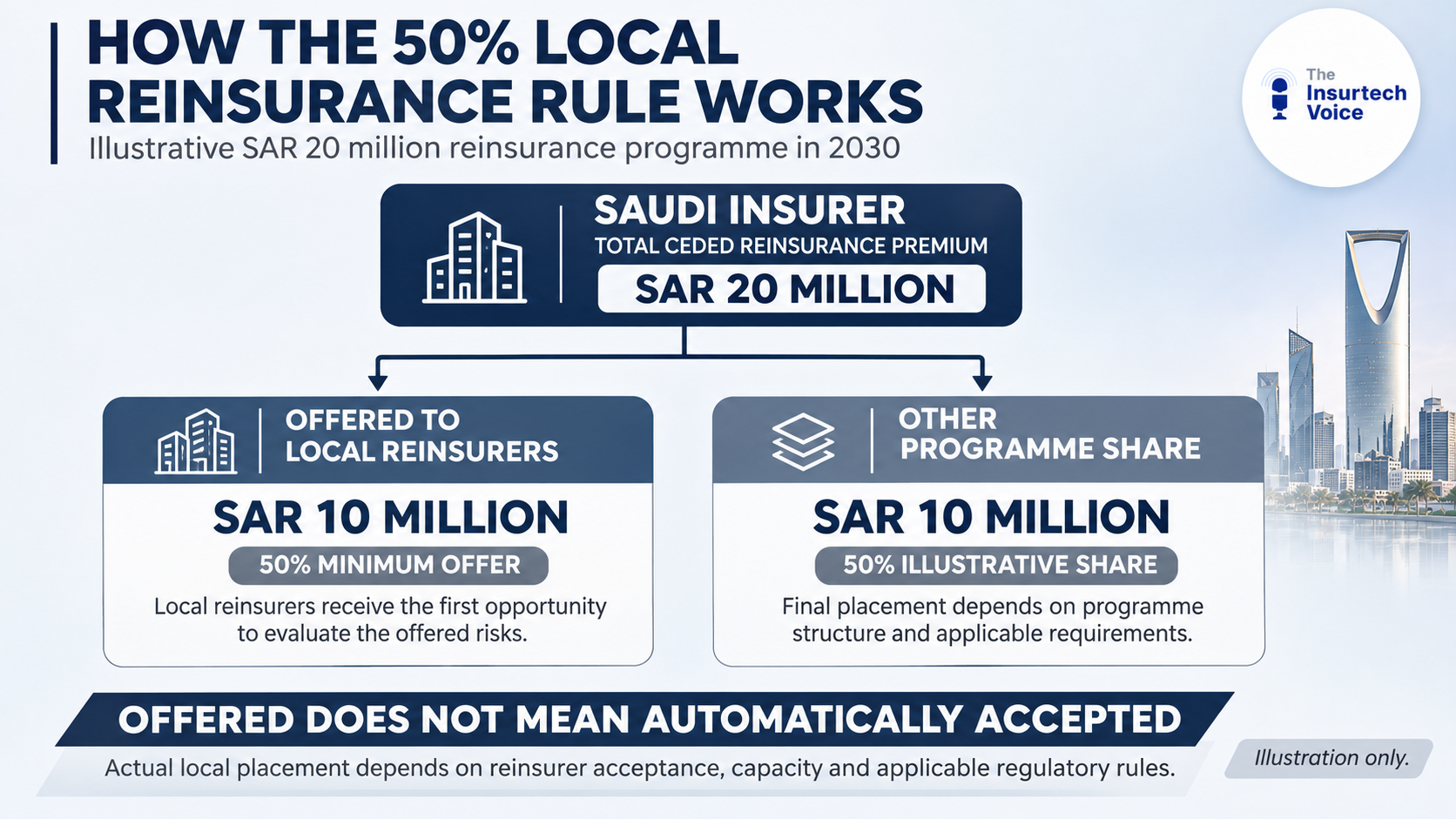
This example uses reinsurance premiums, not the premiums collected from policyholders. It also does not assume that every local offer becomes a completed placement.
For a chief underwriting officer or head of reinsurance, the practical issue is placement execution. The insurer must preserve adequate capacity, pricing and coverage while accommodating the local-offer requirement. If local reinsurers decline an exposure or offer only part of the required capacity, the next steps should follow the full circular and any applicable guidance, rather than assumptions about automatic overseas placement.
Where treaty and facultative teams should focus
The new requirements make it sensible to review how treaty and facultative placements are documented. Relevant questions include: Which contracts and risks fall within scope? How are offers submitted and recorded? How are local responses captured? And how will the insurer demonstrate that the prescribed percentage was offered?
These are operational considerations, not additional obligations independently confirmed from the text of the circular. The full circular should be checked before changing a compliance process.
Why is Saudi Arabia increasing local reinsurance requirements?
The policy is intended to strengthen domestic reinsurance capacity and retain more insurance-related economic activity within the Kingdom. The gradual transition also gives reinsurers time to develop underwriting capabilities and balance-sheet capacity. It comes alongside Saudi Arabia’s transition to risk-based capital requirements in 2027, which will affect how insurers and reinsurers assess their capital against the risks they carry. The two measures address different aspects of the market: local reinsurance access and solvency.
The current market explains why the initiative matters. According to figures cited by Middle East Insurance Review from the Insurance Authority's Saudi Insurance Market Report, Saudi insurers ceded around SAR 10.95 billion in premiums to reinsurers in 2025, and international reinsurers accounted for 80.2% of the amount. That international share was 88.6% in the previous year.
Those figures describe actual cessions, which are different from the new regulatory minimum offer percentages. They provide market context, not a forecast that the international share will fall to exactly 50% by 2030.
Saudi Re has linked the initiative to the National Insurance Strategy. Its stated objective is to create a more capable domestic reinsurance sector that can support Saudi businesses and major development projects.
Which reinsurers could gain from the new rules?
Two domestic reinsurance companies have publicly responded to the announcement: Saudi Re and Riyadh Re.
Saudi Re views the increased local-offer requirement as a source of new business opportunities. Riyadh Re has similarly welcomed the policy, emphasizing domestic capacity, technical underwriting and disciplined risk selection.
However, increased access to submissions is only the first step. Reinsurers still need to decide whether the risk fits their appetite, whether the premium adequately compensates them, and whether their capital and retrocession arrangements can support the exposure.
For local reinsurers, the real commercial opportunity is not simply receiving more submissions. It is converting appropriate submissions into profitable, sustainable business.
What financial impact does Saudi Re expect from local cession?
Saudi Re told the Saudi Exchange that the mechanism could increase its reinsurance revenue by more than 5% of total reinsurance revenue, using its 2025 results as the reference. The company expects the financial impact to begin in 2027.
That is a company forecast, not a regulator's target and not a guaranteed increase in earnings. More revenue does not automatically translate into more underwriting profit, especially if the additional business carries higher claims volatility or requires additional retrocession protection.
For investors and industry executives, the metrics worth monitoring after 2027 will include accepted premium volumes, underwriting profitability, capital adequacy and the cost of retrocession, rather than submission volume alone. For an example of how capital strength and underwriting performance are assessed together, see our coverage of AM Best’s GIG Gulf rating affirmation. That assessment concerns a different insurer and is not a forecast for Saudi Re.
What does this mean for international reinsurers?
International reinsurers are not banned from Saudi Arabia under the disclosed requirements. They may continue to provide capacity for risks that are too large, specialized or concentrated for local reinsurers to absorb on their own.
But their route to some business could change. Domestic reinsurers receive priority to evaluate the required local share, potentially affecting submission timing, participation structures and renewal negotiations.
This creates a commercial question for international markets: will they primarily compete for the remaining business, participate alongside local reinsurers, or provide retrocession capacity behind domestic participants? These are possible market responses, not arrangements mandated by the announcement. A separate regulatory development in Hong Kong’s proposed asset-intensive reinsurance guidelines illustrates how another jurisdiction is reviewing reinsurance transactions, although its proposed approval approach is distinct from Saudi Arabia’s local-offer requirement.
What should insurance executives monitor before 2027?
The first increase takes effect in 2027, making the transition period important for insurers preparing upcoming reinsurance renewals.
| Decision-maker | Immediate area to review |
|---|---|
| Chief underwriting officer | Whether local participation changes programme structure, limits or risk appetite |
| Head of reinsurance | Renewal scheduling, local offers, responses and placement documentation |
| Chief risk officer | Counterparty concentrations, reinsurance recoverability and available capacity |
| Compliance team | Exact scope, definitions, exceptions and reporting requirements in the circular |
| Local reinsurer | Submission capacity, pricing discipline, capital deployment and retrocession needs |
| International reinsurer or broker | How the first-refusal process may affect access, timing and placement strategy |
Three questions remain especially important: How does the full circular define eligible local reinsurers and covered cessions? What procedures apply when an offer is declined or only partly accepted? What evidence must insurers maintain to demonstrate compliance?
These details should not be treated as settled until the underlying regulatory text and any subsequent implementation guidance are reviewed.
What happens next?
The directive has been announced, with the first step taking the minimum local offer from 30% to 35% in 2027. The thresholds then rise to 40% in 2028, 45% in 2029 and 50% in 2030.
The broader shift is significant: Saudi Arabia is giving its domestic reinsurance market a larger first opportunity to participate in risks generated within the Kingdom. Whether that produces a proportional rise in locally retained premium will depend on capacity, pricing and underwriting decisions.
For insurers, this is a change to monitor in reinsurance placement strategy and operating processes. For local reinsurers, it is an opportunity that must be matched by capital and underwriting discipline.
Frequently asked questions
- What is the Saudi Arabia local reinsurance mandate?
- The Saudi Insurance Authority has announced a phased increase in the minimum share of ceded reinsurance premiums insurers must offer to the local market, from the existing 30% to 35% in 2027, 40% in 2028, 45% in 2029 and 50% in 2030. Local reinsurance companies have the right of first refusal.
- What is the Saudi reinsurance cession ratio for 2027?
- The minimum share of ceded reinsurance premiums that Saudi insurers must offer to the local reinsurance market is scheduled to rise to 35% in 2027, from the existing 30%.
- When will Saudi Arabia reach the 50% local reinsurance requirement?
- The Insurance Authority's announced schedule reaches a minimum local-offer share of 50% in 2030, after increases to 35% in 2027, 40% in 2028 and 45% in 2029.
- Does the mandate mean 50% of reinsurance premiums must stay in Saudi Arabia?
- Not necessarily. The announcement specifies a minimum percentage that must be offered to local reinsurers, which have a right of first refusal. The share ultimately placed locally depends on acceptance and applicable implementation rules.
- What does the Saudi reinsurance right of first refusal mean?
- It gives eligible local reinsurers the first opportunity to consider the reinsurance business offered to them. It should not be interpreted as a guarantee that they will accept every risk. Detailed operational conditions should be checked against the Insurance Authority's circular.
- How could the Saudi Insurance Authority reinsurance rules affect insurers?
- Insurers may need to review renewal calendars, local-market offers, reinsurer responses, treaty and facultative placement workflows, and evidence of compliance. The exact obligations depend on the full regulatory circular and its implementing conditions.
- What financial impact does Saudi Re expect?
- Saudi Re said the new mechanism could lift its reinsurance revenue by more than 5% of total reinsurance revenue, using its 2025 financial results as the reference, with an expected impact from the 2027 financial year. This is a company expectation, not a guaranteed outcome.
- Are international reinsurers excluded from Saudi Arabia?
- No. The announced rule prioritizes a minimum offer to the local reinsurance market; it does not announce a general prohibition on international reinsurance. Actual placements will depend on local acceptance, capacity and the applicable regulatory requirements.
Sources
Primary sources
Reporting and analysis
- Middle East Insurance Review, 17 November 2026: Saudi Arabia Regulator Mandates Local Cession Increases to Expand the Insurance Market
- Argaam, 19 November 2026: Moody's Assessment of Saudi Arabia's Increased Local Reinsurance Cession Requirements
- Enterprise Saudi Arabia, 22 November 2026: Saudi Insurers Must Offer Half Their Reinsurance Business Locally by 2030
Reporting note: This article distinguishes confirmed regulatory disclosures from operational analysis. The complete Insurance Authority circular was not independently retrieved for this report, so its detailed definitions and exceptions remain to be confirmed. Prepared with AI assistance and editorial fact-checking against publicly available sources.
The InsurTech Voice · An Initiative by Insurnest