
Winning a court case against an insurance company does not always mean the money arrives straight away. For policyholders still waiting for an insurer to comply with a judgment, Kuwait is taking steps to improve regulatory oversight.
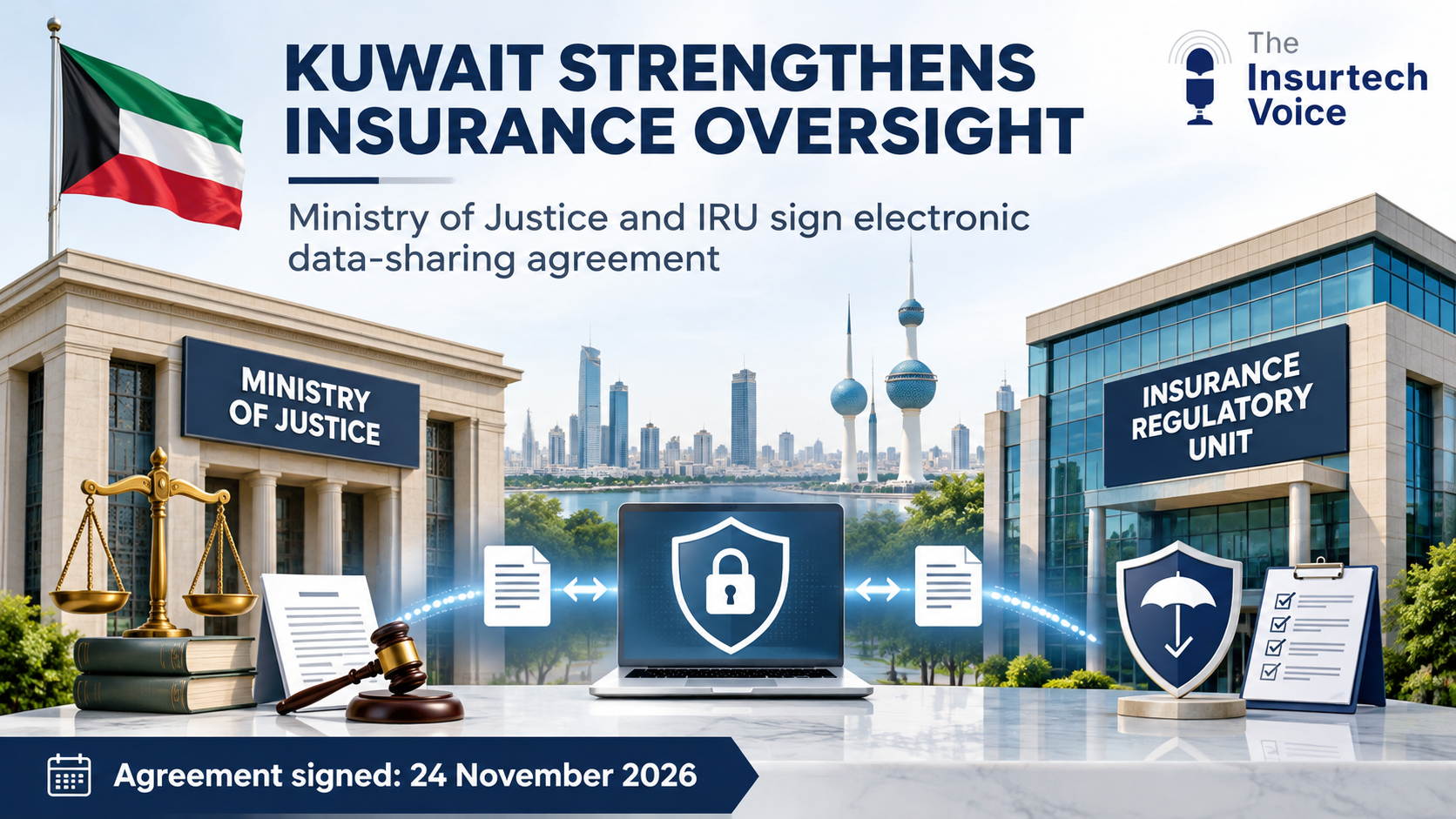
On 24 November 2026, Kuwait's Ministry of Justice and Insurance Regulatory Unit (IRU) signed a memorandum of understanding (MoU) to exchange insurance-related information electronically. The aim is to help the regulator identify legal violations and monitor whether insurers are fulfilling their obligations.
The IRU's official announcement links the agreement to a complaints mechanism introduced earlier in November. Together, the two developments could give the regulator a clearer picture of insurers that fail to comply with final court judgments.
Key Takeaways
- Kuwait's Ministry of Justice and IRU signed the data-sharing agreement on 24 November 2026.
- The planned electronic connection will support insurance supervision and help identify violations of insurance laws.
- The agreement complements Resolution No. 52 of 2026, which sets out procedures for insurance complaints, including those involving unexecuted court judgments.
- Regulatory action could extend to licence revocation, subject to applicable laws and procedures.
- The information exchange must respect legal controls and confidentiality requirements.
What Is the Kuwait Insurance Data Sharing Agreement?
The agreement establishes a framework for Kuwait's Ministry of Justice and insurance regulator to share information electronically and improve supervision of insurance companies.
The two authorities have different responsibilities. The justice system handles court proceedings and enforcement, while the IRU oversees licensed insurance businesses. By connecting their systems, the regulator intends to make better use of relevant judicial information in its supervisory work.
| Authority | Role in the agreement |
|---|---|
| Ministry of Justice | Cooperate and provide access to relevant judicial information |
| Insurance Regulatory Unit | Monitor insurer compliance and pursue appropriate regulatory action |
The arrangement supports supervision under Insurance Regulation Law No. 125 of 2019. It does not give the IRU the powers of a court or replace the judicial enforcement process.
How Will the Electronic Data-Sharing Arrangement Work?
The planned electronic connection will allow the IRU to obtain relevant information from the Ministry of Justice and use it to assess whether insurers are meeting their legal obligations.
An example of an unpaid insurance claim
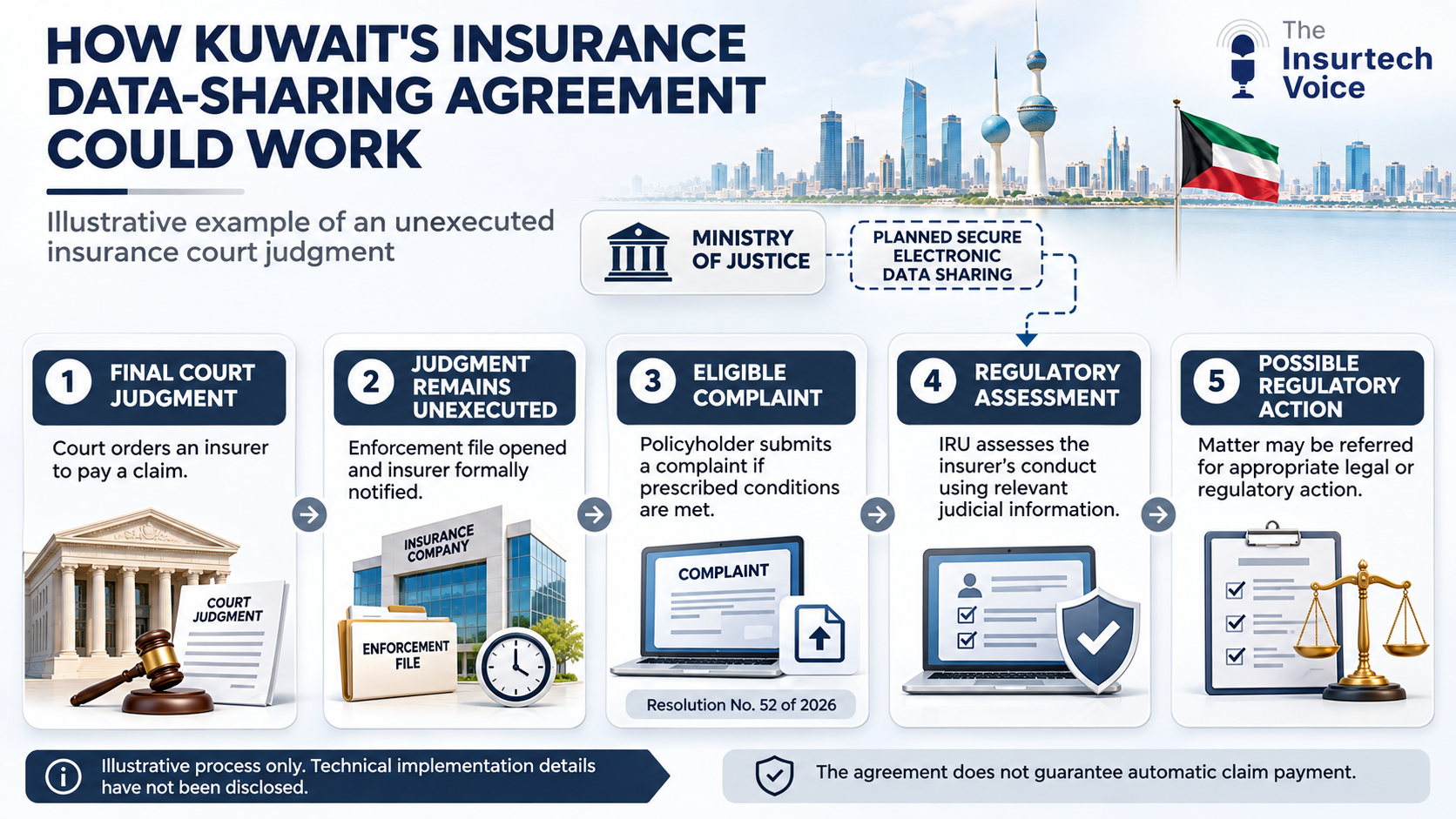
Suppose a policyholder obtains a final court judgment ordering an insurer to pay a claim. An enforcement file is opened, and the insurer is formally notified, but the judgment remains unexecuted.
If the policyholder meets the applicable complaint conditions, they can approach the regulator through its complaints system. Judicial information obtained through the new arrangement could help the IRU assess the insurer's conduct and decide whether further regulatory action is warranted.
This is an illustration of how the agreement could help. The authorities have not yet disclosed exactly how information will move between their systems or whether individual cases will be flagged automatically.
How Does Resolution No. 52 of 2026 Relate to the Agreement?
Resolution No. 52 of 2026 provides the existing complaints framework that the data-sharing agreement is intended to support.
The official resolution and its annex, effective from 9 November 2026, replaced earlier complaints decisions issued in 2022 and 2023.
Article 10 deals with complaints against licensed companies that fail, without legal justification, to execute a final judgment in favour of the complainant. Annex No. 1 sets out the conditions for these complaints, including cases involving unjustified delays.
Who can submit a complaint?
Article 10 specifically refers to individuals and licensed companies. The announcement about the MoU also mentions individuals, private companies and government bodies using the electronic complaints framework. Eligibility depends on the provisions applicable to each case.
What conditions must be satisfied?
A complaint about an unexecuted court judgment must meet the eligibility requirements set out in Annex No. 1 of Resolution No. 52 of 2026.
| Requirement | What it means in practice |
|---|---|
| Final judgment against a licensed company | An ongoing court case does not qualify on its own |
| No judicial suspension of execution | The judgment must remain enforceable |
| Enforcement file and formal notification | An enforcement file must exist, and at least one month must have passed after notification in enforceable form without execution |
| Failure to execute without legal justification | The insurer must have failed to comply without a valid legal reason |
| No duplicate complaint | A repeat complaint requires new circumstances |
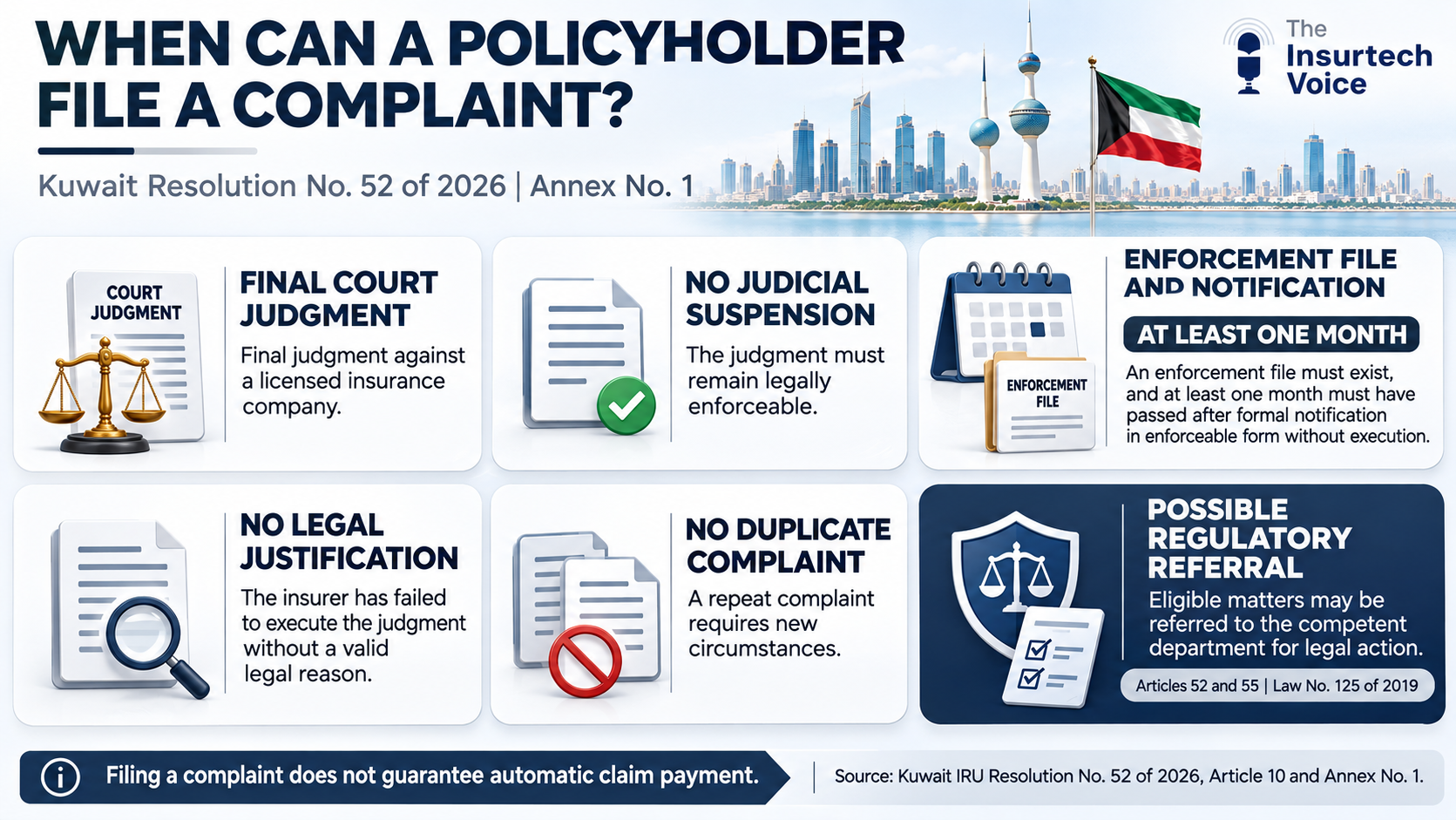
In these cases, the complaints committee's role is limited to referring the matter to the competent department for legal action under Articles 52 and 55 of Law No. 125 of 2019. Filing a complaint is not the same as obtaining a new court judgment.
What Action Can Kuwait's Insurance Regulator Take?
The IRU can pursue regulatory and legal action against insurers that breach applicable insurance laws, with possible measures extending to licence cancellation.
IRU head Mohammad Al-Otaibi highlighted this possibility, according to Kuwait Times and KUNA. Any action would depend on the circumstances of the violation and the applicable legal procedures. An unpaid claim does not automatically result in licence revocation.
The MoU comes shortly after Kuwait suspended three insurance companies on 22 November over separate regulatory violations. The two developments illustrate different aspects of insurance supervision. The agreement does not establish any link between those three companies and unexecuted court judgments.
What Does the Agreement Mean for Policyholders and Insurers? (Our Analysis)
Policyholders could benefit from better oversight of unexecuted judgments, while insurers have reason to review how they track and fulfil their legal obligations.
For policyholders
Customers pursuing a judgment should retain their court documents, enforcement records and correspondence with the insurer. These records can help establish whether a complaint meets the prescribed conditions.
The agreement does not guarantee that outstanding claims will be paid automatically. Policyholders must still follow the relevant judicial and complaints procedures.
For insurance companies
A court judgment may pass through several departments before payment is completed. The legal team communicates the outcome, the claims team identifies the policy and claim, and the finance team processes any payment due.
If these teams keep separate records, it can be difficult to establish who is responsible for following up on a judgment. A shared register of enforceable judgments, clear ownership of each case and records of execution status could help insurers identify unresolved obligations.
These are operational suggestions, not new technical requirements introduced by the MoU.
Why Does Digital Integration Matter for Insurance Oversight?
Electronic information sharing could help regulators identify compliance problems without relying entirely on separate information requests and manual checks.
For insurers, it reinforces the importance of keeping claims, legal and compliance records consistent. When information is exchanged electronically, appropriate access controls and reliable audit trails become particularly important.
Other insurance markets are also exploring digital supervision. India's IRDAI health insurance BAP portal migration is an example of integrated regulatory reporting, although it serves a different purpose from Kuwait's court judgment initiative.
Judicial and insurance records can contain sensitive information. Kuwait's Ministry of Justice has stated that the exchange will respect applicable legal controls and confidentiality requirements.
What Has Not Been Disclosed?
The authorities have confirmed the signing of the agreement, but they have not announced when the electronic connection will become operational or what information will be exchanged.
The announcement also does not specify an implementation budget, a technical timetable or the number and value of outstanding insurance judgments.
For now, the agreement represents a commitment to closer cooperation between the two authorities. Its practical effect will depend on how the electronic connection is implemented and how the regulator uses the information within the existing complaints framework.
Frequently asked questions
- What is the Kuwait Insurance Data Sharing Agreement?
- The Kuwait Insurance Data Sharing Agreement is a memorandum of understanding signed between Kuwait's Ministry of Justice and Insurance Regulatory Unit on 24 November 2026. It establishes a framework for electronic information sharing to strengthen insurance supervision and monitor insurers' compliance with legal obligations.
- Why did Kuwait's Ministry of Justice and Insurance Regulatory Unit sign the agreement?
- The agreement aims to strengthen regulatory oversight, identify violations of insurance laws and help the regulator monitor insurance companies that fail to execute final court judgments.
- How will Kuwait's insurance data-sharing agreement work?
- The planned electronic connection will allow the Insurance Regulatory Unit to obtain relevant judicial information from the Ministry of Justice and use it to assess insurer compliance. The authorities have not disclosed the detailed technical implementation.
- What is Kuwait's Resolution No. 52 of 2026?
- Resolution No. 52 of 2026 establishes procedures for insurance complaints in Kuwait. Article 10 addresses complaints against licensed companies that fail, without legal justification, to execute final court judgments in favour of complainants. The resolution became effective on 9 November 2026.
- When can a policyholder file a complaint against an insurer in Kuwait?
- A complaint concerning an unexecuted court judgment must satisfy the applicable eligibility requirements under Resolution No. 52 of 2026. These include a final enforceable judgment, an enforcement file, at least one month after formal notification in enforceable form without execution, failure to execute without legal justification and no duplicate complaint unless new circumstances exist.
- Can Kuwait's insurance regulator revoke an insurer's licence for failing to comply with court judgments?
- Regulatory action could extend to licence revocation, subject to applicable insurance laws, the circumstances of the violation and legal procedures. Licence revocation is not an automatic consequence of an unpaid insurance claim.
- Does the Kuwait insurance data-sharing agreement guarantee claim payments?
- No. The agreement supports regulatory oversight and information sharing but does not guarantee automatic claim payments. Policyholders must continue to follow applicable judicial enforcement and complaints procedures.
- How will confidential information be protected under the agreement?
- Kuwait's Ministry of Justice has stated that the electronic information exchange will respect applicable legal controls and confidentiality requirements. Detailed technical security measures have not been disclosed.
- When will Kuwait's electronic insurance data-sharing system become operational?
- The agreement was signed on 24 November 2026, but the authorities have not announced an operational launch date, technical implementation timetable or implementation budget.
- What does the data-sharing agreement mean for insurance companies in Kuwait?
- The agreement reinforces the importance of monitoring court judgment compliance, maintaining accurate legal and claims records, and coordinating responsibilities across legal, claims, finance and compliance departments. These are operational considerations rather than new technical requirements imposed by the agreement.
Sources
Primary sources
- Insurance Regulatory Unit: Cooperation memorandum with the Ministry of Justice, 24 November 2026.
- Insurance Regulatory Unit: Resolution No. 52 of 2026, including Annex No. 1 (Official PDF), 9 November 2026.
- Insurance Regulatory Unit: Announcement on the revised insurance complaints mechanism, 9 November 2026.
Supporting reporting
Editorial note: This article is based on the original Arabic regulatory announcement and resolution, with AI assistance in English drafting. The claim example and operational suggestions are editorial explanations. This article is for information only and does not constitute legal advice. Individual cases should be checked with the relevant authorities or a qualified adviser.
The InsurTech Voice · An Initiative by Insurnest