
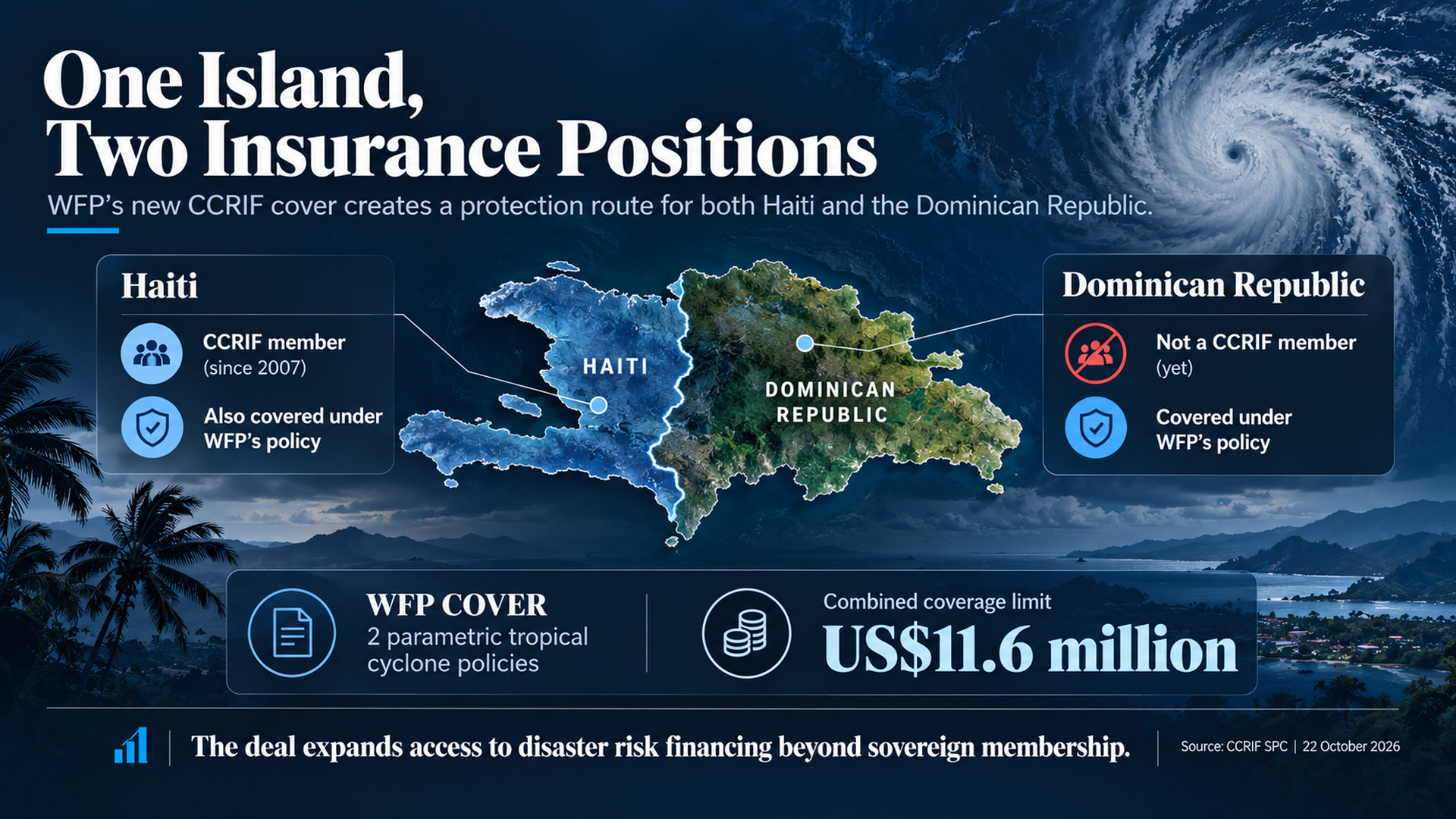
When a hurricane hits Haiti, the first few days decide how many families go without food. The UN World Food Programme (WFP), the world's largest humanitarian organisation, has now bought insurance to pay for those days. On 22 October 2026, WFP purchased two parametric tropical cyclone policies from CCRIF SPC, covering Haiti and the Dominican Republic with a combined limit of US$11.6 million. It is the first UN agency, and the first multilateral organisation, to join the Caribbean risk pool.
Look at the second country on the policy. The Dominican Republic isn't a CCRIF member yet, so its government has no CCRIF cover of its own. Through WFP's policy, money from the pool can now reach vulnerable families there anyway.
WFP parametric insurance at a glance
| Detail | Figure |
|---|---|
| Buyer | UN World Food Programme (WFP) |
| Insurer | CCRIF SPC, the Caribbean and Central American risk pool |
| Cover | Two parametric tropical cyclone policies |
| Countries covered | Haiti and the Dominican Republic |
| Combined coverage limit | US$11.6 million |
| Payout speed | Within 14 days of a triggering event |
| Announced | 22 October 2026 |
Editorial note: Based on the joint WFP and CCRIF announcement of 22 October 2026 and the sources listed below; percentage comparisons are our own calculations. Drafted with AI assistance and reviewed by The InsurTech Voice editorial team; for information only, not insurance or investment advice.
What has the World Food Programme bought?
WFP has bought two CCRIF tropical cyclone policies with a combined coverage limit of US$11.6 million, covering Haiti and the Dominican Republic. If a qualifying hurricane or major tropical storm triggers a policy, CCRIF pays WFP directly, and WFP can use the money for food, cash transfers and other emergency assistance.
Think of the US$11.6 million as a maximum. WFP only gets paid if a storm meets the policy's conditions.
The deal also marks a change in WFP's role. Until now, WFP worked alongside CCRIF through the WFP-CCRIF Social Protection Top-up Model, helping governments channel their own CCRIF payouts into national social protection schemes. In Dominica, for example, WFP contributed US$300,000 towards the government's tropical cyclone premium for 2021/22 and 2022/23. Now WFP is a policyholder in its own right.
How does CCRIF tropical cyclone insurance work?
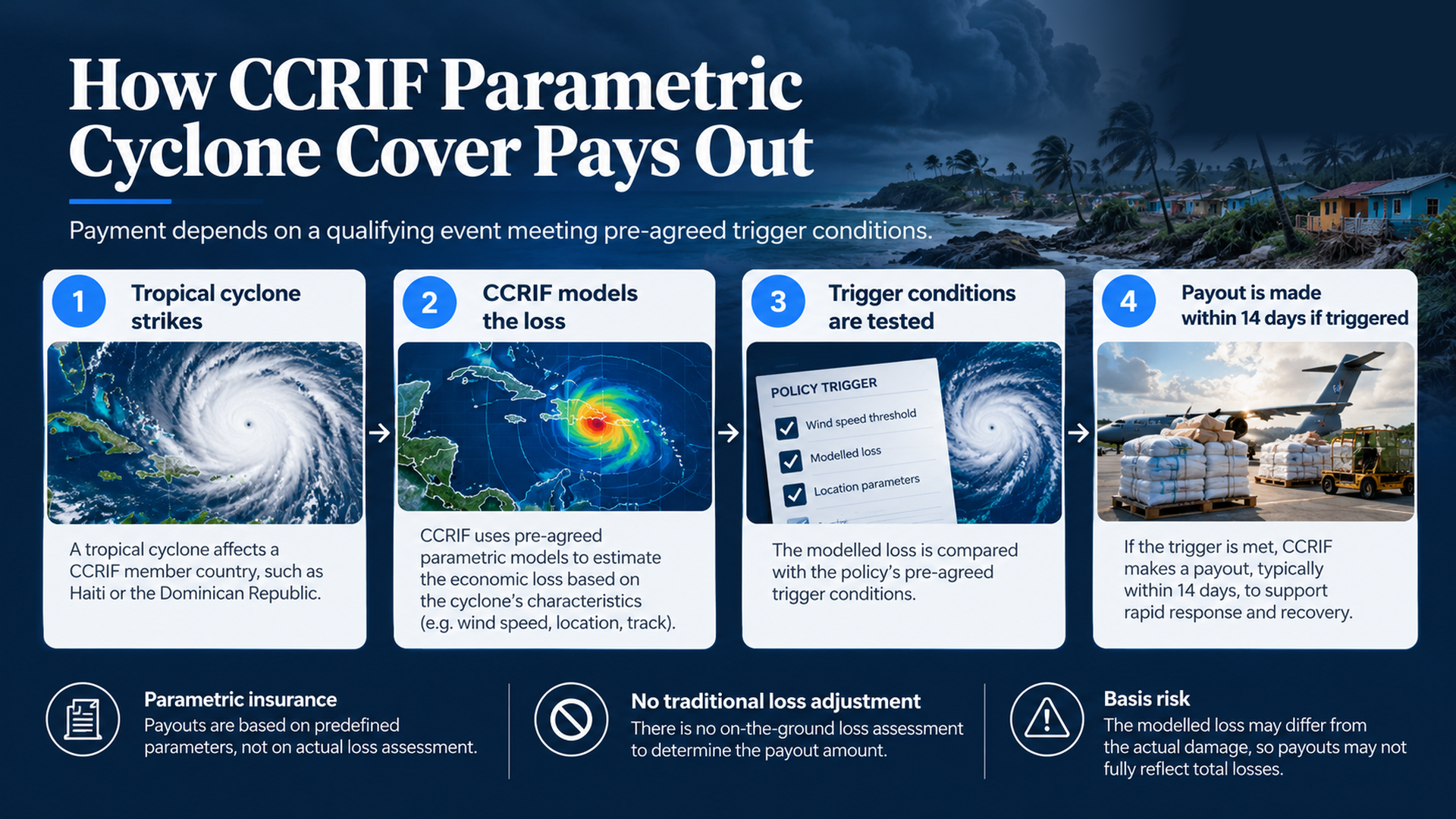
Parametric insurance pays a pre-agreed amount when a measured event crosses a set threshold, rather than after a loss adjuster assesses the actual damage. That is the key difference from traditional indemnity insurance, and it is what makes parametric cover fast.
CCRIF's version is based on modelled loss. When a storm passes, CCRIF uses its own catastrophe models to estimate the impact on the covered area. If the modelled loss meets the policy trigger, the payout is calculated from the policy terms and paid within 14 days, with no on-the-ground loss assessment required.
The trade-off is basis risk: the payout may not match what actually happened on the ground. A destructive storm can fall short of the trigger, and a payout can arrive for a storm that caused less damage than modelled. Designing triggers that keep that gap small is careful actuarial work, the kind of risk thinking explored in our founder story on actuary Sumit Ramani.
Why WFP wants money in days, not weeks
Humanitarian agencies usually raise money after a disaster, through donor appeals that can take weeks. Parametric cover reverses that order. If a policy triggers, WFP can have the money within days, without first going through lengthy resource mobilisation.
Speed matters most in a place like Haiti, where more than half the population already faces acute or worse food insecurity, according to WFP. A major storm there can push families into crisis within days. Alex Robayo, WFP's country director in the Dominican Republic, describes the period after a storm as the time "when every hour counts."
CCRIF has the track record to back the model. Since 2007, it has made 82 payouts totalling US$483 million, reaching more than 5 million people. Haiti alone, a member since 2007, has received over US$80 million on its own sovereign policies, most recently after Hurricane Melissa in 2025.
Why the Dominican Republic policy stands out
The Dominican Republic shares the island of Hispaniola with Haiti and faces the same hurricane risk, but its government has not yet joined CCRIF. WFP's policy creates a route for parametric funding to reach the country regardless.
According to the announcement, direct cover lets WFP finance emergency aid where national systems are strained or where the government is not a CCRIF member. That is a practical answer to the protection gap: the share of disaster losses that no insurance covers. The gap is wide. In the first half of 2026, around 58% of global natural catastrophe damage was uninsured, based on Swiss Re Institute figures in our coverage of Swiss Re's 2026 catastrophe losses.
What does this mean for the insurance industry?
Parametric insurance has mostly been bought by governments and, more recently, utilities. WFP's purchase opens a new buyer group: humanitarian agencies. CCRIF chief executive Isaac Anthony framed it directly, saying parametric insurance "is not only a tool for governments."
That matters because demand for the pool is already rising fast. WFP becomes CCRIF's 40th member, and total CCRIF insurance coverage for the 2026/27 policy year is up 25% to US$1.8 billion, the biggest one-year jump in its history. A new type of buyer widens that demand further.
Measured against that total, WFP's US$11.6 million is under 1%. The amount is small, but the precedent could matter more. If a UN agency can hold parametric cover in its own name, other aid organisations can too, which would mean new demand for the insurers, reinsurers and risk advisers behind regional risk pools. It also shows humanitarian disaster risk financing moving from pilot concept to real market, in line with WFP's own direction: the agency has used parametric risk transfer for nearly two decades and is working towards catastrophe bonds for food security.
For now, it's one deal. No other humanitarian agencies joined CCRIF as part of this announcement.
What happens next?
WFP's cover is now in place, subject to the policy terms. The official Atlantic hurricane season runs until 30 November, and any qualifying hurricane or major tropical storm affecting Haiti or the Dominican Republic could trigger a payout.
Over the coming months, these are the developments worth watching:
- A first payout. Whether either policy triggers, and how quickly the money reaches families on the ground.
- More humanitarian buyers. Whether other UN agencies or NGOs follow WFP into CCRIF or other regional risk pools.
- The Dominican Republic. Whether the government decides to join CCRIF in its own right.
- WFP's catastrophe bond plans. Whether WFP's work on catastrophe bonds for food security moves ahead.
Stay Ahead of Insurance Industry News
Follow The InsurTech Voice for parametric insurance, catastrophe risk, reinsurance and global insurance innovation news. Subscribe to The InsurTech Voice
Frequently asked questions
- What is the World Food Programme parametric insurance deal?
- On 22 October 2026, the UN World Food Programme (WFP) joined CCRIF SPC and bought two parametric tropical cyclone policies covering Haiti and the Dominican Republic, with a combined coverage limit of US$11.6 million. WFP is the first UN agency and first multilateral organisation to join CCRIF.
- How much cyclone insurance did the World Food Programme buy?
- WFP bought cyclone insurance with a combined coverage limit of US$11.6 million across two policies. The limit is the maximum the policies can pay, not money WFP has received.
- What is CCRIF SPC?
- CCRIF SPC, formerly the Caribbean Catastrophe Risk Insurance Facility, is a not-for-profit, multi-country risk pool set up in 2007 after Hurricane Ivan. It sells parametric insurance to governments, utilities and organisations in the Caribbean and Central America, and now has 40 members.
- How does CCRIF tropical cyclone insurance pay out?
- CCRIF uses its own models to estimate a storm's impact on the covered area. If that modelled loss meets the policy's trigger, CCRIF pays a pre-agreed amount within 14 days, without waiting for on-the-ground damage assessments.
- Is WFP the first UN agency to buy parametric insurance?
- WFP is the first UN agency to join CCRIF and buy cover from it. WFP itself has used parametric risk transfer in other arrangements for nearly two decades, including weather-index insurance and support for regional risk pools.
- Why is the Dominican Republic policy significant?
- The Dominican Republic is not yet a CCRIF member, so its government has no CCRIF cover of its own. WFP's policy means CCRIF funding can still reach vulnerable families there if a qualifying tropical cyclone strikes.
- What is humanitarian disaster risk financing?
- Humanitarian disaster risk financing means arranging funding before a disaster, through tools such as parametric insurance or contingency funds, so aid agencies can respond immediately instead of appealing to donors after the event.
- Has WFP received a payout from CCRIF?
- No payout has been announced. A payout would only follow if a hurricane or major tropical storm affecting Haiti or the Dominican Republic meets the policy conditions.
Sources
Primary sources
- WFP and CCRIF SPC: A new era of humanitarian disaster risk financing, WFP becomes first UN agency to join CCRIF, 22 October 2026
- CCRIF SPC: FAQs on the WFP-CCRIF Social Protection Top-up Model, May 2024
Reporting and analysis
- Artemis: World Food Programme buys parametric tropical cyclone insurance from CCRIF
- Reinsurance News: WFP secures $11.6m cyclone parametric insurance through CCRIF, 23 October 2026
- Artemis: CCRIF lifts parametric risk pool coverage to $1.8bn for current policy year
- PreventionWeb: Dominica signs disaster risk management agreement with UN WFP
The InsurTech Voice · An Initiative by Insurnest