

Guidewire built its business on the systems where insurers keep their policies, bills and claims. Now it wants the layer that decides what a risk should cost.
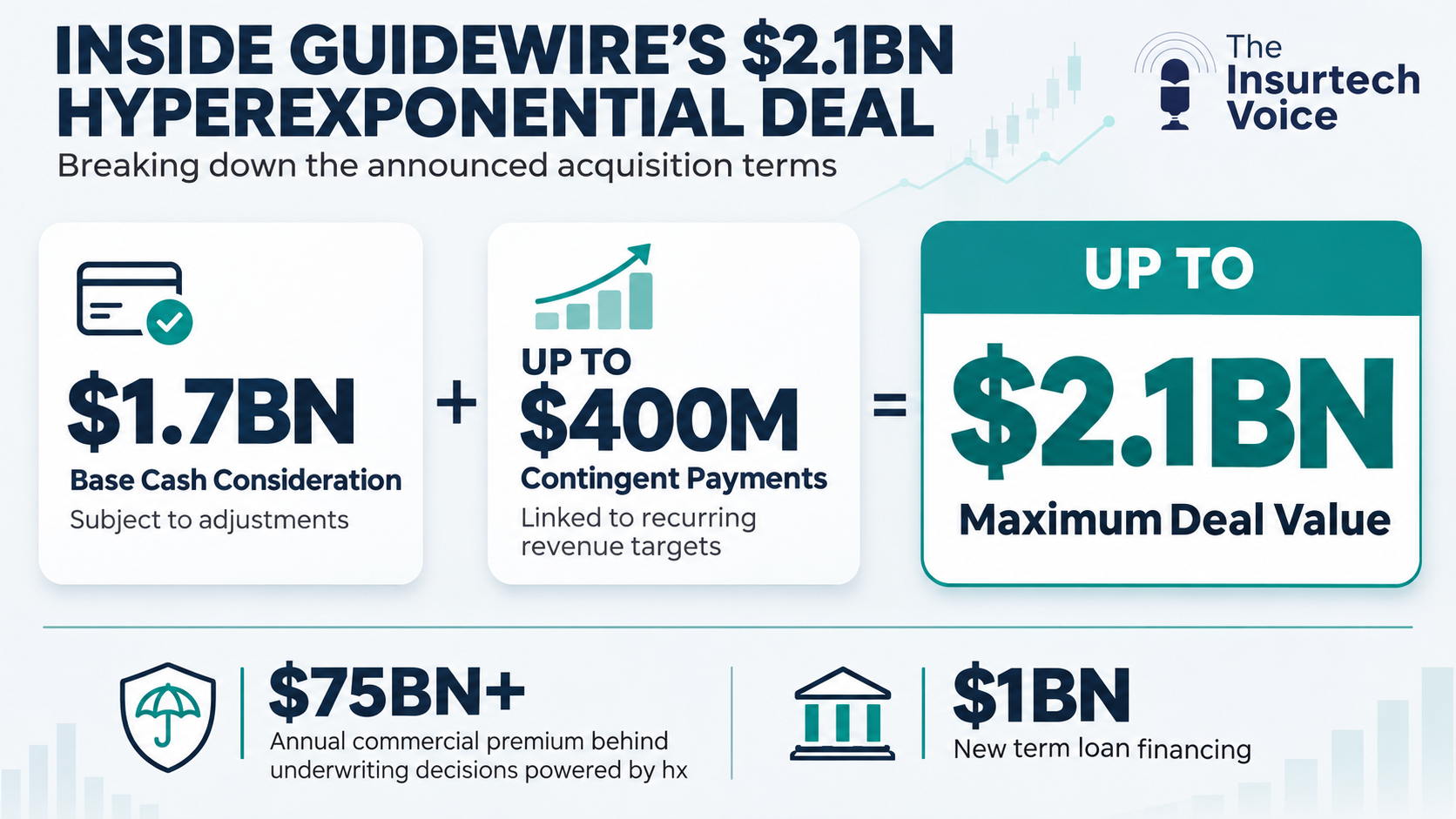
On 27 October 2026, at its Connections conference in Las Vegas, Guidewire signed a definitive agreement to buy hyperexponential, the London pricing software company known as hx. The Guidewire hyperexponential acquisition carries a base price of $1.7 billion in cash, with up to $400 million more if hx hits recurring revenue targets.
The deal has not closed yet. Guidewire expects completion in the second quarter of its fiscal year 2027. Guidewire's financial year ends on 31 July, so that quarter runs from November 2026 to January 2027.
For Indian insurers, the deal is an early look at where core systems vendors are heading, with pricing and underwriting tools built on top of the policy system.
By the Numbers
- $1.7 billion in cash upfront, subject to adjustments
- Up to $400 million in contingent payments, which Guidewire's finance chief says would be earned over three years
- $1 billion of new term loans to fund it, committed by Bank of America and Citibank, plus cash on hand
- More than $75 billion of annual commercial premium covered by underwriting decisions that hx has powered
- A boost to recurring revenue growth: at least 6.5 percentage points added to Guidewire's annual recurring revenue (ARR) growth in fiscal 2027, and at least 1.5 points to its organic growth from fiscal 2028
- $91 million in publicly disclosed funding for hx, which was founded in 2017
- Not disclosed: hx's own revenue
What hx Actually Sells
Guidewire's systems handle the transaction. The hyperexponential pricing platform handles the judgement that comes before it.
Insurers, reinsurers and managing general agents (MGAs) use hyperexponential insurance pricing tools to build pricing models, assess complex risks and steer their portfolios. Its customers include Aviva, Allianz, Sompo, Markel, HDI, Cincinnati Financial, Convex, Bowhead and Beazley, which is now part of Zurich following the Zurich–Beazley deal. Its strongest base is among commercial and specialty insurers in the UK.
The two companies already knew each other. hx was a Guidewire technology partner before the deal was signed.
Agentic Underwriting, in Plain Terms
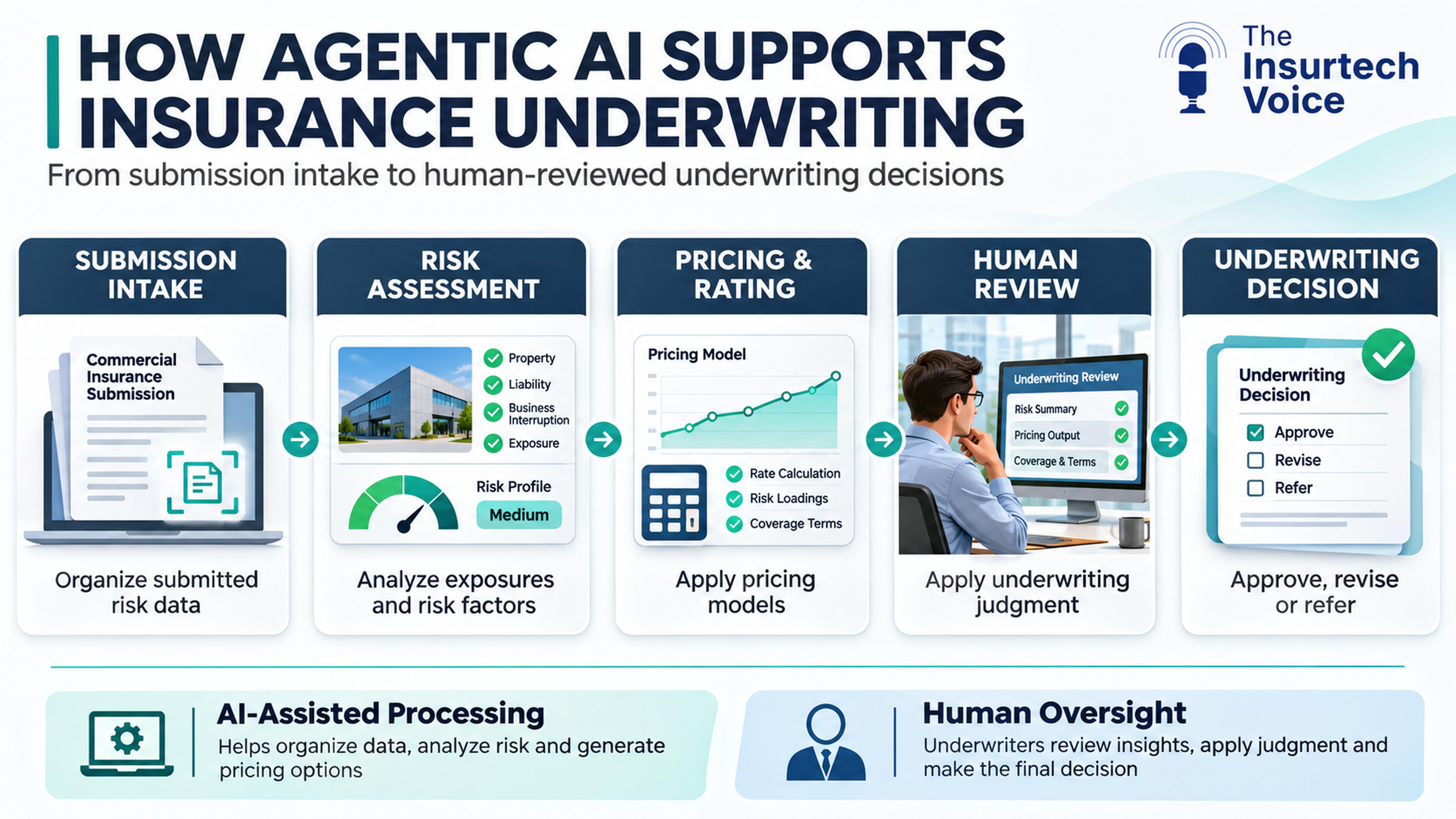
Guidewire uses "agentic underwriting" to describe AI agents working alongside underwriters and actuaries to assess risk, price it and make decisions. The promise covers everything from complex specialty risks to high-volume commercial business.
hx says its platform already covers submission triage, risk assessment, pricing, rating and portfolio steering. In practice, agentic AI in insurance underwriting could mean software working through those steps and handing a proposed decision to a human underwriter. Guidewire says this should let insurers answer more submissions, faster, while keeping prices consistent with their best underwriting judgement.
Amrit Santhirasenan, hx's co-founder and chief executive, put it in terms underwriters will recognise. He said the combined business would help insurers respond to submissions faster and, more importantly, improve loss ratios and allocate capital better.
Guidewire also pointed to Celent research citing one consulting firm's finding that AI can make complex commercial underwriting significantly more efficient and cut loss ratios by percentage points.
Part of a Pattern
This is not Guidewire's first AI purchase, and it is not the only vendor shopping.
| Date | Move |
|---|---|
| October 2025 | Guidewire agrees to buy ProNavigator, an AI knowledge assistant for insurers |
| July 2026 | Rival Duck Creek announces it has acquired Send, an underwriting platform supporting more than $26 billion of premium |
| August 2026 | Guidewire's Qusar release adds a framework for building and running AI agents on its cloud platform |
| 27 October 2026 | Guidewire agrees to buy hx for up to $2.1 billion |
| 2 November 2026 | Gore Mutual announces its ProNavigator deployment across claims and underwriting |
Read together, these moves suggest the big core systems vendors now want to own commercial insurance pricing technology as well as the systems that store the results. Guidewire told analysts it sees agentic underwriting as a market worth about $30 billion, roughly 1% of direct written premium, alongside similar-sized opportunities in core systems and agentic claims.
The ProNavigator rollout at Gore Mutual shows the other half of that strategy at work. We covered it in our report on Gore Mutual's Guidewire ProNavigator deployment.
Where Indian Insurers Fit In
No Indian insurer appears among the hx customers named by the companies. But the direction of travel is the same here. At the state-run general insurers, officials want underwriters to combine actuarial models with AI as part of the turnaround plans they must now file.
"Pricing is where an insurer's judgement turns into profit or loss, so it was always going to be the next battleground after core systems. For Indian insurers, the lesson isn't to buy an agent. It's to get pricing models and underwriting data clean enough that an agent would have something reliable to work with," said Hitul Mistry, founder of The InsurTech Voice.
What to Watch Before the Deal Closes
| When | What to watch |
|---|---|
| December 2026 | Earnings call with updated fiscal 2027 guidance, including hx |
| Before closing | Whether hx stays available to non-Guidewire insurers |
| Any time | Whether hx's revenue is disclosed |
| Nov 2026 – Jan 2027 | Expected closing window |
The second point matters most to customers. Duck Creek was clearer when it bought Send in July 2026, saying Send would stay available as a standalone engine that integrates with all core systems.
On price, Guidewire is paying $1.7 billion upfront for a business its finance chief described as slightly cash-flow positive and slightly loss-making at the operating level. Its own filing also lists the risk that the deal may not close on time, or at all.
Buyers have already shown they will pay heavily for insurance software, as the $6.1 billion buyout of claims software provider CCC Intelligent Solutions shows. Whether AI-powered underwriting solutions earn the same valuations will depend on how quickly insurers move from pilots to everyday use.
Behind the numbers: Deal terms come from Guidewire's announcement and its 8-K filing with the US Securities and Exchange Commission; the three-year earn-out and financial profile of hx come from Guidewire's investor day remarks as reported. This piece was written with AI support and reviewed by our editors against those filings. For information only, not investment advice.
Frequently asked questions
- What is the Guidewire hyperexponential acquisition?
- Guidewire has signed a definitive agreement to acquire hyperexponential (hx), a London-based provider of AI-native underwriting and pricing software for commercial property and casualty insurers. It was announced on 27 October 2026 at Guidewire's Connections conference.
- How much is Guidewire paying for hyperexponential?
- A base price of $1.7 billion in cash, subject to adjustments, plus up to $400 million in contingent payments if hx meets specified recurring revenue targets. That puts the maximum value at about $2.1 billion.
- When will the deal close?
- Guidewire expects it to close in the second quarter of its fiscal year 2027, which runs from November 2026 to January 2027. The deal is a signed agreement, not a completed acquisition, and Guidewire lists the risk that it may not close on time or at all.
- What does hyperexponential do?
- hx runs a pricing and underwriting platform for commercial and specialty insurance. Insurers, reinsurers and MGAs use it to build pricing models, assess complex risks and steer their portfolios. It has powered underwriting decisions across more than $75 billion in annual commercial premium.
- What is agentic underwriting?
- Guidewire uses the term for an approach in which AI agents work alongside underwriters and actuaries to assess risk, price it and make decisions, from complex specialty risks to high-volume commercial business.
- How will Guidewire pay for the deal?
- Through $1 billion of new term loan financing, backed by a binding commitment from Bank of America and Citibank, plus existing cash.
- Who uses hyperexponential's platform?
- Customers named by the companies include Aviva, Allianz, Sompo, Beazley, Markel, HDI, Cincinnati Financial, Convex and Bowhead.
Sources
Company filings and announcements
- US SEC, Guidewire Form 8-K, Exhibit 99.1, 27 October 2026: Guidewire Signs Definitive Agreement to Acquire hyperexponential
- US SEC, Guidewire Form 8-K, Exhibit 99.2: Investor presentation on the hyperexponential acquisition
Reporting
- TechCrunch, 27 October 2026: Guidewire buys Hyperexponential for $1.7B in cash
- Reinsurance News, 27 October 2026: Guidewire agrees $1.7bn deal for AI underwriting and pricing software firm hyperexponential
- Coverager: Guidewire to acquire hyperexponential
- Yahoo Finance: Guidewire Investor Day, AI push and hyperexponential deal
- BERI: Your hyperexponential terms are unclear after Guidewire's $1.7B buy
- PR Newswire, 7 July 2026: Duck Creek Acquires Send, Creating the Industry's Only Agentic Underwriting-to-Core Platform
- US SEC, Guidewire Form 10-K for the fiscal year ended 31 July 2025
The InsurTech Voice · An Initiative by Insurnest