

In brief: Cyber insurance claims from Indian banks are estimated to have crossed ₹150 crore in the first half of FY27, driven by ransomware and data breaches. The banking sector's claims ratio has risen 50-60% in a year. Premium rates have not followed, because reinsurance capacity remains plentiful, but brokers warn that rates, capacity or appetite could change if losses keep climbing.
Indian banks spent the last five years buying far more cyber insurance. This year, they are claiming on it far more.
Banking sector cyber insurance claims in India are estimated to have exceeded ₹150 crore so far in FY27 (April 2026 to March 2027), according to industry experts quoted by Business Standard. Five years ago, claims from banks typically ranged between ₹25 crore and ₹75 crore. Insurers are paying out more, yet the price of cover has barely moved.
A note on the numbers: The figures in this article are estimates from brokers and industry experts. Neither IRDAI nor the insurers have published official data on cyber claims by sector.
How Big Are the Banking Sector Cyber Insurance Losses?
The jump is sharp. Industry experts say the banking sector's cyber claims ratio, which compares claims with premium, has risen by 50-60% over the past year. Shikha Hassani, senior vice-president at Unilight Insurance Brokers, puts claims from the wider banking, financial services and insurance (BFSI) sector at ₹150-175 crore, nearly 50% higher than last year.
| Measure | Figure |
|---|---|
| Bank cyber claims, FY27 so far | More than ₹150 crore |
| BFSI cyber claims (Unilight estimate) | ₹150-175 crore, about 50% higher than last year |
| Typical bank claims five years ago | ₹25-75 crore |
| Change in banking claims ratio, past year | Up 50-60% |
| Total cyber insurance premium, FY26 (all sectors) | ₹900-1,100 crore |
| Typical sum insured for banks and financial institutions | $10-25 million in FY21; $50-100 million in FY26 |
Source: Business Standard, citing industry experts
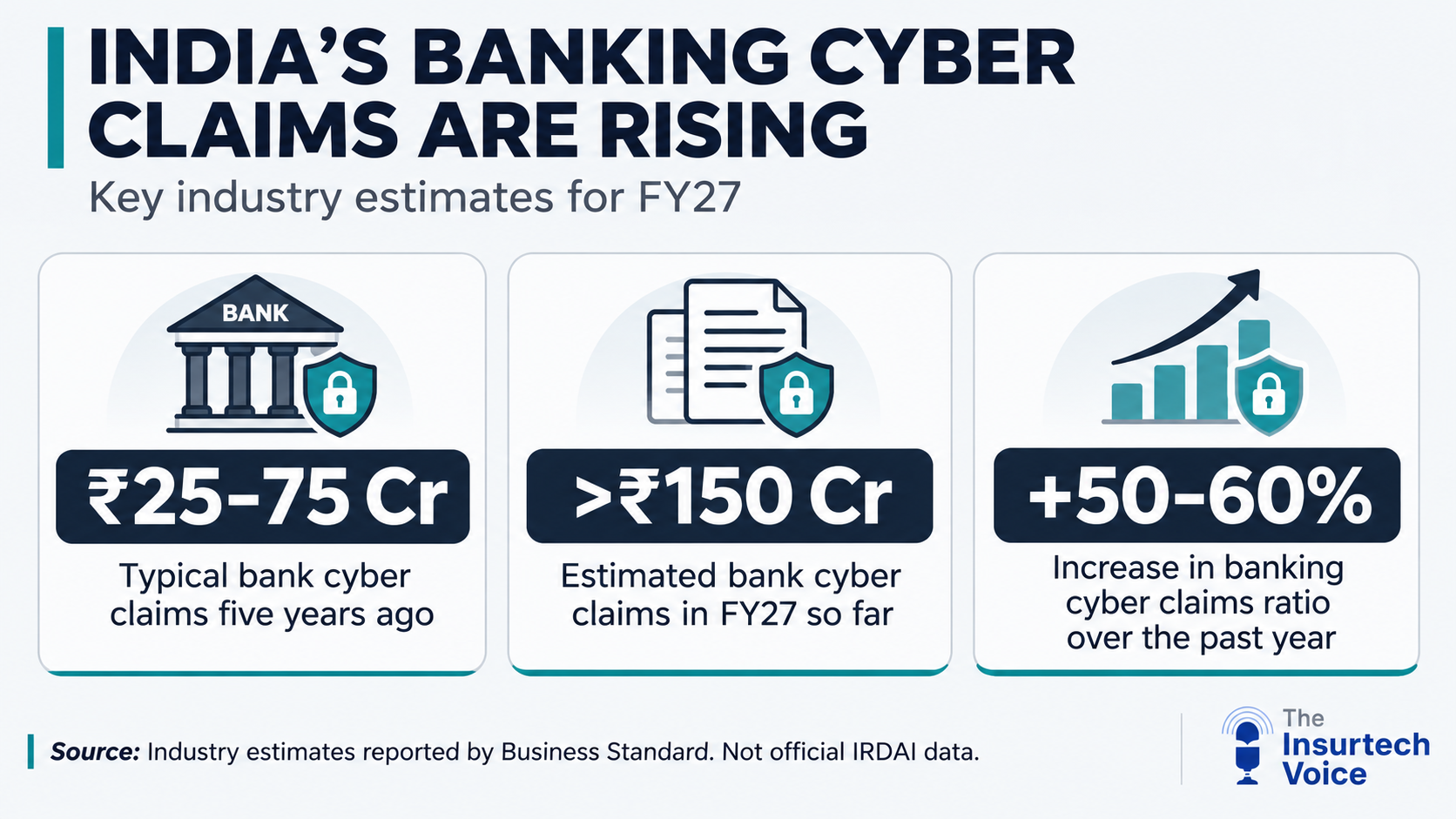
To put that in perspective, ₹150 crore of claims from one sector in half a year is roughly 14-17% of all the cyber premium the Indian market wrote across every industry in FY26 (our calculation from the estimates above).
Several banks have reported cyber incidents this year, among them State Bank of India, Central Bank of India, Bank of Baroda and AU Small Finance Bank, producing losses for insurers that write BFSI business. Industry experts say the sector had no major incidents last year, which makes this year's rise stand out even more.
Why Is the Cyber Insurance Claims Ratio in India Rising?
The cyber insurance claims surge in India is coming from two types of attack. Evaa Saiwal, business head for liability and cyber insurance at PolicyBazaar for Business, says the increase has been driven largely by ransomware and data breaches, not by business interruption losses. Both the frequency and severity of claims rose significantly in the second half of 2026, she says, and forensic costs alone can run past ₹50 lakh for each affected company.

Some of the rise reflects better visibility rather than more attacks. Hassani says greater awareness, stricter reporting requirements and stronger cyber-resilience frameworks are bringing incidents that once went unreported, or under-reported, into the claims pipeline.
Banks have been preparing for this. The typical sum insured for banks and financial institutions has risen from $10-25 million in FY21 to $50-100 million in FY26, according to industry experts, and lenders now review their cover every year, sometimes even during the policy period.
Data protection law is adding to the pressure. The Digital Personal Data Protection (DPDP) Rules were notified on 13 November 2025, and most substantive obligations under the Act, including security safeguards and breach reporting, apply from 13 May 2027. Organisations are reassessing their exposure to data-related liabilities ahead of that date, and strengthening their cover accordingly.
Why Are Cyber Insurance Premium Rates in India Still Soft?
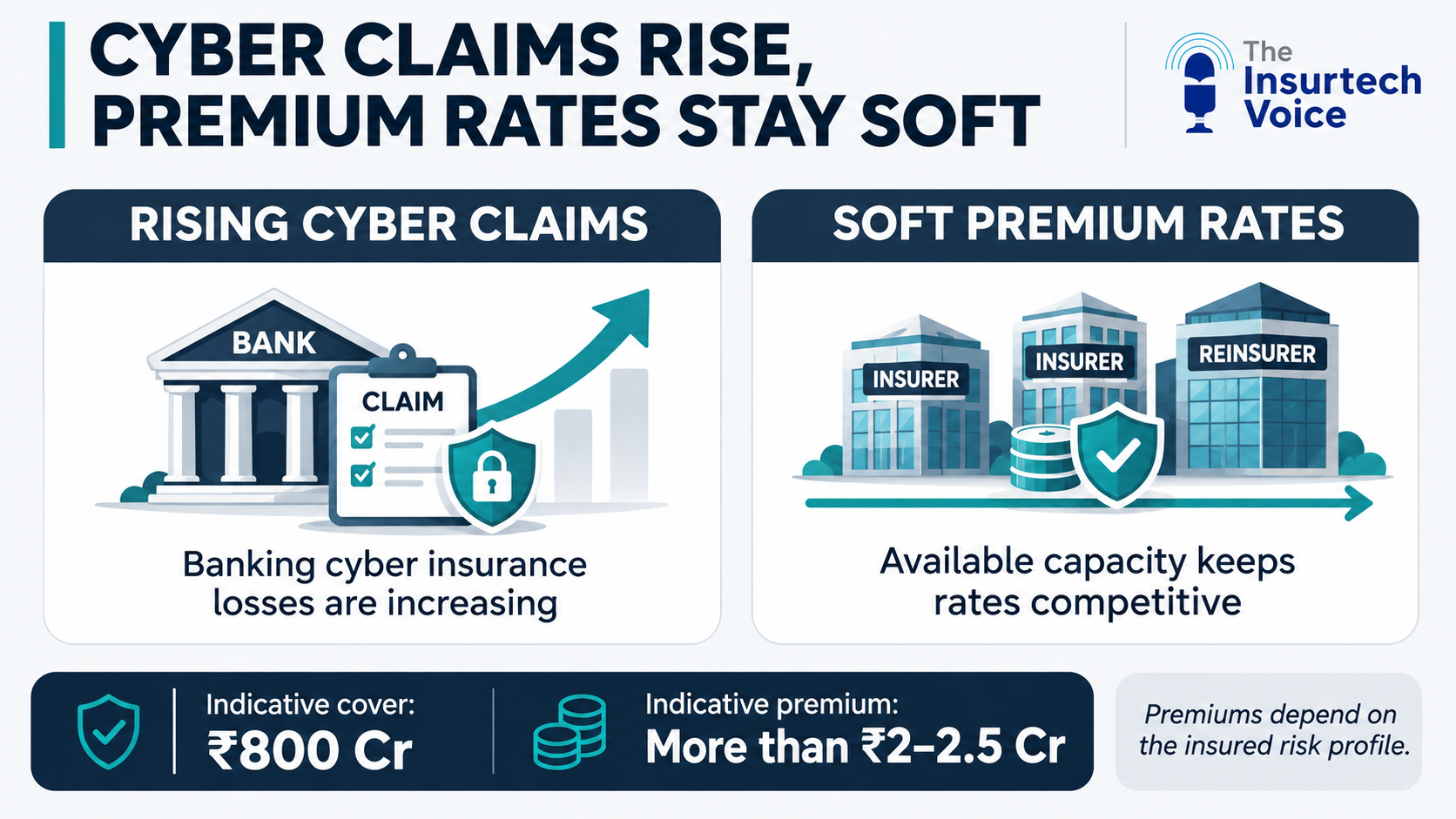
Supply has outrun the losses, at least for now. Insurers and reinsurers have expanded their capacity, helped by foreign players entering the Indian market, and that competition is keeping prices down.
Hassani gives a sense of current pricing: a cover of around ₹800 crore can attract premiums of more than ₹2-2.5 crore, depending on the risk profile. That works out to a rate on line, meaning premium as a share of the cover limit, of roughly 0.25-0.3% or slightly more (our calculation). That is low for a line where claims are climbing this quickly.
The panel of general insurance leaders at the Business Standard BFSI Insight Summit on 27 October described how this cycle usually turns. Abundant capital puts pressure on rates, while a major catastrophe can push them up by draining reinsurance capacity. That means Indian cyber pricing can depend partly on what happens to reinsurers elsewhere. Our report on Swiss Re's 2026 catastrophe loss estimate gives a sense of the losses reinsurers are absorbing this year. Consolidation at the top of the global market is another factor to watch: Zurich has completed its acquisition of Beazley, one of the largest specialist cyber insurers.
Brokers say a correction is possible. Hassani warns that if claims keep rising, insurers could raise rates, restrict underwriting capacity or temporarily pull back from some segments. Saiwal says premiums remain under pressure for now, but rising claims could eventually lead insurers to reprice as they reassess the risk.
Why Are Cyber Insurance Underwriting Risks in India Hard to Price?
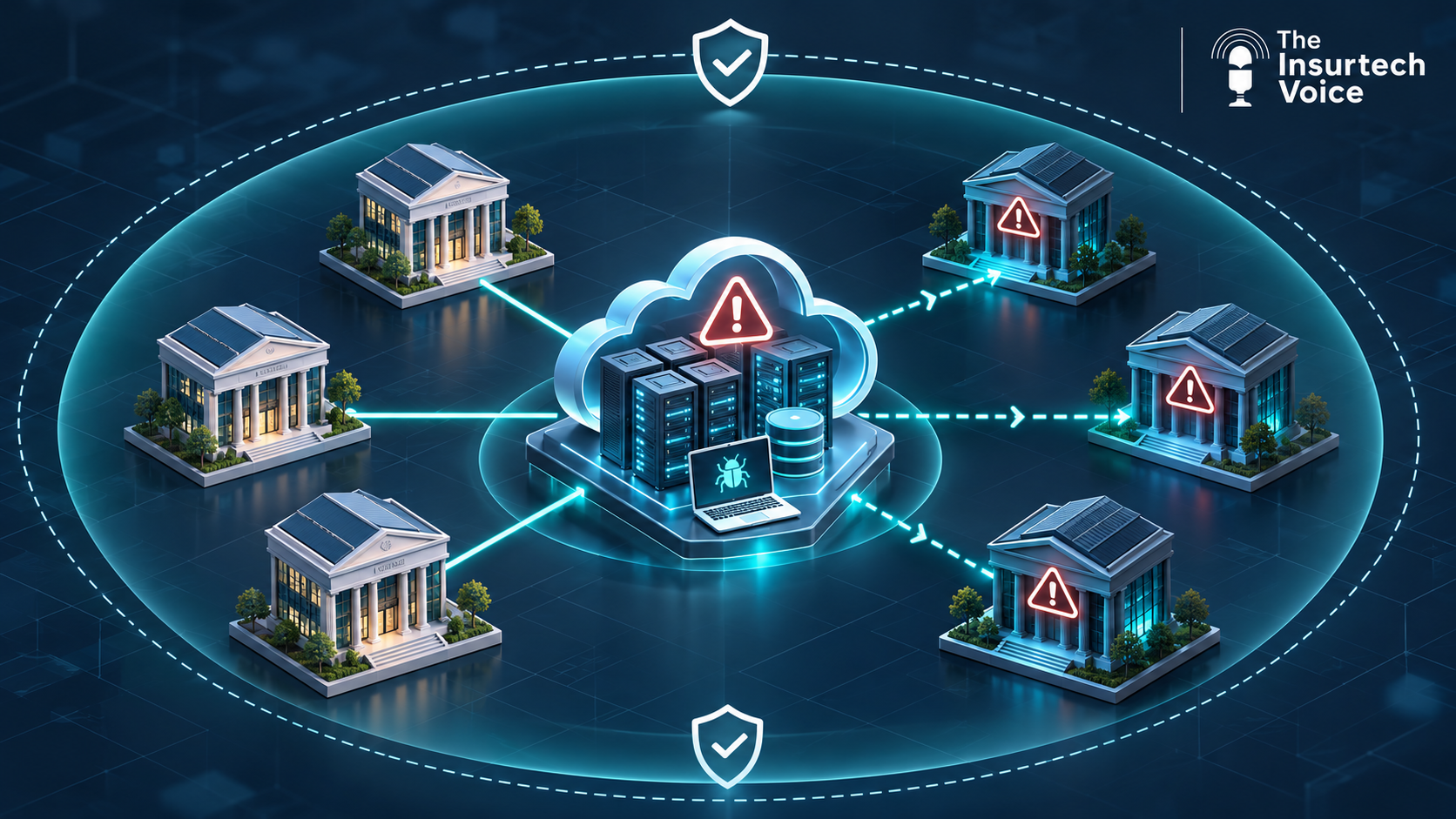
The answer most insurers give is accumulation. Unlike a fire or a flood, a cyber incident can spread through shared technology and service providers and hit many policyholders at once, across different regions. That makes it hard to estimate exposure, price policies and decide how much risk to keep.
Hitesh Joshi, chairman and managing director of GIC Re (General Insurance Corporation of India), told the summit panel that preparedness varies across insurers and depends on their enterprise risk management, risk appetite, reinsurance arrangements and ability to stress-test potential losses. He argued that insurance pools should be used where commercial solutions are not available. Panellists also said new reinsurers entering India would need to bring expertise in Indian risks, not just capital.
AI is making the job harder. It enables more sophisticated fraud, including synthetic documents. In India, the government has already asked state-run general insurers to adopt AI tools and digital inspections against fraudulent claims as part of the turnaround plans they must now file. AI also creates new questions about coverage, because existing policies may not clearly cover losses caused by AI agents that act unexpectedly or without authorisation. "Cyber risk is evolving almost on a daily basis," said Animesh Das, managing director and chief executive of Acko General Insurance, who called for real-time evaluation and human oversight as insurers adopt AI tools. How insurers word AI cover is already a live debate globally; Marsh's chief executive has warned that blanket AI exclusions risk leaving gaps in cover.
There is also a demand gap at the retail end. A study cited at the summit found that 69% of respondents wanted to buy retail cyber insurance, but only 4% had tried or bought a policy. Panellists put that down partly to products that are hard to compare and uncertainty about what the policies cover.
What Should Insurers, Brokers and Banks Watch?
Our analysis: The numbers point to a market where prices have not caught up with losses, at least not yet.
Insurers writing large bank programmes at today's rates are relying on reinsurance capacity staying cheap. Underwriting on each bank's actual security practices, which summit panellists called for, is the obvious protection, along with checking that policy wordings on ransomware, forensic costs and AI-related losses say what both sides think they say.
For banks, the advice from brokers is consistent: insurance works alongside stronger cybersecurity, not instead of it. With claims rising and the DPDP deadline in May 2027, renewal conversations are better started early, while capacity is still easy to find.
Brokers, meanwhile, have a client-education job to do. Buyers used to rising limits at flat prices may not be ready for a market that turns, and the brokers quoted here are already warning that it could.
"Banks have doubled their cyber limits in five years, but the price of that cover hasn't risen with the losses. Insurers that start underwriting on a bank's actual security controls, not just its size, will be the ones still writing this business when capacity tightens," said Hitul Mistry, founder of Insurnest.
For now, buyers still have the upper hand on price. Whether that lasts through the next renewal season will depend as much on reinsurers' appetite for cyber as on the claims coming out of Indian banks.
Editorial note: Claims and premium figures are industry estimates reported by Business Standard; IRDAI has not published official sector-wise cyber claims data. The rate-on-line and claims-to-premium comparisons are our own calculations from those estimates. Drafted with AI assistance and reviewed by The InsurTech Voice editorial team. For information only, not investment or legal advice.
Frequently asked questions
- How large are banking sector cyber insurance claims in India this year?
- Industry experts estimate that cyber insurance claims from banks crossed ₹150 crore in the first half of FY27. One broker puts claims from the wider BFSI sector at ₹150-175 crore, nearly 50% higher than last year. These are industry estimates, not official IRDAI data.
- Why are cyber insurance claims rising in India's banking sector?
- Mainly ransomware attacks and data breaches. Several banks, including State Bank of India, Central Bank of India, Bank of Baroda and AU Small Finance Bank, reported cyber incidents this year. Stricter reporting requirements are also bringing previously unreported incidents into the claims pipeline.
- How has the cyber insurance claims ratio changed in India?
- Industry experts say the claims ratio for cyber cover in the banking sector has risen by 50-60% over the past year. Five years ago, claims from banks typically ranged between ₹25 crore and ₹75 crore.
- Why are cyber insurance premium rates in India still low?
- Insurers and reinsurers have expanded capacity, including through foreign players entering the Indian market. That supply keeps rates soft. A cover of around ₹800 crore can currently attract premiums of more than ₹2-2.5 crore, depending on the risk profile.
- How big is India's cyber insurance market?
- The broader cyber insurance market is estimated to have generated ₹900-1,100 crore in premiums in FY26.
- What are the main cyber insurance underwriting risks in India?
- Accumulation is the biggest. A single cyber incident can spread through shared technology and service providers and trigger claims from many policyholders at once. AI adds new risks, including synthetic-document fraud and uncertainty over whether policies cover losses caused by AI agents acting without authorisation.
- How does the DPDP Act affect cyber insurance for banks?
- The Digital Personal Data Protection Rules were notified on 13 November 2025, and most substantive obligations, including security safeguards and breach reporting, apply from 13 May 2027. The approaching deadline is prompting organisations to reassess data-related liabilities and their cyber cover.
Sources
Reporting
- Business Standard, 1 November 2026: Cyberattacks pushing up insurance claims; premium rates stay soft: Experts
- Business Standard, 28 October 2026: AI poses new risks, makes assessment more complex: General insurers
DPDP Act timeline
- Mondaq: DPDP Act compliance for startups and MSMEs (DPDP Rules notified 13 November 2025; substantive obligations from 13 May 2027)
- ELP: Shaping India's data protection regime, DPDP Rules published
- Legal 500 (Saga Legal): The privacy timer starts now, analysing the DPDP Rules and the 18-month countdown (security safeguards and breach reporting from May 2027)
The InsurTech Voice · An Initiative by Insurnest