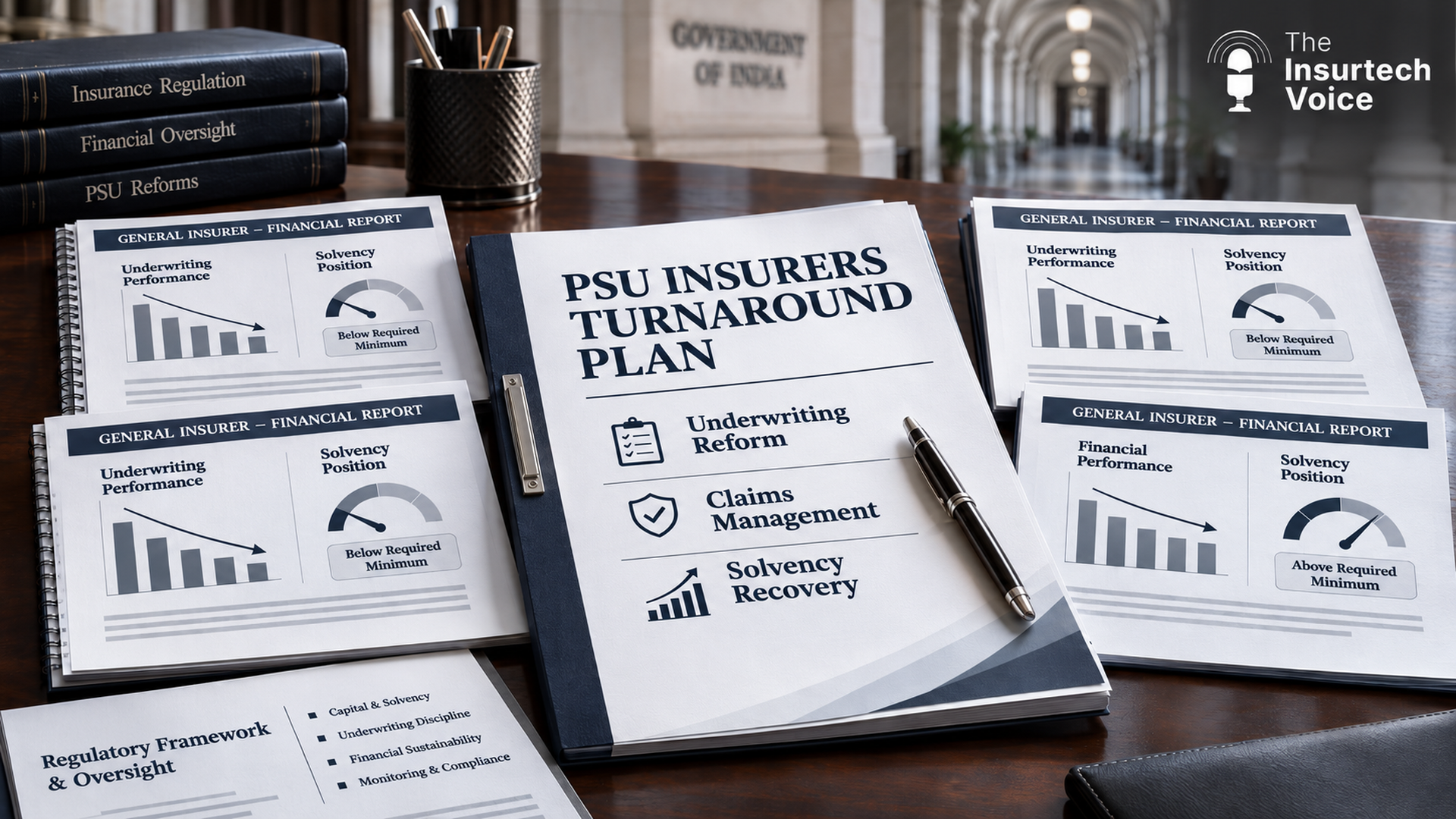
Key takeaways: India's four state-run general insurers (New India Assurance, Oriental Insurance, United India Insurance and National Insurance) must submit board-approved turnaround plans to the government. Each plan has to show how the insurer will exit unprofitable segments, tighten claims and pricing, and restore solvency. Three of the four have negative solvency ratios against a 150% requirement, and any fresh government capital will depend on measurable improvement.
India's public sector general insurers have been losing money on their core business for years, and the government has kept topping up their capital. Between FY20 and FY22 it put ₹17,450 crore into National Insurance, Oriental Insurance and United India Insurance. All three now have solvency ratios further below zero than they were before that money went in.
The Centre now wants to see a fix before it commits any more. State-run general insurers will submit board-approved plans to the government spelling out how they will scale back or exit loss-making business, people familiar with the development told The Economic Times.
The exercise covers all four members of the General Insurers' (Public Sector) Association of India (GIPSA): New India Assurance, Oriental Insurance, United India Insurance and National Insurance. New India is the surprise on that list. Until this year, it was the profitable one.
What is confirmed and what is reported: The details so far come from executives and officials speaking to the press, not from a published government order. No formal circular has been made public, and the reports do not mention a submission deadline.
What Do the Turnaround Plans Have to Cover?
Executives who spoke to The Economic Times said the government will judge the four companies against a roadmap. Its parameters include underwriting capacity, technology and organisational restructuring.
The most sensitive area is business mix. The insurers have been told to stop writing lines that lose money, and government-sponsored health schemes, where claims routinely run ahead of premium, are high on that list. One executive, who asked not to be named, said these schemes need more sensible pricing, closer oversight of claims and reinsurance that is properly structured, so that less of the risk stays on the insurers' own books.
Fraud is the second target. The government sees fraudulent claims as a major reason for the losses in motor and property insurance. It wants the insurers to bring in AI tools and digital inspections quickly, so that suspicious claims are caught before they are paid instead of showing up months later in the loss ratio.
Another executive raised a different idea: more business ties between the insurers and the public sector banks, including in retail products.
How Far Below the Solvency Requirement Are the PSU Insurers?
The solvency ratio is the regulator's measure of whether an insurer holds enough capital to meet what it owes policyholders. The Insurance Regulatory and Development Authority of India (IRDAI) sets the minimum at 150%, often written as 1.5x. The three stressed insurers are nowhere near it.
| Insurer | Solvency ratio, end-FY25 | Solvency ratio, end-FY26 |
|---|---|---|
| United India Insurance | -65% | -136% |
| National Insurance | -67% | -111% |
| Oriental Insurance | -103% | -163% |
Source: Business Standard
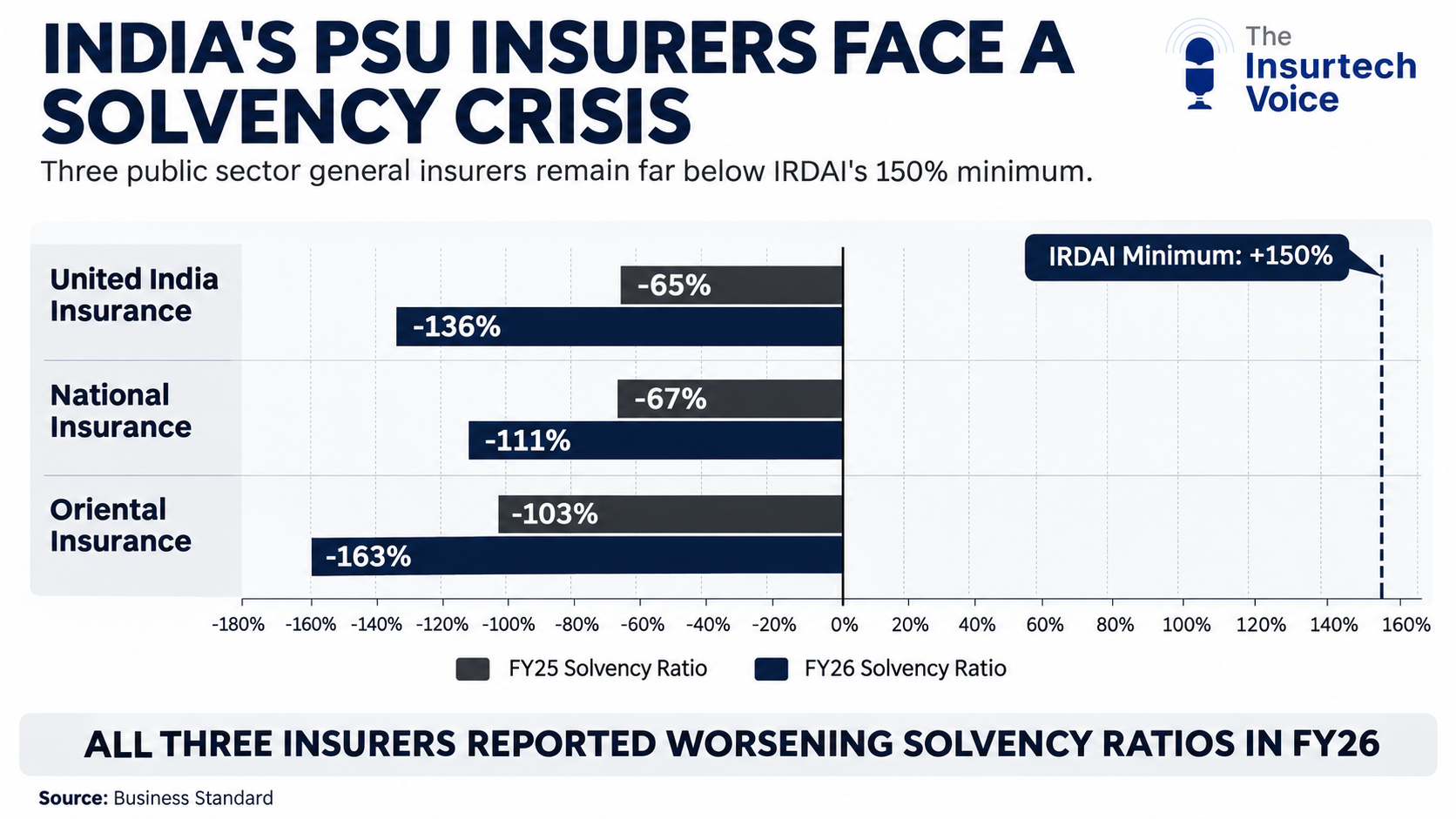
All three ratios are below zero, and all three worsened within a single year.
The Reserve Bank of India (RBI) has taken notice. Its June 2026 Financial Stability Report described the deterioration at the three insurers as a direct financial stability concern. Mint reported that the RBI found the general insurers in question below the 1.5x threshold in every quarter from Q4 FY25 to Q4 FY26, although the central bank did not name them.
Underwriting Losses Widened Sharply in FY26
PSU general insurers' underwriting losses are where the problem starts. Across the public sector multiline insurers, the combined underwriting loss rose 58.3% in FY26 (April 2025 to March 2026) to ₹29,070.57 crore.
| Insurer | FY26 underwriting loss | Year-on-year change |
|---|---|---|
| New India Assurance | ₹8,801.9 crore | +44% |
| United India Insurance | ₹8,335.7 crore | +113% |
| Oriental Insurance | ₹7,307.77 crore | +84% |
| National Insurance | ₹4,625.16 crore | about +6% |
Source: Business Standard
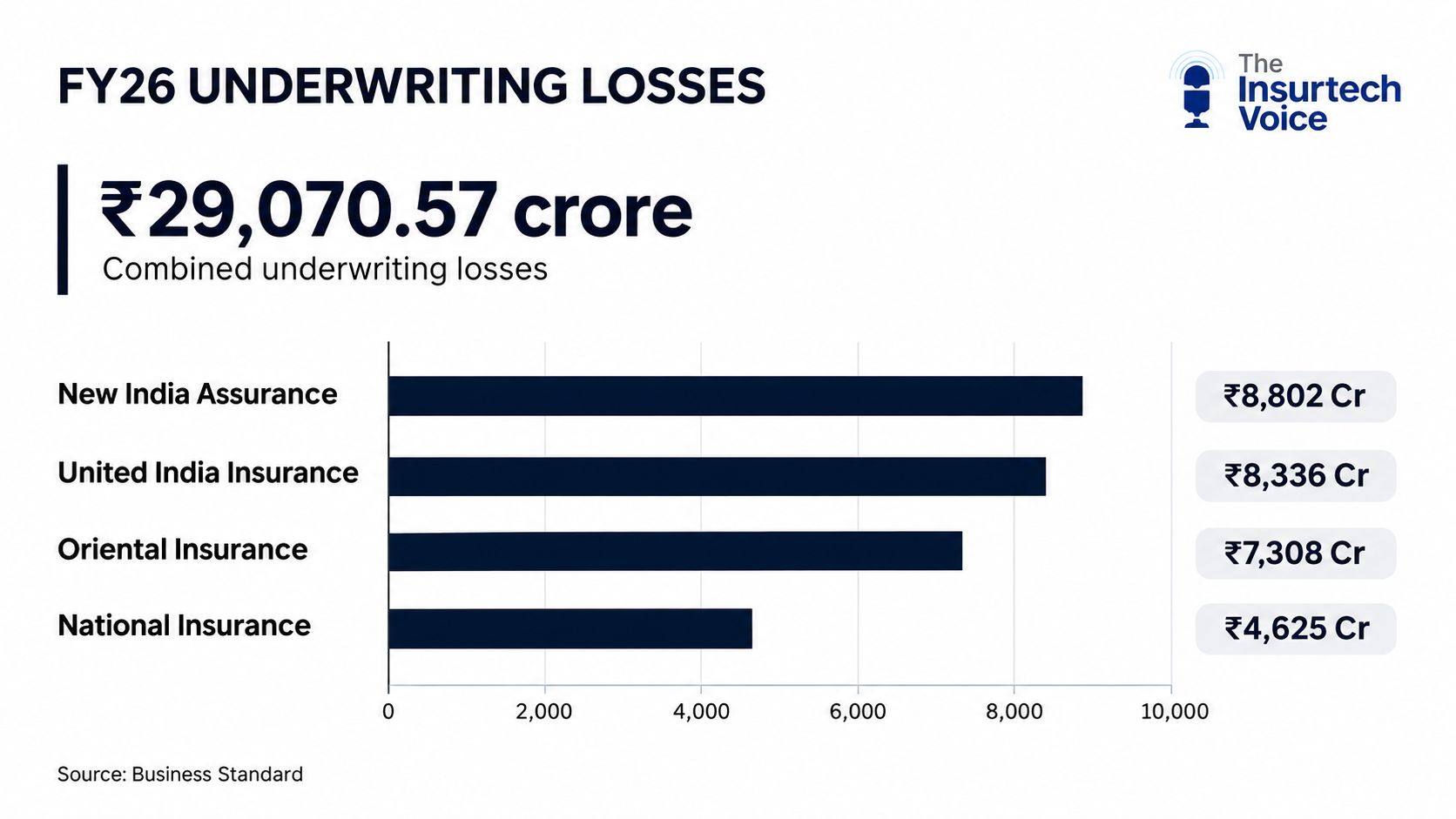
The bottom line looks no better. General Insurance Council data show the three stressed insurers lost ₹31,200.86 crore between them over five years. Losses peaked at ₹11,434.38 crore in FY26, wiping out the brief net profits Oriental and United India had posted in FY25. Their net incurred claims ratios have stayed close to or above 100% for years, which means they have been paying out roughly what they collect in premium before counting salaries, rent or commissions.
New India Assurance Is No Longer the Exception
New India, the country's largest general insurer, has long been the group's financial cushion. It earned a net profit of ₹1,384 crore in FY26 despite a large underwriting loss, because investment income covered the gap. That cushion has thinned quickly.
For the quarter ended September 2026, New India reported a standalone net loss of ₹1,267 crore, following a ₹257 crore loss in the June quarter. The September loss came even after the company booked roughly ₹1,800 crore in capital gains from selling part of its stake in the National Stock Exchange (NSE). The same quarter carried an extra ₹715 crore provision for motor third-party claims, a segment where the company had earlier pointed to the lack of a premium revision. Its solvency ratio slipped from 1.80x in June to 1.61x. That is still above the 1.5x minimum, but the cushion is shrinking.
Across all four insurers, the combined net loss for FY26 came to more than ₹10,000 crore. That is roughly the three stressed insurers' ₹11,434 crore loss, offset by New India's ₹1,384 crore profit.
Why Fresh Capital Now Comes With Conditions
The government's turnaround plan for general insurers reverses the usual order: improvement first, capital second. It builds on a strategy finalised in September 2026, which Business Standard reported links the amount and timing of any new equity for National, Oriental and United India to improvements in their performance. The strategy calls for an overhaul of underwriting, more product innovation and pay tied to performance. One official told the paper that an equity infusion would achieve little unless the underlying problems were fixed first.
The caution has a history. In July 2020, the government dropped its plan to merge the three insurers, and the Cabinet approved a ₹12,450 crore capital infusion instead, part of the ₹17,450 crore that went in between FY20 and FY22. That money bought some time but did not fix the underlying business.
Parliament has pushed in the same direction. In August, a parliamentary standing committee recommended a time-bound roadmap for these companies to reach solvency on their own, without relying on accounting adjustments or emergency capital.
The capital gap is large. Rating agency ICRA estimates that, on current trends, the three insurers could need about ₹39,000 crore by March 2027 to meet the solvency requirement. Some short-term relief may come from their investment holdings. Together the three own 90 million NSE shares and offered 14.96 million of them at ₹1,785 each in the exchange's IPO. That is a one-time gain from selling assets and does nothing for underwriting.
Oversight is getting tighter as well. Performance will be reviewed every quarter by the government and internally by the insurers themselves. Department of Financial Services (DFS) Secretary Sanjay Lohiya has asked the companies to build a standard set of key performance indicators.
Underwriting, Products and People: Where the Plans Must Deliver
Officials want the insurers to pair their traditional actuarial models with AI, so they can understand customer profiles better and reduce losses without cutting the cover they offer. Pricing risk well is a craft in itself; our founder story on an actuary who moved from calculating risk to taking it looks at what that shift demands. In crop insurance, one sector expert has suggested linking underwriting for Pradhan Mantri Fasal Bima Yojana to IoT weather data and satellite imagery.
The plans also have to show how the insurers will grow, not only what they will exit. PwC India's Amit Roy has argued that the PSUs' reach and large risk pools could let them design new products at different price points for smaller, underserved markets.
Staffing may be the hardest problem to fix. Officials describe a cycle: losses hold down pay, low pay drives people out, and new competitors arriving after the liberalisation of foreign direct investment make skilled staff harder to keep. Performance-linked incentives are on the table, but only after losses are under control.
What This Means for the Rest of the Market
If the PSUs pull back from underpriced group health, government scheme business and loss-making commercial accounts, private general insurers could gain market share. They should be careful not to take on the very risks the PSUs are trying to exit.
Brokers and corporate buyers should prepare for tougher renewals. Large accounts that relied on cheap public sector pricing may face higher rates, tighter terms or fewer insurers willing to quote. For brokers, this comes at the same time as IRDAI's proposed commission caps, which would squeeze their revenue from another direction.
Reinsurers may see more demand for properly structured programmes, particularly on government health schemes. They are likely to ask for evidence that pricing has been corrected before offering better terms. Hospitals, third-party administrators and claims partners working with the PSUs should expect closer scrutiny of bills, stricter approvals and more digital checks. Claims service is drawing the regulator's attention too: IRDAI chairman Ajay Seth has said buyers should be able to compare insurers on measures such as how quickly hospital admissions are approved, as we reported in our coverage of his comments on pricing and transparency.
For InsurTech and claims-technology providers, fraud analytics, digital inspection and AI-assisted underwriting now have explicit policy backing at India's largest state-owned insurers. Our conversation with Pranshu Diwan on why AI's biggest wins are in distribution and claims explores where that opportunity sits, and investors are already paying for this kind of efficiency elsewhere: in the US, a GTCR-led group has agreed a $6.1 billion buyout of claims software provider CCC Intelligent Solutions. Whether any of this turns into contracts here will depend on what each board signs off and how quickly public sector procurement moves.
What Should Industry Leaders Watch Now?
The PSU general insurers' turnaround plans will go through their boards before the government sees them, and the first signals will show up well before any capital decision. Four are worth tracking.
- Board approvals and filings, which will show which segments each insurer plans to cut back or exit, and how quickly.
- Government health scheme renewals. Repricing or withdrawal here would be the clearest evidence that the new discipline is real.
- Quarterly solvency ratios, to see whether the three stressed insurers stabilise and whether New India stays comfortably above 1.5x.
- Motor and property claims ratios. If the fraud controls work, these lines should improve first.
The Bigger Question
The turnaround plans now being drafted at India's state-run general insurers leave a bigger question unanswered. New India held 12.83% of India's non-life market in the first nine months of FY25, with Oriental and United India at 6.42% and 6.45%. These companies still play a large role, particularly in rural, agricultural and lower-income segments that private insurers tend to avoid.
The government's position is now clear: no more automatic bailouts, and capital only in return for proof of improvement. It is uncertain whether the boards can deliver a PSU general insurance financial recovery on the timeline ICRA's numbers imply. If they cannot, the consolidation debate that ended in 2020 is likely to return.
Editorial note: Details of the turnaround plans are based on reporting by The Economic Times and Business Standard citing officials and executives; the government has not published a formal order. Financial figures are from company disclosures, the RBI Financial Stability Report and General Insurance Council data as reported. Drafted with AI assistance and reviewed by The InsurTech Voice editorial team. For information only, not investment or regulatory advice.
Frequently asked questions
- What are the state-run general insurers' turnaround plans?
- They are board-approved plans that India's four public sector general insurers have to submit to the government. Each one must set out how the company will scale back or exit loss-making business, tighten underwriting and claims control, and rebuild its solvency.
- Which insurers have to submit turnaround plans?
- All four state-owned general insurers: New India Assurance, Oriental Insurance, United India Insurance and National Insurance. Oriental, United India and National are currently below IRDAI's solvency requirement.
- Why are PSU general insurers facing solvency issues?
- Years of underwriting losses, with claims ratios close to or above 100%, have used up their capital. At the end of FY26, United India, National and Oriental had solvency ratios of -136%, -111% and -163%, against IRDAI's minimum of 150%.
- What is a solvency ratio in insurance?
- It compares the capital an insurer actually has with the capital the regulator requires it to hold. IRDAI's minimum is 150%, often written as 1.5x. A negative ratio means the insurer's available capital buffer has been wiped out entirely.
- Will the government give more capital to PSU general insurers?
- Possibly, but not automatically. Under a strategy finalised in September 2026, the amount and timing of any fresh equity depend on measurable improvement in each insurer's performance.
- How large were PSU general insurers' underwriting losses in FY26?
- Combined underwriting losses at the public sector multiline general insurers rose 58.3% to ₹29,070.57 crore in FY26.
- Is New India Assurance also in trouble?
- It is under pressure but still solvent. It reported a standalone net loss of ₹1,267 crore for the September 2026 quarter, and its solvency ratio fell to 1.61x, which remains above IRDAI's 1.5x requirement.
Sources
Primary sources
Reporting and analysis
- The Economic Times: State-run general insurers to submit turnaround plans
- Business Standard, 24 September 2026: Govt sets riders for funds to three stressed PSU general insurers
- Mint, 3 July 2026: Insurance solvency gets RBI attention
- Business Standard, July 2020: Govt calls off merger of the three public sector general insurers
- PolicyCircle: Public sector insurers need a new business model
The InsurTech Voice · An Initiative by Insurnest