
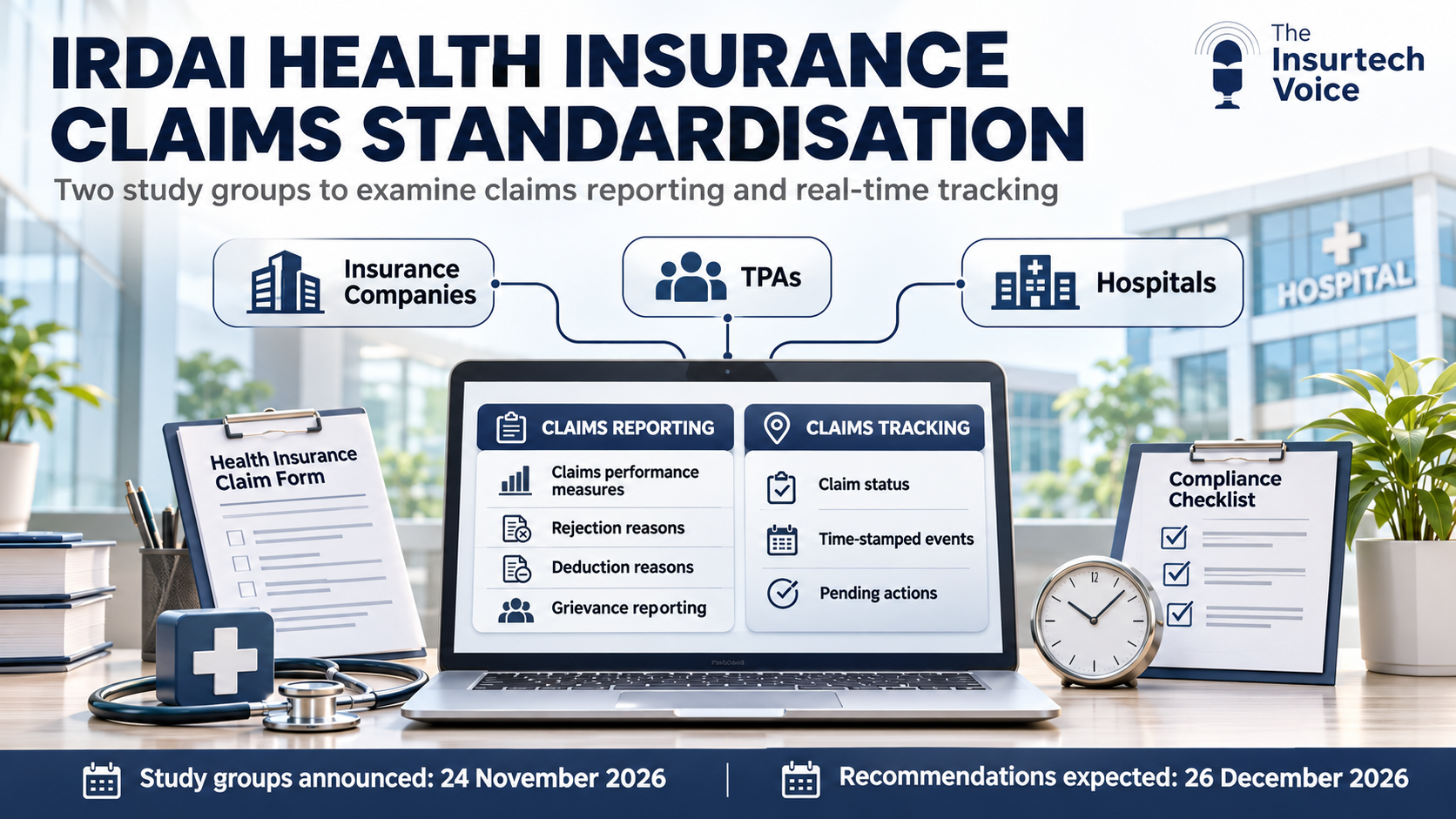
IRDAI is revisiting how health insurance claims are reported and tracked in India, more than five years after reiterating its requirements for electronic claim tracking. This time, the focus is on making claims information more consistent across insurers and giving greater visibility into what happens between the submission of a claim and its settlement.
On 24 November 2026, the Insurance Regulatory and Development Authority of India (IRDAI) announced two study groups under the Health Insurance Sub-Committee of its Insurance Advisory Committee (IAC). One will examine common claims performance measures and standardised reasons for rejections and deductions. The other will explore improvements to real-time claim tracking across insurers, third-party administrators (TPAs) and hospitals.
Both groups are expected to submit their recommendations by 26 December 2026. The announcement establishes a study initiative, not a new mandatory claims regulation.
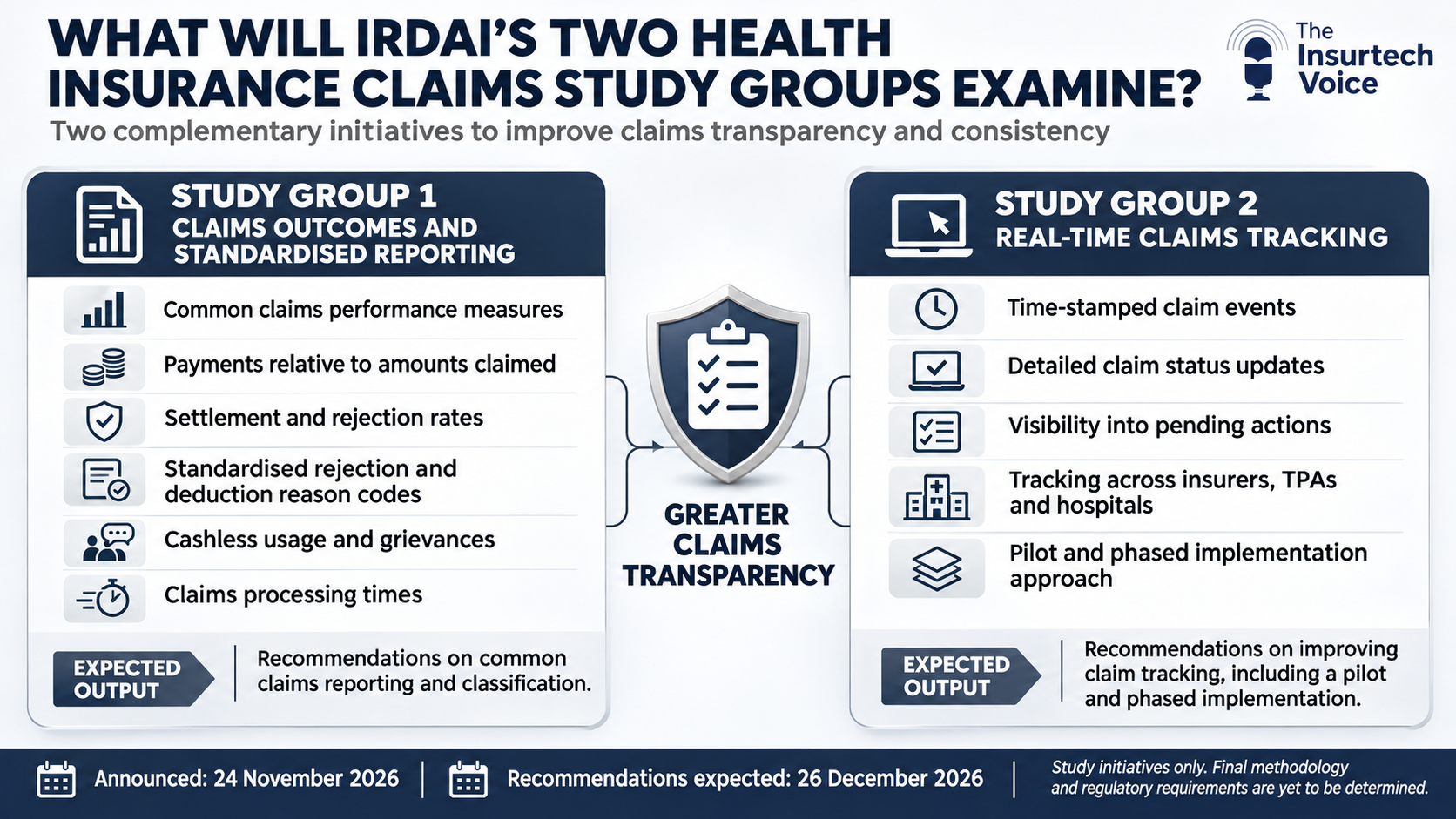
What will the two IRDAI health insurance claims study groups examine?
The first group will look at how claims outcomes are measured and reported. The second will examine how information about individual claims can be made available while they are being processed.
| Area | Study group 1 | Study group 2 |
|---|---|---|
| Focus | Claims outcomes and grievances | Real-time claim tracking |
| Scope | Common performance measures, rejection and deduction reason codes | Time-stamped claim events, status updates and pending actions |
| Expected output | Recommendations on reporting and classification | Recommendations on a pilot and phased implementation |
According to IRDAI's announcement reproduced by TaxGuru, both groups are chaired by Executive Director Dr Ayyaj Tamboli, with Chief General Manager (Health Insurance) Manoj Kumar coordinating the work. Participants include insurers, TPAs, the Insurance Information Bureau of India, the Asian Development Bank and the World Bank.
Why is IRDAI looking to standardise health insurance claims reporting?
A claim settlement rate can indicate how many claims an insurer settles, but it does not necessarily reveal how much of the claimed amount is paid. Two insurers may report similar settlement rates while recording quite different levels of deductions. That makes comparisons based on a single measure incomplete.
The first study group will examine a wider set of indicators, including payments relative to amounts claimed, settlement and rejection rates, deductions, cashless usage, grievances and processing times. The definitions and calculation methods are yet to be recommended. The focus on claims processing times follows earlier comments by IRDAI Chairman Ajay Seth, covered in our report on the health insurance BAP portal migration. That migration concerns regulatory returns and product filing, not individual claim tracking.
How could standardised claim rejection reason codes help?
Insurers and TPAs may currently use different internal descriptions for similar claim decisions. A common classification could make it easier to distinguish between reasons for full rejection and partial payment and identify recurring patterns across the industry.
For example, deductions associated with benefit limits could be reported separately from those associated with excluded expenses. This distinction matters because a deduction may arise from a legitimate policy condition rather than a problem in claims handling. Comparable data could help distinguish those issues, although the figures would still need to be interpreted alongside the underlying policy terms.
IRDAI has not yet published the proposed list of codes or the methodology for reporting them.
What could an integrated health insurance claims tracking framework look like?
The second group will examine ways to make individual claim progress more visible, including time-stamped events and information about outstanding actions. ETHealthworld's reporting also describes the proposed pilot and phased implementation approach.
A possible framework could connect the records maintained by insurers, TPAs and hospitals without requiring all participants to use the same claims management system. A shared claim reference and common definitions for claim events could help establish which records relate to the same case.
The following illustrates the information such a framework might capture at different stages.
| Claims stage | Information that could be captured |
|---|---|
| Pre-authorisation | Request submission, receipt, acknowledgement and decision |
| Document verification | Documents received, outstanding requirements and queries |
| Claims assessment | Assessment status, pending actions and responsible party |
| Approval and settlement | Approved amount, deductions, reason codes and payment status |
| Monitoring and reporting | Processing timestamps, overdue actions, performance measures and audit records |
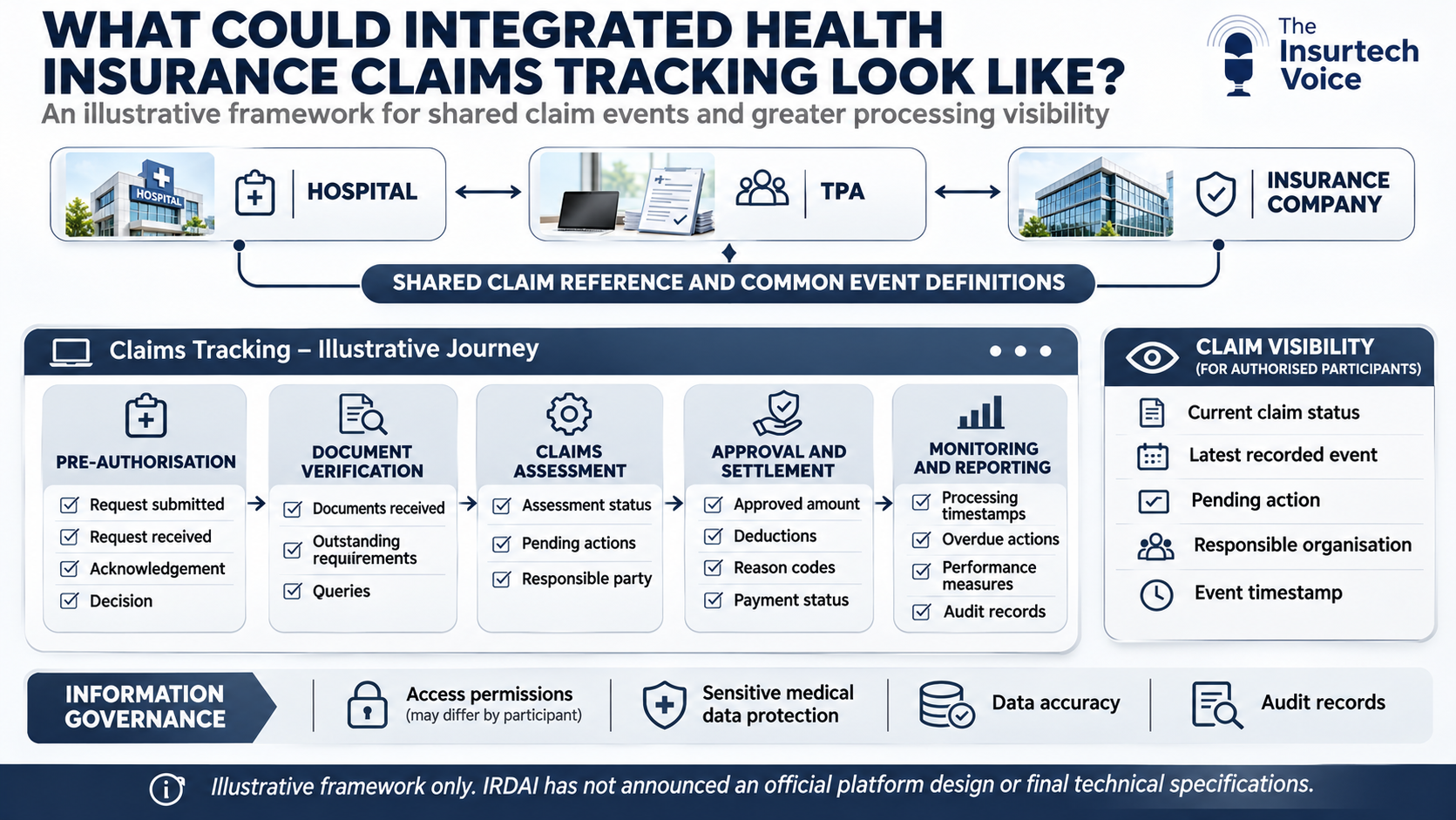
The distinction between submission and receipt is particularly important. A hospital may record a cashless request as submitted while the TPA has yet to acknowledge it. Both systems can show different statuses without either necessarily being wrong. Recording these as separate events could make it easier to establish where the request is held up.
Such an exchange would also raise questions about data accuracy, access permissions and the protection of sensitive medical information. Greater visibility into a claim does not require every participant to see every document associated with it. The importance of protecting sensitive insurance records is also illustrated by the recent IBM and Axis Max Life data protection partnership, a separate initiative focused on database security.
This is an illustrative framework, not an official IRDAI platform design. The regulator has not announced a centralised platform, final technical specifications or a mandatory feature list.
Is electronic health insurance claim tracking new in India?
No. The November 2026 initiative builds on earlier regulatory requirements rather than introducing electronic claim tracking for the first time.
| Date | Regulatory development |
|---|---|
| April 2019 | Earlier electronic claim tracking instructions, referenced in the 2021 circular |
| 19 March 2021 | IRDAI reiterated electronic tracking requirements and addressed reasons for denial and disallowed amounts |
| 29 May 2024 | Master Circular introduced specified cashless and discharge authorisation timelines and addressed adverse claim decisions |
| 24 November 2026 | Two study groups announced to examine more consistent reporting and detailed claim tracking |
The Health Insurance Claims Settlement circular of 19 March 2021, reference IRDAI/HLT/CIR/MISC/053/03/2021, also allowed insurers to delegate operation of electronic tracking systems to TPAs.
Under the Master Circular on Health Insurance Business issued on 29 May 2024, decisions on cashless authorisation requests are to be made within one hour, with final discharge authorisation within three hours of the hospital's request. The circular also addresses review of repudiations and explanations of adverse decisions with reference to policy terms.
The distinction in 2026 is the emphasis on consistent measures and more detailed visibility across organisations, not simply the availability of an online claim status.
What could these changes mean for the insurance industry?
If common reporting measures are adopted, comparisons between insurers could extend beyond the number of claims settled. The amount paid relative to the amount claimed, the distribution of deduction reasons and the time spent at individual processing stages could provide a fuller picture of claims outcomes.
For insurers and TPAs, consistent classifications could also make it easier to reconcile records and understand recurring disputes. Hospitals are part of the picture because document submissions, responses to queries and discharge requests originate outside insurer systems. Whether the framework can distinguish these events reliably will influence how useful the resulting data is.
These developments come as insurance accounts for a growing share of healthcare financing, as discussed in our analysis of health insurance expenditure in India in 2023-24.
What happens next?
The two groups are expected to report by 26 December 2026. The tracking group is also expected to recommend a pilot involving selected insurers, TPAs and hospitals before wider implementation.
The final reporting methodology, reason codes, technical arrangements and implementation dates remain undecided. Any new regulatory obligations would depend on IRDAI's subsequent decisions. Until then, the existing claims requirements remain relevant. The study also fits into the regulator’s wider review of insurance practices, which includes planned changes to claims management and grievance redressal discussed in our coverage of IRDAI’s insurance commission reforms.
The recommendations will offer a clearer indication of how far the industry can move from separate claim-status records towards comparable claims outcomes and a more consistent account of how individual claims are processed.
Frequently asked questions
- What is IRDAI's health insurance claims standardisation initiative?
- Announced on 24 November 2026, the initiative involves two study groups examining common claims and grievance metrics, standardised reasons for adverse claim decisions and real-time claim tracking.
- What will the two health insurance claims study groups examine?
- The first will examine common reporting measures and reason codes. The second will recommend ways to improve visibility into claim progress and an implementation plan.
- When are the study groups expected to submit their reports?
- Both groups are expected to report to IRDAI by 26 December 2026. This is a recommendation deadline, not a mandatory implementation date.
- What are health insurance claim rejection reason codes?
- They are structured identifiers used to classify why a claim or part of a claim was not accepted. The proposed common framework would help insurers report decisions consistently. The final codes have not been announced.
- Is electronic health insurance claim tracking new in India?
- No. IRDAI's circular of 19 March 2021 reiterated electronic claim tracking instructions dating back to 2019. The 2026 initiative examines more consistent and detailed visibility across the industry.
- Will standardised codes guarantee that health insurance claims are paid?
- No. Standardised reasons could improve transparency, but claim admissibility depends on policy terms and applicable regulatory requirements.
- Who is involved in the proposed claims tracking pilot?
- The second group is expected to recommend a pilot involving selected insurers, third-party administrators and hospitals. Participants and launch dates have not been announced in the material reviewed.
- Are the November 2026 health insurance claims proposals mandatory?
- No. The announcement establishes study groups. Any new implementation obligations will depend on subsequent regulatory decisions.
Sources
Regulatory documents and announcement
- IRDAI press release of 24 November 2026, reproduced by TaxGuru, published 25 November 2026.
- IRDAI: Health Insurance Claims Settlement, 19 March 2021, original circular hosted by Simpliance.
- IRDAI: Master Circular on Health Insurance Business, 29 May 2024, original circular hosted by the Institute of Actuaries of India.
Supporting reporting
- ETHealthworld: IRDAI Moves to Make Health Claims More Transparent, Enable Real-time Tracking, 25 November 2026.
Editorial note: This article uses regulatory documents and reporting with AI-assisted research and drafting. The proposed platform capabilities and operational implications are illustrative analysis. This article is informational and is not legal or individual insurance advice.
The InsurTech Voice · An Initiative by Insurnest