
Key takeaways: IRDAI's public consultation on insurance commission and expense reforms closed on 31 October 2026, and the regulator is now reviewing more than 650 responses from insurers, brokers, banks, NBFCs and agents. The draft includes product-wise commission caps, a 2% cap on single-premium credit life and lower expense-of-management limits. Nothing is final yet, and no start date has been confirmed, although 1 January and 1 April 2027 have been mentioned.
The comment window has shut, and the regulator now has a large pile of submissions to work through. The Insurance Regulatory and Development Authority of India (IRDAI) is set to review more than 650 responses on its insurance commission reforms before deciding what the final rules look like and when they start.
The volume of feedback reflects how much is at stake. The draft, published on 23 September under the title Recalibrating Economics of Insurance Distribution, would bring back hard commission caps for the first time since 2023 and shrink the share of premium insurers can spend on running their business. If it goes through as written, almost everyone who sells insurance in India, from tied agents to banks, brokers and lenders, would be paid differently.
Where things stand (IRDAI insurance commission reforms update, 2 November 2026): These are proposals, not regulations. IRDAI has not published final rules, and it has not said how long its review will take.
How Did the IRDAI Insurance Commission Consultation Unfold?
IRDAI released the paper with a 25 October deadline. Brokers asked for more time almost immediately. The Insurance Brokers Association of India (IBAI) filed its first formal response on 29 September and wanted the window kept open until the end of December. In mid-October, IRDAI chairman Ajay Seth made no such promise and asked stakeholders to stick to the existing date.
The responses kept coming. On 24 October, with more than 650 comments already received, IRDAI pushed the deadline to 31 October, citing significant interest and the need for wider participation. Brokers got an extra week, not the two months they had asked for.
IRDAI has not yet published a final tally. The 650-plus figure is what it disclosed when it announced the extension, so the actual number of submissions is likely to be higher.
| Date | Milestone |
|---|---|
| 23 September 2026 | IRDAI publishes the consultation paper |
| 29 September 2026 | IBAI files its first formal response |
| Mid-October 2026 | Seth asks stakeholders to keep to the deadline |
| 24 October 2026 | Deadline extended after 650+ comments |
| 31 October 2026 | Consultation closes |
| 1 January or 1 April 2027 | Possible start dates mentioned by Seth (not confirmed) |
What Is IRDAI Reviewing?
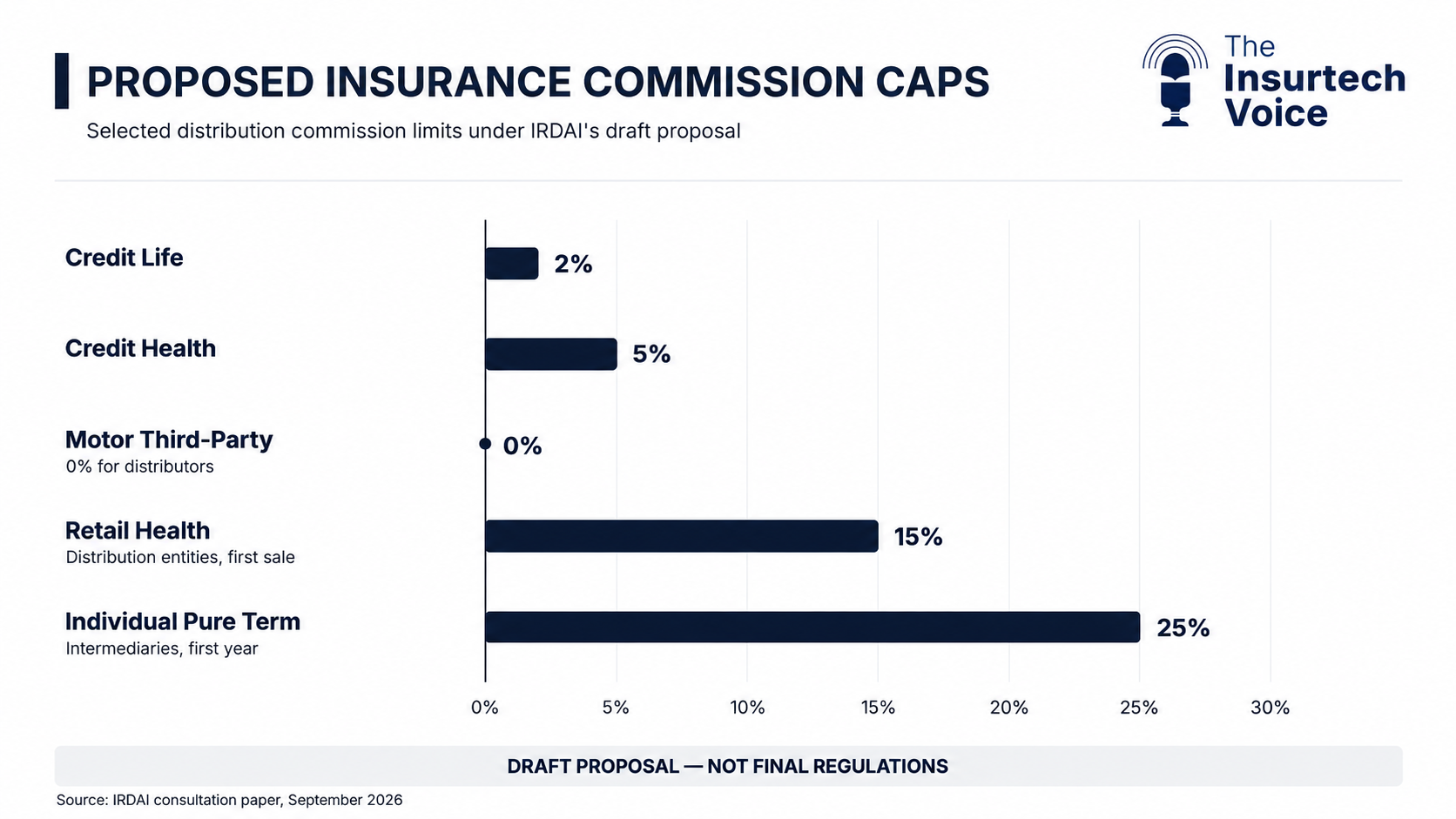
We covered the full draft in our explainer on IRDAI's proposed commission rules. In short, the regulator wants to replace today's flexible system, where insurers can pay distributors what they like as long as total expenses stay within an overall cap, with separate commission limits for each product and sales channel.
| Product or line | Proposed cap |
|---|---|
| Single-premium credit life (sold with loans) | 2% |
| Credit health | 5% |
| Motor third-party | Nil for distributors; 2.5% for agents |
| Retail health, first sale | 15% for distribution entities; 20% for agents |
| Individual pure term, first year | 25% for intermediaries; 30% for agents |
| Single-premium savings products | About 1-2% |
All figures are draft proposals and could change.
The expense side matters just as much. Life insurers would have to bring company-level expenses of management (EoM) down to 15% of gross direct premium within two years and 12.5% within five. For general insurers, the limit would fall from 30% to 20% over five years, measured on domestic premium only.
The paper also sets out new rules on how insurance is sold, including a ban on making insurance a compulsory condition of a loan and commission clawbacks where mis-selling is proven; see our explainer for the full list.
Why Did the Draft Draw So Much Industry Feedback?
Insurance industry feedback on commission reforms has been heavy for a simple reason: IRDAI's own numbers. The regulator says that after commission caps were removed in 2023, distribution costs grew much faster than the business. Between 2022-23 and 2024-25, life insurers' payouts to corporate agents rose 125% while premiums grew 28%. In general insurance, broker commissions climbed 173% against premium growth of 37%.
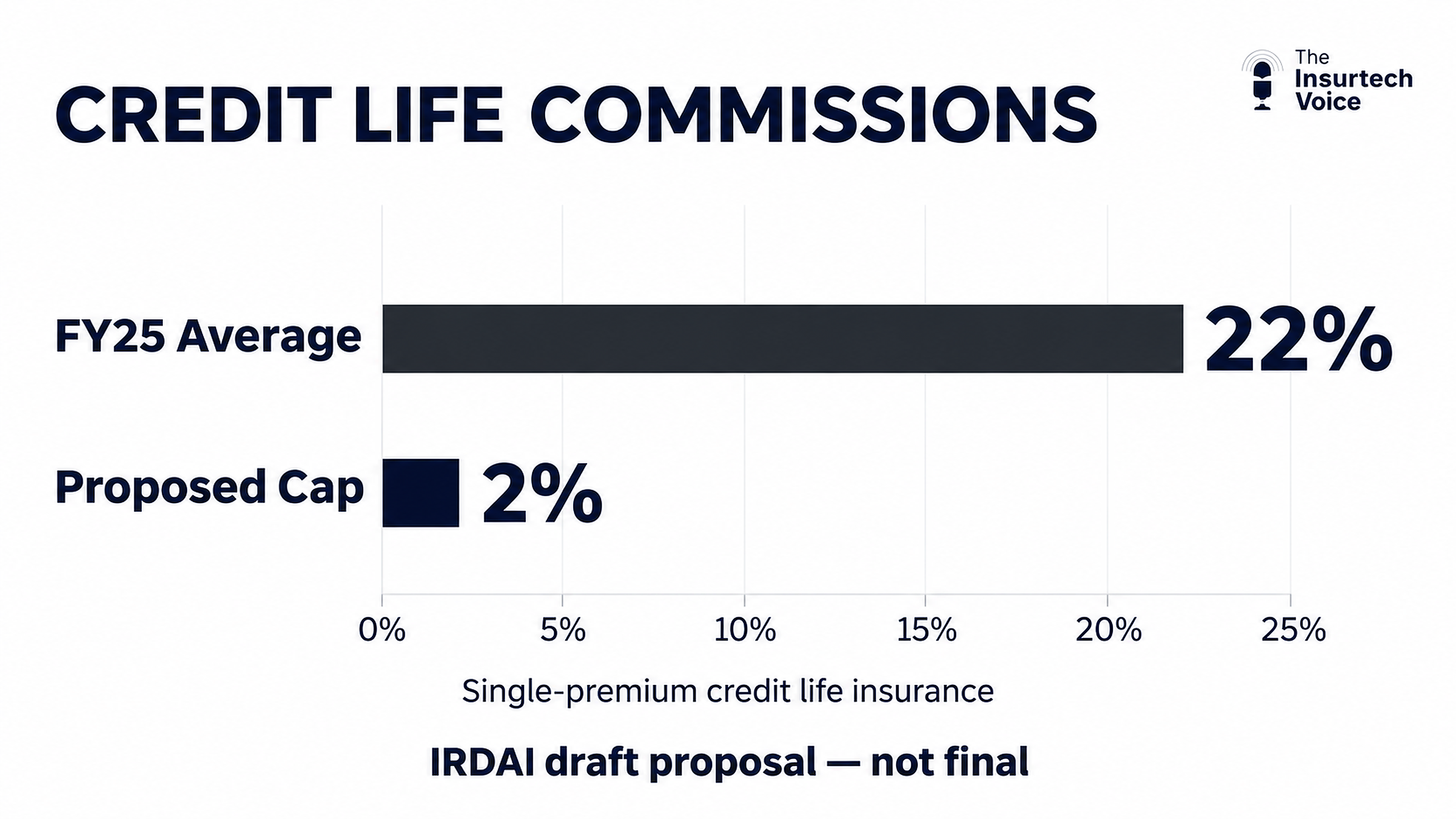
Credit life is the sharpest example. Credit life cover pays off a borrower's outstanding loan if they die during the loan term, and it is usually sold alongside the loan. According to the paper, commissions on single-premium credit life averaged 22% in FY25, while effective payouts on group credit life sold through NBFCs had risen to around 45%. A 2% cap would cut that income by more than 90%.
The regulator also points to what customers get in return. Surrenders and withdrawals made up 39% of life insurance benefits paid in FY26, up from 32% in FY22, and were higher than maturity payouts. IRDAI uses the figures to argue that policyholders are not getting enough value from what they are sold.
What Has the Industry Told IRDAI?
The IRDAI insurance commission feedback is far from uniform. Each part of the distribution chain is arguing about the part of the draft that hurts it most.
Brokers: Keep the 2023 Framework
IBAI represents 798 licensed brokers who place about 40% of India's general insurance premium. It has warned that the proposals could put at least one million livelihoods at risk over five years, and reports suggest intermediaries could lose 60-70% of their revenue under the draft caps.
Its requests are specific. IBAI wants the 2023 framework kept until its scheduled review in 2028, any caps limited to credit-linked and low-choice sales, commercial and large risks exempted, and an impact assessment published before final rules are drafted. IBAI vice president S Mohan summed up the brokers' case to ANI: "Insurance is sold, not bought over the counter."
IRDAI has not accepted the job-loss argument. Its whole-time member for distribution, Girija Subramanian, has said wider distribution could create work rather than remove it.
NBFCs: A Five-Year Glide Path
The Finance Industry Development Council (FIDC), which represents NBFCs, made its case in a 24 October submission. It argues the proposed 2% cap on credit life and 5% on credit health does not reflect what it costs lenders to sell these policies. By FIDC's own cost model, distribution works out to about 32% of premium once acquisition, branches, technology, compliance, servicing and the credit risk of financing premiums are counted.
Instead of an immediate cut, FIDC has proposed that NBFCs bring commissions down from the current 45-49% to about 25% over five years, matching the glide path IRDAI has given insurers on expenses. It has warned that a sudden cut could push lenders out of insurance distribution, weakening reach in rural and semi-urban India.
Banks: Counting the Fee Hit
Banks are among the largest insurance distributors and promoters of several insurers, so they have been working out what the draft would cost them. RBL Bank has estimated its bancassurance income could fall 50-60% if the norms are implemented as drafted. Central Bank of India expects its bancassurance fees to drop by a third, from ₹76 crore to ₹49 crore.
For the sector as a whole, the hit looks manageable but not trivial. Analysts at IIFL Capital estimate bancassurance contributes nearly 10% of banks' fee income and around 3% of profit after tax, from an income pool of about $2.2 billion that has grown 28% a year over the past three years.
Life Insurers: Cautious, Not Combative
Insurers have been more measured in public. ICICI Life, for which credit life makes up roughly a third of the protection business, acknowledged on its October earnings call that the paper proposes a fairly significant cut, but it stopped short of opposing it and said it was too early to estimate the impact. The company did push back on one point: it says its credit life cover is sold with customer consent and is voluntary, whereas IRDAI's paper describes such cover as near mandatory in practice.
The RBI: Comments on the Way
The banking regulator is also weighing in. Reserve Bank of India (RBI) Governor Sanjay Malhotra said in October that the RBI will submit its own comments to IRDAI. He noted that the draft is open to feedback from industry and consumer groups, and that IRDAI will decide in the interest of both.
What Happens Next in IRDAI's Review of Insurance Commission Proposals?
IRDAI's next step is to work through the submissions and then publish final regulations. Seth has said the regulator will review all feedback carefully before deciding when the new rules take effect. He has mentioned 1 January and 1 April 2027 as possible start dates, but neither has been confirmed. Some reports point to April 2027.
Three things will show how far IRDAI has listened. The first is whether the caps move, especially on credit life, where lenders have pushed back hardest. The second is the length of any transition period. Seth has signalled openness to one, but has said it would be limited so the reform cannot be postponed indefinitely. The third is whether smaller players and low-value policies get relief, which Seth has said were among the most common requests in his meetings with the industry.
Seth has also asked stakeholders to back their recommendations with the business case behind them and to explain how their suggestions would benefit policyholders.
Commissions are only the beginning. Seth has described this review as phase one, with reforms to claims management, grievance redressal and product regulation expected next financial year.
What Should Insurers, Brokers and Banks Do While IRDAI Decides?
Our analysis: The comment window is closed, so the useful work now is preparing for a range of outcomes rather than arguing the draft.
Insurers should plan for two scenarios: the caps largely as drafted, and caps eased on credit life with a longer transition. If the rules start on 1 January, there will be little time to renegotiate distribution contracts, so it makes sense to know now which ones would need to change. For general insurers, the expense cut lands at a difficult moment for some. The state-run insurers, for example, are already being asked to file turnaround plans to cut losses and restore solvency.
Brokers made their case for keeping the 2023 framework. If IRDAI does not accept it, the question becomes which services clients will still pay for. Our founder story on a broker-founder who rebuilt the economics of insurance advice is a useful reference point.
Banks and NBFCs should look at product mix and at how credit-linked insurance is offered. IRDAI's paper describes credit cover as near mandatory in practice, while insurers such as ICICI Life say it is sold with customer consent. Whatever happens to the caps, lenders that can show clear consent records will be in a stronger position.
Digital platforms and InsurTechs may gain if market infrastructure institutions such as Bima Sugam are formally recognised as a distribution channel. The regulator is also scrutinising how insurance is sold online, as Seth's concerns about insurance quotes that ask for a phone number first show.
India Is Not Alone
Regulators across Asia are moving in the same direction. Hong Kong's Insurance Authority capped first-year commission on long-term participating policies at 70% from 1 January 2026. The Monetary Authority of Singapore updated its Balanced Scorecard framework in December 2025, linking part of adviser pay to measures other than sales.
The common thread is a shift away from rewarding distributors for volume and towards rewarding them for suitability and service. India's final rules will show how far IRDAI is willing to go, and how much of the 650-plus responses it has taken on board.
Editorial note: This article is based on IRDAI's consultation paper and press release, and on reporting by Business Standard, Insurance Business, Elets BFSI, Mint, Reuters and The Economic Times. Industry figures are estimates made by the organisations quoted. Drafted with AI assistance and reviewed by The InsurTech Voice editorial team. For information only, not legal, regulatory or investment advice.
Frequently asked questions
- Why is IRDAI reviewing more than 650 responses on insurance commissions?
- IRDAI asked for public comments on its consultation paper, Recalibrating Economics of Insurance Distribution, which proposes new commission caps and lower expense limits. By the time it extended the deadline, it had received more than 650 responses. It must review them before issuing final regulations.
- When did the IRDAI insurance commission consultation close?
- On 31 October 2026. The original deadline was 25 October, but IRDAI extended it by a week on 24 October, citing significant interest and the need for wider participation.
- Are IRDAI's commission reforms final?
- No. They are proposals. IRDAI has not issued final regulations, and the caps, expense limits and timelines could change after it reviews the feedback.
- When will the new commission rules take effect?
- No date has been confirmed. IRDAI chairman Ajay Seth has mentioned 1 January or 1 April 2027 as possible start dates, depending on the feedback received.
- What is the proposed commission cap on credit life insurance?
- The draft proposes capping commission on single-premium credit life cover sold with loans at 2%, and credit health at 5%. According to the paper, single-premium credit life commissions averaged 22% in FY25, while effective payouts on group credit life sold through NBFCs had risen to around 45%.
- What has the insurance industry said in its feedback?
- Brokers want the 2023 framework kept until its 2028 review and warn of a 60-70% revenue hit. NBFCs have asked for a five-year glide path to 25% on credit-linked insurance. Banks such as RBL Bank have estimated steep falls in bancassurance income, and the RBI has said it will send its own comments.
- Will customers pay less for insurance if the caps go through?
- That is IRDAI's stated aim. The regulator says lower distribution and management costs should make general insurance more affordable and improve returns on life savings products. How much of that reaches customers will depend on the final rules and how insurers price their products.
Sources
Primary sources
- IRDAI press release, 23 September 2026: Recalibrating Economics of Insurance Distribution
- IRDAI consultation paper: Recalibrating Economics of Insurance Distribution
Reporting and analysis
- The Economic Times: Irdai to weigh 650 responses on insurance commissions
- Business Standard, 25 October 2026: Irdai extends feedback window for proposed insurance distribution reforms
- Business Standard, 23 September 2026: Irdai proposes tighter expense limits, new commission caps for insurers
- Insurance Business, 27 October 2026: Indian brokers face 60%-70% revenue hit under proposed commission caps
- Elets BFSI, 26 October 2026: NBFCs seek five-year glide path as IRDAI weighs insurance commission caps
- Business Standard, 18 October 2026: Banks weigh income impact of Irdai's proposed insurance commission caps
- Business Standard, 7 October 2026: RBI to firm up views on Irdai's proposed insurance commission overhaul
- Mint via TradingView, 13 October 2026: ICICI Life defends credit cover as Irdai weighs steep commission cut
- Indian Opinion, summarising The Economic Times and Business Standard: Banks assess hit from Irdai's proposed insurance commission caps
- Reuters, 15 October 2026: India insurance regulator to oversee smooth transition to new commission rules
- The InsurTech Voice, 21 October 2026: IRDAI chairman promises an orderly shift on commission rules
The InsurTech Voice · An Initiative by Insurnest