
Key takeaways: From 2 November 2026, insurers in India must generate UINs for new and modified health insurance products only through the Health Product Module of IRDAI's Business Analytics Platform (BAP). Health regulatory returns, including FY 2024-25, FY 2025-26 and RET 197 for the first half of FY 2026-27, also move to the portal. The circular is dated 30 October 2026 and applies to all insurers except reinsurers, foreign reinsurer branches, AIC and ECGC.
Until last week, health insurers in India generated product UINs under a process the regulator had set out in an email. From today, 2 November 2026, every new health product, and every change to an existing one, has to get its Unique Identification Number (UIN) through a single regulatory portal.
The Insurance Regulatory and Development Authority of India (IRDAI) announced the change in a circular dated 30 October, reference IRDAI/HLT/CIR/MISC/141/10/2026, issued by the regulator's Chief General Manager (Health). Under the IRDAI health insurance BAP portal migration, both health regulatory returns and health product filing move onto IRDAI's upgraded Business Analytics Platform (BAP), the system the regulator already uses to collect data from insurers.
Where things stand: This is a final circular, not a draft or consultation. The Health Product Module requirement took effect on 2 November 2026, three days after the circular was dated.
What Does the IRDAI BAP Portal Circular 2026 Change?
IRDAI says it has upgraded BAP to give insurers one integrated platform for regulatory reporting and health product work. The functions for filing health returns, generating UINs for new health products and modifying existing ones have all been built into a Health module on BAP. The circular sets out two parts to the change.
IRDAI Health Regulatory Returns Move to the Health Module
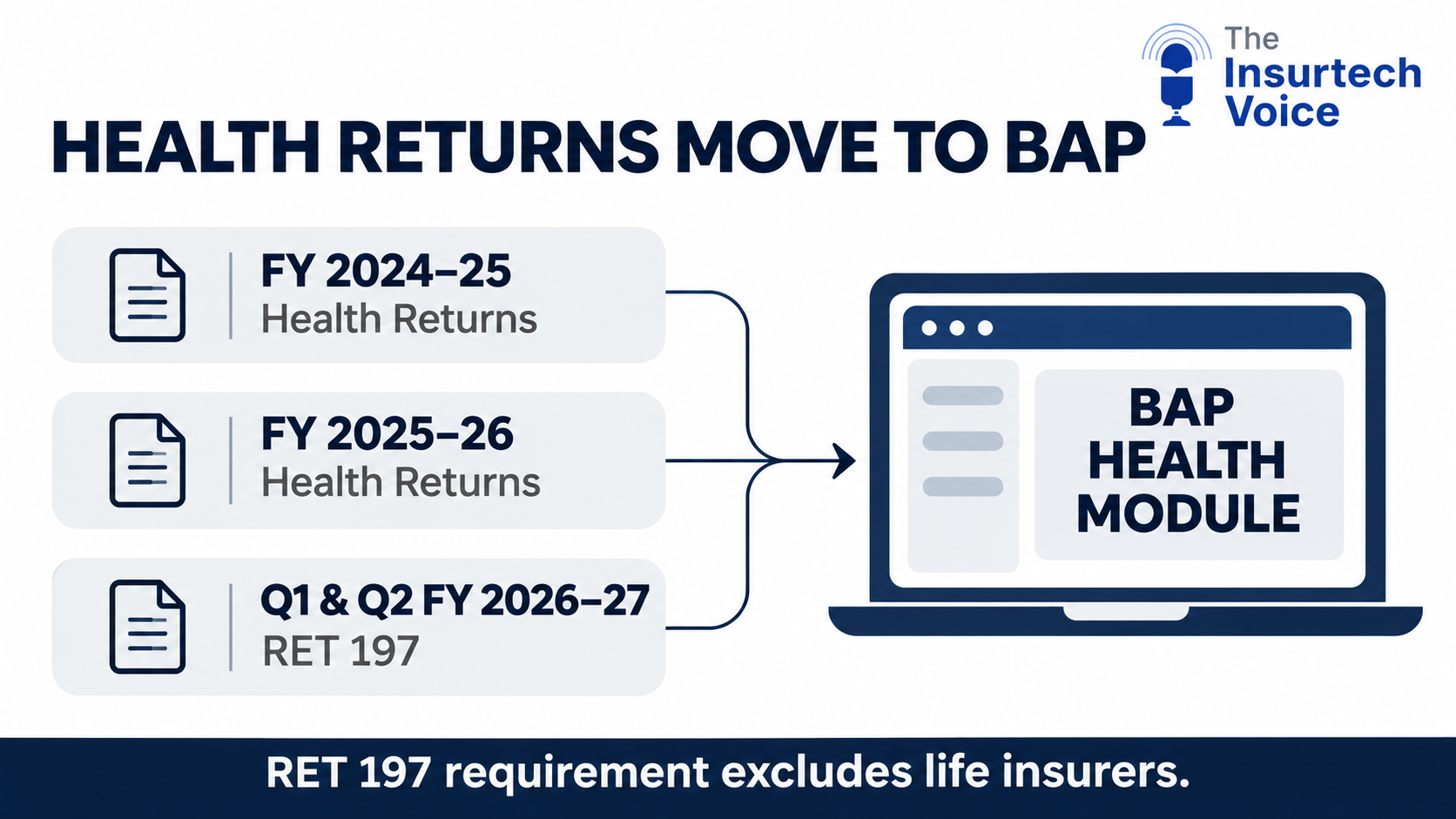
All concerned insurers must now submit their IRDAI health regulatory returns through the Health module of BAP. The circular lists four sets: the health returns for FY 2024-25 and FY 2025-26, RET 197 for the first and second quarters of FY 2026-27 (not required from life insurers), and returns for every later period at the frequency already prescribed.
The circular refers to RET 197 by number only and does not describe its contents. Two of the four sets cover financial years that have already closed. The circular does not set a separate deadline for them; insurers will need to check the operational guidelines on the portal for submission timelines.
IRDAI Health Product UIN Generation Goes Through One Module
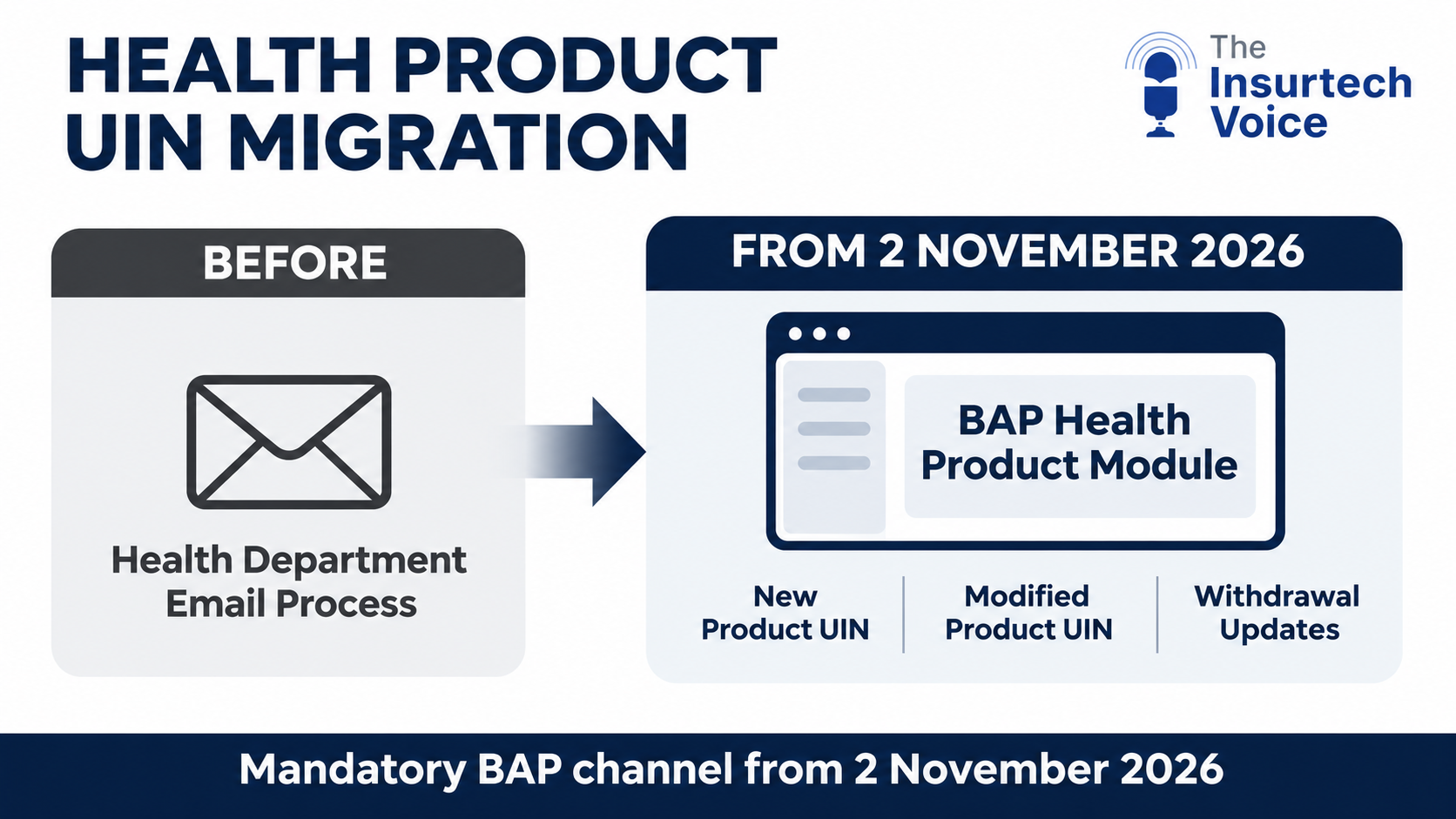
The bigger operational change is on the product side. With effect from 2 November 2026, insurers must use the IRDAI Health Product Module of the BAP portal, and nothing else, to generate UINs for new health products and for changes to existing ones. Product withdrawals are reported through the same module.
A UIN is the unique identification number IRDAI assigns to each insurance product. Until now, health UINs were generated under a process the IRDAI Health Department set out in an email dated 10 June 2024. The circular states that the email no longer applies.
| What moves | Where it goes | From when |
|---|---|---|
| Health returns for FY 2024-25 and FY 2025-26 | BAP Health module | Now available on the portal |
| RET 197, Q1 and Q2 FY 2026-27 (not life insurers) | BAP Health module | Now available on the portal |
| Health returns for later periods | BAP Health module | At the prescribed frequency |
| UINs for new and modified health products | BAP Health Product Module only | 2 November 2026 |
| Health product withdrawal updates | BAP Health Product Module only | 2 November 2026 |
Source: IRDAI circular IRDAI/HLT/CIR/MISC/141/10/2026
Which Insurers Does It Apply To?
The circular is addressed to all insurers apart from four groups: reinsurers, foreign reinsurer branches (FRBs), the Agriculture Insurance Company of India (AIC) and the Export Credit Guarantee Corporation of India (ECGC). That brings in standalone health insurers and general insurers writing health business. Life insurers are covered too, with one stated exception: they do not have to file RET 197 for the first two quarters of FY 2026-27.
Which returns and product filings each insurer actually makes will depend on its business. The circular refers throughout to "concerned insurers" and leaves the detail to the operational guidelines, which IRDAI says are available on the BAP portal for all users.
Why Is IRDAI Moving Health Insurance Regulatory Reporting to the BAP Portal?
BAP is the platform through which IRDAI collects data from insurers. It was designed as a business analytics system to support supervision, track industry trends and assess insurers on a risk basis. Moving health insurance regulatory reporting onto the BAP portal puts health data in the same structured system as the rest of that supervisory information.
Health is not the first line of business to make the move. On 28 August 2026, IRDAI issued a circular (IRDAI/REINS/CIR/MISC/114/08/2026) migrating reinsurance regulatory returns and related functions to the upgraded BAP. That shift covered reinsurance returns from FY 2024-25, corporate governance returns from FY 2025-26, pool administrator returns and final reinsurance programme summaries from FY 2026-27, along with File Reference Number applications for cross-border reinsurers and approvals for the appointment and pay of reinsurer chiefs.
The groundwork goes back further. IRDAI's Master Circular on Submission of Returns, issued on 14 June 2024, consolidated 202 regulatory returns into one reference document and already allowed business statistics for health to be filed through BAP or by email. The October circular removes that choice for health and makes BAP the only route.
It follows the same playbook IRDAI used for reinsurance in August; health is simply next in line.
What Should Health Insurers Do Now?
Our analysis: The first job is on the product side. Anyone with a health filing in progress under the old email process before 2 November should find out where it stands. The circular doesn't say how pending applications are handled, and it is better to ask IRDAI's Health Department than to guess. Launch plans for the next few months should also leave room for teams to get used to the new module.
Compliance teams have a backlog to deal with: two full years of health returns, plus RET 197 for the first half of this year, now going into a portal that may expect a different format from the email files it replaces. The operational guidelines on the portal will set the timelines.
There is a quieter point for data teams. Once returns sit side by side in one structured system, mismatches between them become easier for the regulator to spot, so the quality of the internal data behind each return matters more than it did when files went by email. Our founder story on why data and AI matter most in insurance distribution and claims looks at the same issue from inside an insurer.
What Comes Next?
The circular itself changes the process, not the product rules. But IRDAI has more planned for health. Chairman Ajay Seth has said that reforms to claims management, grievance redressal and product regulation are expected next financial year, after the current review of more than 650 responses on insurance commission reforms. Whatever changes come out of that work, health product filings will now run through BAP.
The regulator has also shown interest in making insurer performance easier to compare. Speaking at the Business Standard BFSI Insight Summit in late October, Seth said conventional claim settlement ratios do not show how quickly insurers approve hospital admissions and discharges, and that improving access to such information will be a regulatory priority. We covered his wider remarks in our report on his comments about insurance pricing. Structured health data on one platform is the kind of foundation that comparison would need, although IRDAI has not linked the BAP migration to any such plan.
The first real test comes over the next few weeks, as product teams make their first UIN requests through the new module and compliance teams work through the backlog.
Editorial note: This article is based on the text of IRDAI circular IRDAI/HLT/CIR/MISC/141/10/2026 dated 30 October 2026, IRDAI's 28 August 2026 reinsurance circular, and reporting by The Insurance Reporter, TaxGuru, Insurance Business and Business Standard. Drafted with AI assistance and reviewed by The InsurTech Voice editorial team. For information only, not legal or regulatory advice.
Frequently asked questions
- What is the IRDAI health insurance BAP portal migration?
- It is IRDAI's move of health regulatory returns and health product UIN generation onto its upgraded Business Analytics Platform (BAP). It was announced in a circular dated 30 October 2026, reference IRDAI/HLT/CIR/MISC/141/10/2026.
- From when must health product UINs be generated through the BAP portal?
- From 2 November 2026. From that date, UINs for new health insurance products and for modifications to existing ones must be generated exclusively through the Health Product Module of the BAP portal. Updates on product withdrawals also go through the module.
- Which insurers does the circular apply to?
- All insurers except reinsurers, foreign reinsurer branches (FRBs), the Agriculture Insurance Company of India (AIC) and the Export Credit Guarantee Corporation of India (ECGC).
- Which health regulatory returns must be filed through BAP?
- Health regulatory returns for FY 2024-25 and FY 2025-26, the RET 197 return for the first and second quarters of FY 2026-27 (life insurers excepted), and all returns for later periods at the prescribed frequency.
- What is a UIN in health insurance?
- A UIN, or Unique Identification Number, is the identifier IRDAI assigns to each insurance product. From 2 November 2026, UINs for new and modified health products are generated through the Health Product Module of the BAP portal.
- What happens to the earlier email process for health UINs?
- It no longer applies. The circular states that the IRDAI Health Department's email communication of 10 June 2024 on UIN generation for health products has ceased to be applicable.
- What happens to health UIN applications made by email before 2 November?
- The circular does not say. Insurers with applications in progress under the old email process should confirm the position with IRDAI's Health Department.
- Does the circular change health insurance product rules?
- No. It changes the channel through which insurers file returns and generate UINs, not the rules products must meet. Operational guidelines for both modules are available on the BAP portal.
Sources
Primary sources
- IRDAI circular IRDAI/HLT/CIR/MISC/141/10/2026, 30 October 2026: Migration of Health Regulatory Returns and Health Product UIN Generation to the Integrated Business Analytics Platform (BAP)
- IRDAI circular IRDAI/REINS/CIR/MISC/114/08/2026, 28 August 2026: Migration of Reinsurance Regulatory Returns and Other Reinsurance Functionalities to the Integrated BAP (as published by TaxGuru)
Reporting and analysis
- The Insurance Reporter, 31 October 2026: IRDAI moves health regulatory returns, product UIN generation to BAP portal
- TaxGuru, 30 October 2026: IRDAI migrates health regulatory returns and product UIN generation to integrated BAP portal
- TeamLease RegTech, 1 September 2026: IRDAI migration of reinsurance regulatory returns to integrated BAP
- Insurance Business, 27 October 2026: Indian brokers face 60%-70% revenue hit under proposed commission caps (Seth on next year's reforms)
- Business Standard, 28 October 2026: Insurance must grow 1.5-2x faster than GDP, says Irdai chief Ajay Seth
The InsurTech Voice · An Initiative by Insurnest