
Key takeaways
- Insurers want IRDAI scale based EoM limits, so insurers of different sizes are not all held to the same cap on expenses of management (EoM), the share of premium spent on commissions and running costs.
- They are also asking for phased insurance commission cuts, a glide path for EoM limits and a rethink of rules on group credit life.
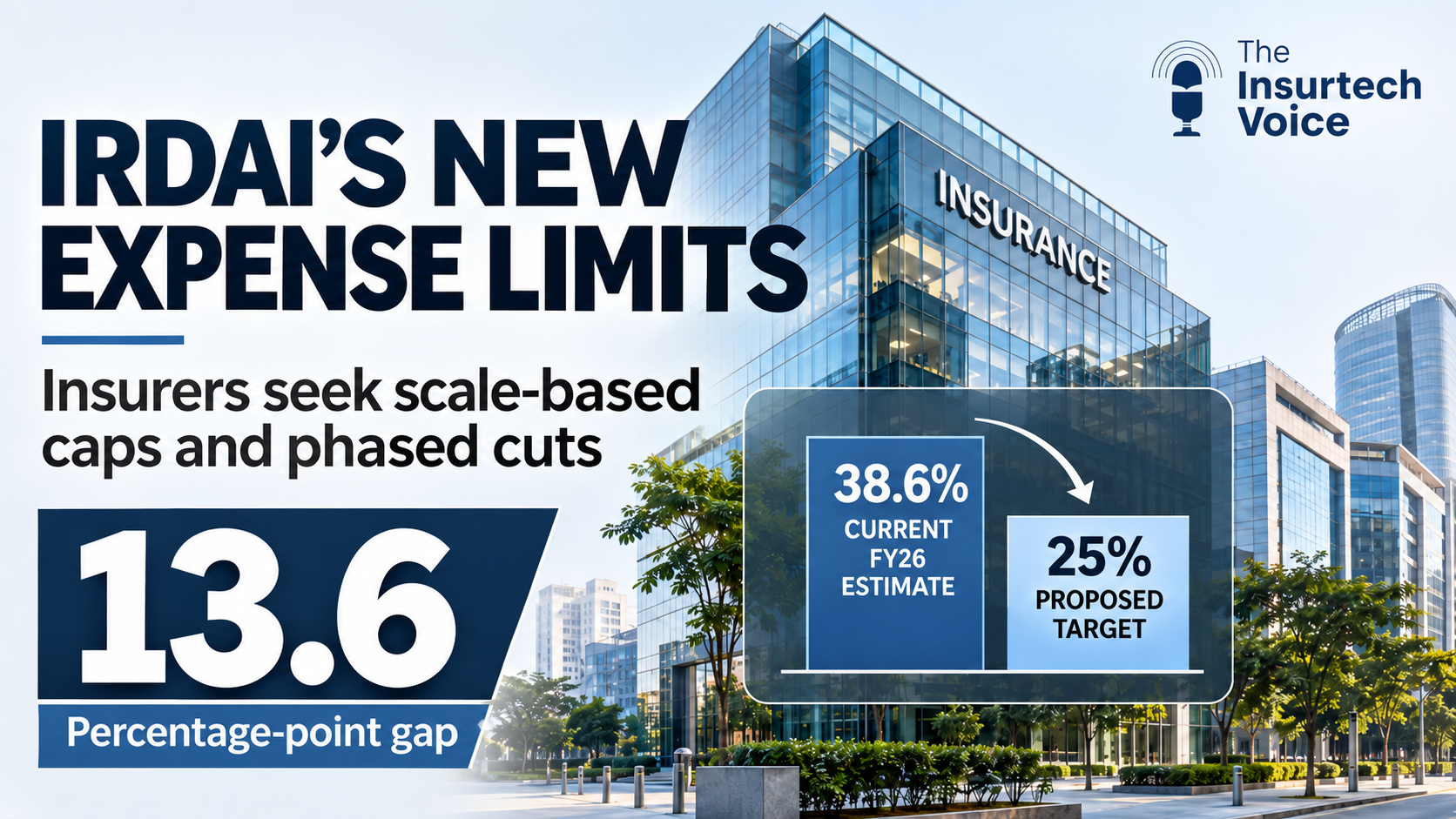
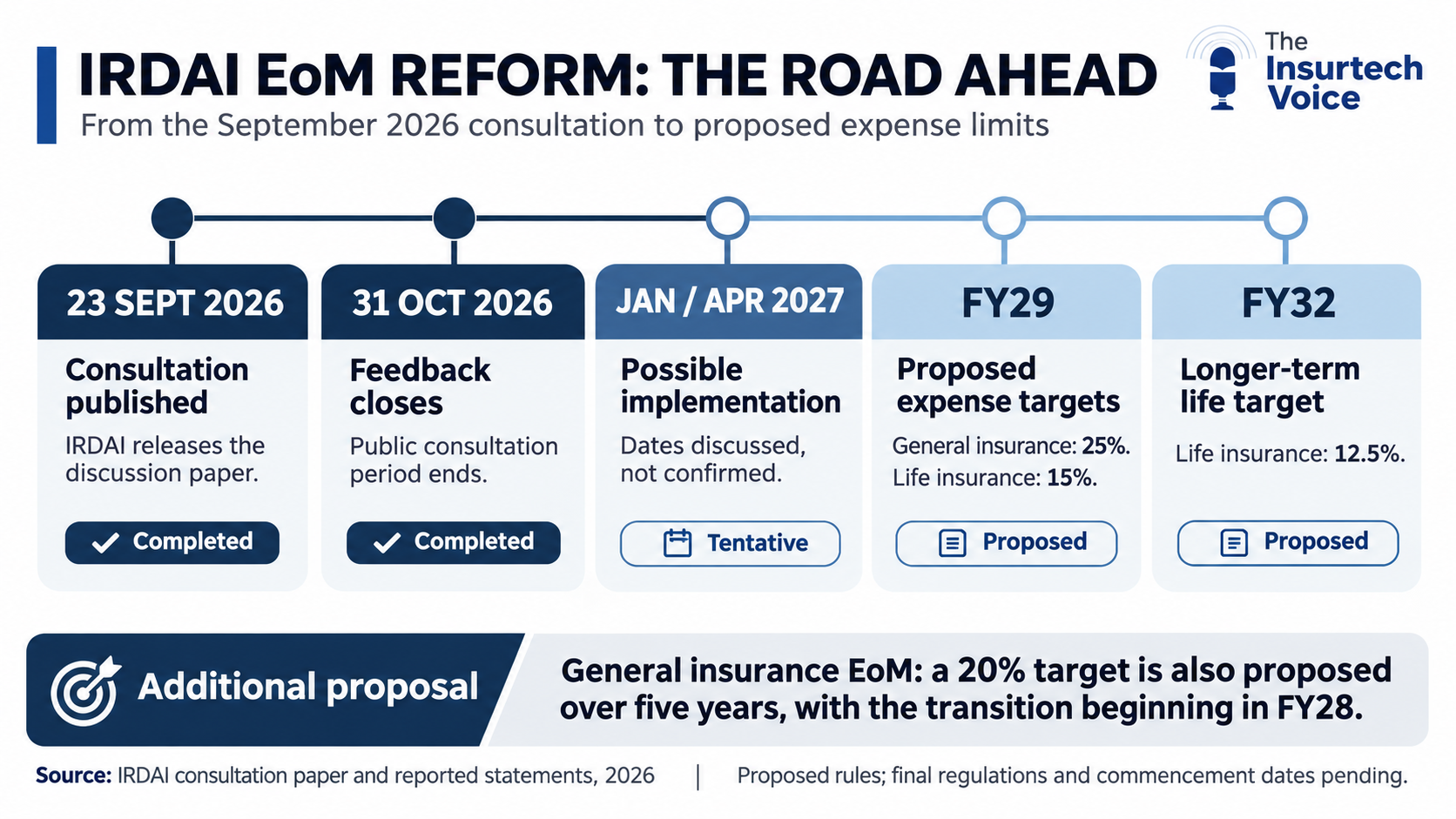
- IRDAI has proposed cutting general insurers' EoM to 25% in two years and 20% in five, starting in FY28, and life insurers' to 15% and then 12.5%.
- Mint's calculations show some of the largest insurers could need cuts of up to 13.6 percentage points.
- IRDAI is reviewing more than 650 responses. None of the proposals is final.
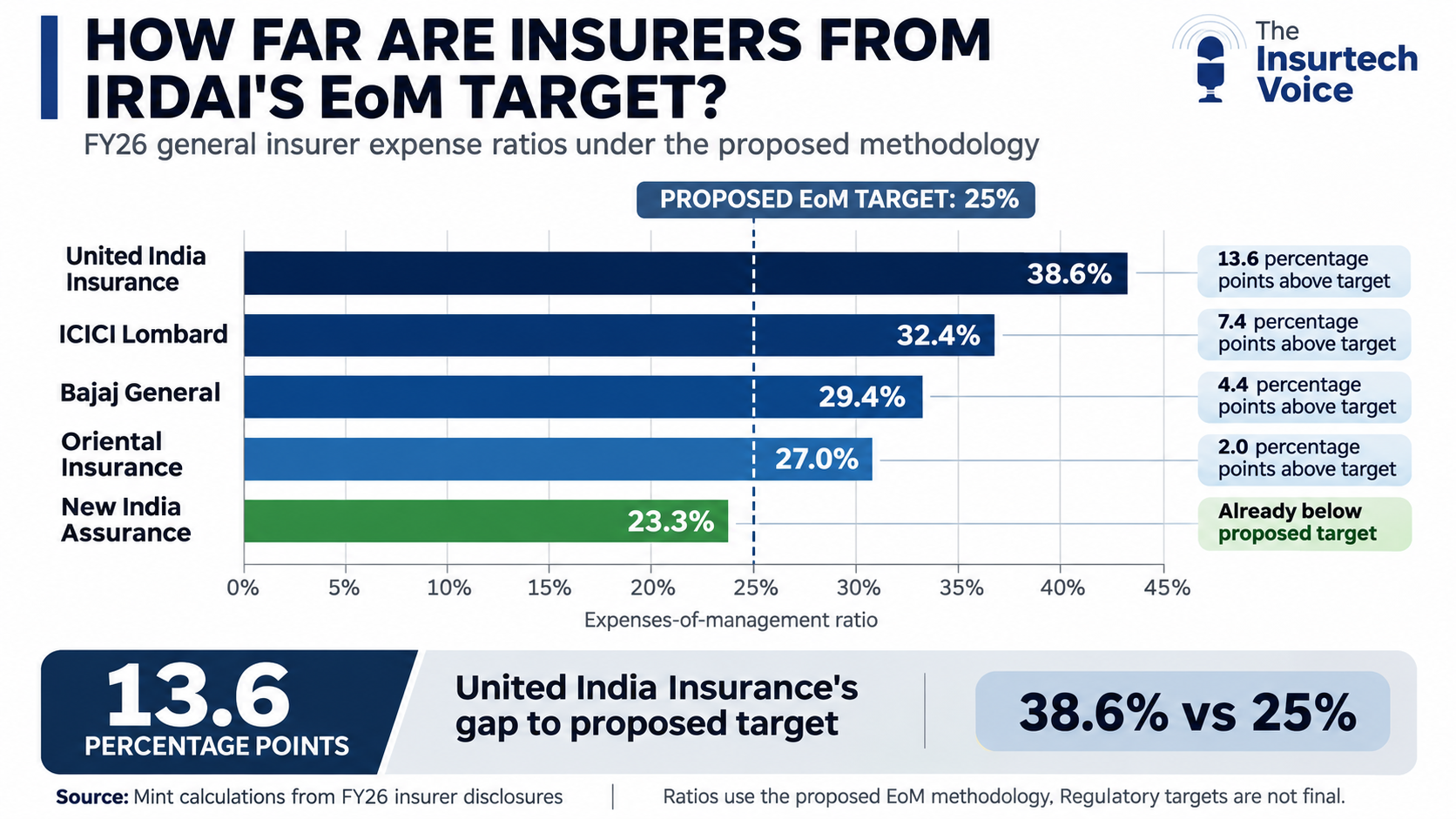
Some of India's biggest insurers are a long way from the expense limits IRDAI wants them to meet. Mint worked through FY26 disclosures for the top five general and life insurers. Meeting the FY29 ceilings (for the year to March 2029) could require cuts of up to 13.6 percentage points for general insurers and 10.9 points for life insurers.
For United India Insurance, that means bringing expenses down from 38.6% of premium to 25%.
That gap explains what the industry is now asking for. Insurers want the Insurance Regulatory and Development Authority of India (IRDAI) to slow the pace of its commission and expense cuts, and to stop treating every insurer the same regardless of size.
The proposals sit in IRDAI's consultation paper, Recalibrating Economics of Insurance Distribution, published on 23 September 2026. The consultation closed on 31 October, and the regulator is now reviewing more than 650 responses.
What Insurers Are Asking For
Insurers want a slower pace, limits that reflect their size and more room for credit life. They put that case to IRDAI chairman Ajay Seth at an informal meeting in Mumbai, days after the paper came out.
The cuts they want to slow are steep in places:
| Product | Proposed cap (individual agents / corporate distributors) | Current rates |
|---|---|---|
| Term insurance | 30% / 25% | Up to 51% |
| Health insurance | 20% / 15% | About 24% |
| Motor insurance | 0–15% | About 26% |
| Savings products | 5–25% | 14–37% |
Source: Business Standard. Proposed caps are under consultation.
Analysts expect cuts of roughly one-third to half across new life, health and motor business. Banks, NBFCs and brokers would feel them more than individual agents, because their caps are lower, while insurers with large agency forces would be relatively less affected.
- A glide path. That means cuts phased in over several years, for both commissions and the EoM limit. One senior industry official said the cuts should recognise the real cost of distribution, and warned that a sharp reduction could hurt growth and penetration. NBFCs, for example, have proposed bringing credit-linked commissions down from 45–49% to about 25% over five years.
- Size-based limits. Insurers want companies of different sizes treated differently under the EoM framework. That is the argument behind IRDAI scale based EoM limits.
- Room for group credit life. Group credit life is cover sold alongside a loan that pays it off if the borrower dies. IRDAI has proposed a 2% commission cap on single-premium credit life. Insurers asked it to reconsider the proposed ban on bundling these policies with loans, saying it could make high-volume, low-ticket distribution commercially difficult.
Why Size Matters
Size matters because one cap ignores how far along each insurer is in building its distribution.
Expenses of management in insurance are the money spent on commissions to agents and other distributors, plus the cost of running the business. The argument is that a single cap treats a young insurer building its network the same way as one that built its network decades ago.
Shubhra Goel, managing director at Alvarez & Marsal India, told Mint that even large insurers want a phased transition. Some mid-sized and smaller insurers, she said, lack the proprietary distribution channels the framework assumes. Building those channels is hard when expenses are already high and premium growth is still catching up.
Saurabh Bhalerao, head of BFSI research at CareEdge Group, raised a different point. A single company-wide ratio can hide large differences between lines of business. Selling a fire policy, he noted, is not the same as selling health insurance, and rural distribution differs from urban.
The case for EoM limits for small insurers is not a case for no limits.
"A single expense ratio asks a ten-year-old insurer and a seventy-year-old one to run on the same budget. Scale-based limits make sense, but only with a clear end date. Otherwise they become a permanent reason not to fix costs," said Hitul Mistry, founder of The InsurTech Voice.
How Far Insurers Are From the Limits
Most of the biggest general insurers sit well above the proposed limit, while the largest life insurers are split.
Part of the gap comes from a change in how EoM is measured for general insurers:
- A narrower base. Expenses would be measured against premium from policies sold directly in India, not gross written premium.
- Crop insurance at one-third. Crop premiums would count at one-third of their value.
- No reinsurance offset. Reinsurance commissions could no longer be set against costs.
- Allowances inside the cap. Existing allowances for technology, awareness and rural business would move inside the limit.
In simple terms, the new method makes most general insurers' expense ratios look higher before any cut is made.
Mint recalculated FY26 expense ratios under the proposed method. The proposed two-year targets are 25% for general insurers and 15% for life insurers.
General insurers (two-year target: 25%)
| Insurer | EoM under proposed method (FY26) | EoM under current method (FY26) | Gap to target |
|---|---|---|---|
| United India Insurance | 38.6% | 38.1% | 13.6 points |
| ICICI Lombard | 32.4% | 29.8% | 7.4 points |
| Bajaj General | 29.4% | 27.8% | 4.4 points |
| Oriental Insurance | 27.0% | 25.7% | 2.0 points |
| New India Assurance | 23.3% | 21.2% | Already within target |
Life insurers (two-year target: 15%)
| Insurer | EoM under proposed method (FY26) | Gap to target |
|---|---|---|
| HDFC Life | 21.2% | 6.2 points |
| ICICI Prudential Life | 18.1% | 3.1 points |
| LIC | 11.9% | Already within target |
| SBI Life | 10.6% | Already within target |
Source: Mint's calculations from FY26 disclosures; gaps are our calculation. Life insurers' current limits are set product by product, so only the proposed-method figures are comparable. The 10.9-point figure Mint cites for life insurers does not match any insurer named in its published figures, so it likely relates to the fifth company in its analysis. Actual ratios may be slightly higher because some allowances are not broken out in public filings.
Among the top five general insurers, only New India Assurance already meets the proposed two-year target. United India is above even the current 30% limit, at a time when it is one of the state-run insurers required to file turnaround plans to cut losses.
The largest life insurers face a different problem. LIC and SBI Life are already below 15%, and Mint notes they may instead be held to the stricter 10% goal set for insurers that were below the benchmarks in FY25.
The Cost of Missing
Missing the limits would carry real penalties. Insurers that breach the ceilings could face:
- restrictions on launching new products
- limits on paying dividends
- in extreme cases, curbs on new business through the channel responsible for the overrun
IRDAI has already shown it will act. In August 2026, it barred Acko General Insurance, Niva Bupa Health Insurance, Pramerica Life Insurance and Edelweiss Life Insurance from opening new branches for six months, after finding lapses in following EoM limits in FY25.
What IRDAI Has to Weigh
Whatever form the IRDAI EoM regulations 2026 finally take, the regulator has to balance two goals. It wants lower distribution costs and better value for policyholders.
IRDAI's case is that distribution costs have grown much faster than the business since commission caps were removed in 2023. Between 2022-23 and 2024-25, life insurers' payouts to corporate agents rose 125% while premiums grew 28%; in general insurance, broker commissions rose 173% against 37% premium growth.
The industry's worry is that growth, especially at smaller insurers, could slow if the cuts come too fast.
In our view, the phased insurance commission cuts and size-based limits insurers want would ease the second concern without abandoning the first, provided they come with firm deadlines.
Seth has said IRDAI will review all feedback before deciding when the rules start, and has mentioned 1 January or 1 April 2027 as possible dates. New commission rules could therefore start in 2027, while the EoM targets would be phased in from FY28 (April 2027 to March 2028).
There are signs IRDAI may meet the industry part of the way. Seth has said a phased rollout is among the options being considered, and the regulator is weighing concerns raised by smaller insurers. He has also made clear that any transition would be limited, with no open-ended delays.
Before any final rules, it plans to publish draft regulations for another round of public consultation.
We covered the full set of submissions in our report on IRDAI's review of more than 650 responses, and the original proposals in our explainer on IRDAI's proposed commission rules.
Insurance company expense limits look set to come down. The open question is whether every insurer has to get there at the same speed.
Sources and method: Expense figures are Mint's calculations from FY26 financial disclosures; details of the industry's requests come from Business Standard and Mint. Prepared with AI assistance and reviewed by The InsurTech Voice editors. These are proposals under consultation, not final regulations. For information only, not investment advice.
Frequently asked questions
- What are scale-based EoM limits?
- They would set different expenses of management limits for insurers of different sizes, rather than one uniform cap for all. Insurers asked IRDAI for this kind of differentiated treatment after it proposed tighter EoM limits in its September 2026 consultation paper.
- What are expenses of management in insurance?
- Expenses of management (EoM) are the money an insurer spends on commissions to agents and other distributors plus the cost of running its business, measured as a share of premium.
- What EoM limits has IRDAI proposed?
- General insurers would move to 25% of premium in two years and 20% in five years, starting in FY28. Life insurers would move to 15% by FY29 and 12.5% by FY32. Insurers already below these benchmarks may be held to tighter targets. These are proposals, not final rules.
- What commission caps has IRDAI proposed?
- Under the draft, term insurance commissions would be capped at 30% for individual agents and 25% for corporate distributors, against up to 51% now. Health would be capped at 20% and 15%, against about 24% now. Motor would face caps of 0-15% and savings products 5-25%. Single-premium credit life would be capped at 2%. These are proposals, not final rules.
- Why do insurers want phased commission cuts?
- Insurers argue that sharp, immediate cuts could hurt growth and penetration, and that distribution costs need to reflect the actual work done by intermediaries. They have asked for a glide path for both commissions and the EoM limit.
- Which insurers are furthest from the proposed limits?
- According to Mint's calculations on FY26 disclosures under the proposed method, United India Insurance would be at 38.6% and ICICI Lombard at 32.4% against a 25% two-year target for general insurers. Among life insurers, HDFC Life would be at 21.2% and ICICI Prudential Life at 18.1% against a 15% target.
- What happens if an insurer breaches EoM limits?
- Insurers that breach the ceilings could face restrictions on launching new products and paying dividends, and in extreme cases curbs on new business through the channel responsible. In August 2026, IRDAI barred four insurers from opening new branches for six months over EoM lapses in FY25.
- When will IRDAI decide?
- IRDAI is reviewing more than 650 responses to its consultation, which closed on 31 October 2026. Chairman Ajay Seth has mentioned 1 January or 1 April 2027 as possible start dates, but no date has been confirmed. IRDAI plans to publish draft regulations for another round of consultation before final rules.
Sources
Regulatory document
Reporting
- Business Standard, 28 September 2026: Insurers seek softer landing on Irdai commission cuts in meet with chief
- Mint via TradingView, 15 October 2026: Facing steep expense cuts under proposed Irdai caps, insurers seek gentler glide path
- Business Standard, 23 September 2026: Irdai proposes tighter expense limits, new commission caps for insurers
- Beinsure, 25 September 2026: IRDAI proposes insurance distribution overhaul and lower expense caps
- Whalesbook, 2 November 2026: IRDAI concludes feedback on commission reform overhaul
- Insurance Business, 27 October 2026: Indian brokers face 60%-70% revenue hit under proposed commission caps
- News Karnataka, 16 October 2026: IRDAI open to insurance reform suggestions
- Inc42: IRDAI mulls introducing insurance commission caps from January 2027
- Mint via TradingView, 13 October 2026: ICICI Life defends credit cover as Irdai weighs steep commission cut
- Elets BFSI, 26 October 2026: NBFCs seek five-year glide path as IRDAI weighs insurance commission caps
- NewsBytes: IRDAI may offer insurers limited transition before commission caps
The InsurTech Voice · An Initiative by Insurnest