
Key takeaways
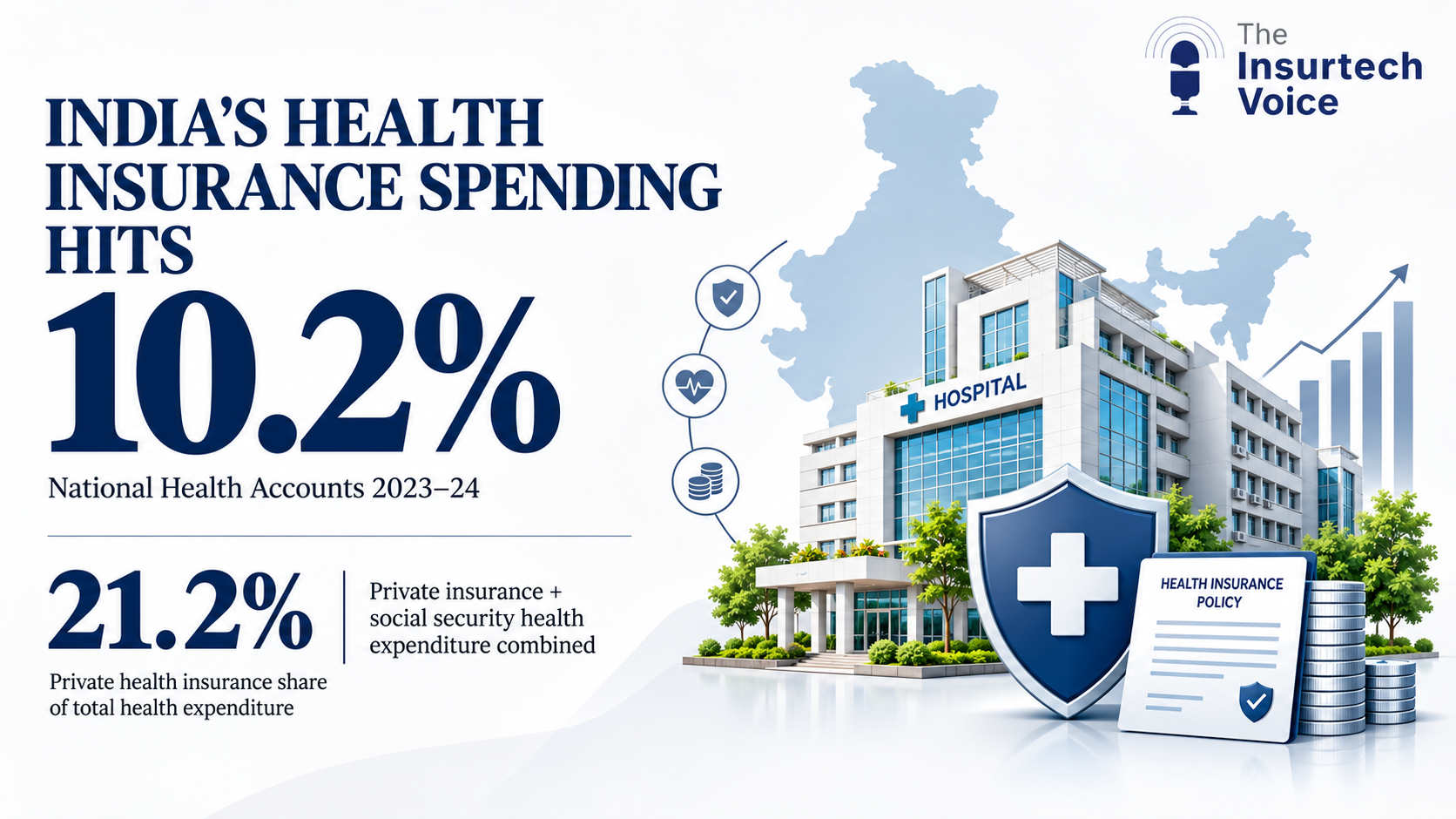
- Health insurance expenditure in India in 2023-24 reached 10.2% of total health spending, three times its 3.4% share in 2013-14.
- With government-supported schemes such as PM-JAY at 11%, the two together financed 21.2% of India's health spending, the first time both have topped 10%.
- Households paid 42.7% of health costs directly, down from 64.2% a decade earlier.
- Government health expenditure more than tripled to ₹4.14 lakh crore.
- The figures come from the National Health Accounts 2023-24, released by the Ministry of Health and Family Welfare on 15 November 2026.
More than one rupee in every five that India spends on healthcare is now paid through either health insurance or a government health scheme.
That is the headline for insurers in the National Health Accounts (NHA) Estimates for India 2023-24, released by the Ministry of Health and Family Welfare on 15 November 2026. Private health insurance alone financed 10.2% of the country's total health expenditure in 2023-24. A decade earlier, it covered just 3.4%.
The NHA estimates are India's official record of who pays for healthcare. They measure total health expenditure, meaning all health spending in the country, whether paid by the government, households, insurers, employers or donors. Most figures in this article are shares of that total.
The 2023-24 estimates cover the financial year from April 2023 to March 2024. They were released about two and a half years after that year ended, so these are the latest official figures, not this year's.
This is the eleventh round, prepared by the National Health Accounts Technical Secretariat at the National Health Systems Resource Centre (NHSRC) using the international System of Health Accounts 2011 framework.
A Decade in Six Numbers
| Indicator | 2013-14 | 2023-24 |
|---|---|---|
| Private health insurance (share of total health expenditure) | 3.4% | 10.2% |
| Social security expenditure on health (share) | 6.0% | 11.0% |
| Combined share | 9.4% | 21.2% |
| Out-of-pocket expenditure (share) | 64.2% | 42.7% |
| Government health expenditure | ₹1,29,778 crore | ₹4,14,196 crore |
| Per capita government health expenditure | ₹1,042 | ₹2,959 |
Source: National Health Accounts Estimates for India 2023-24, Ministry of Health and Family Welfare.
Private Health Insurance Growth in India
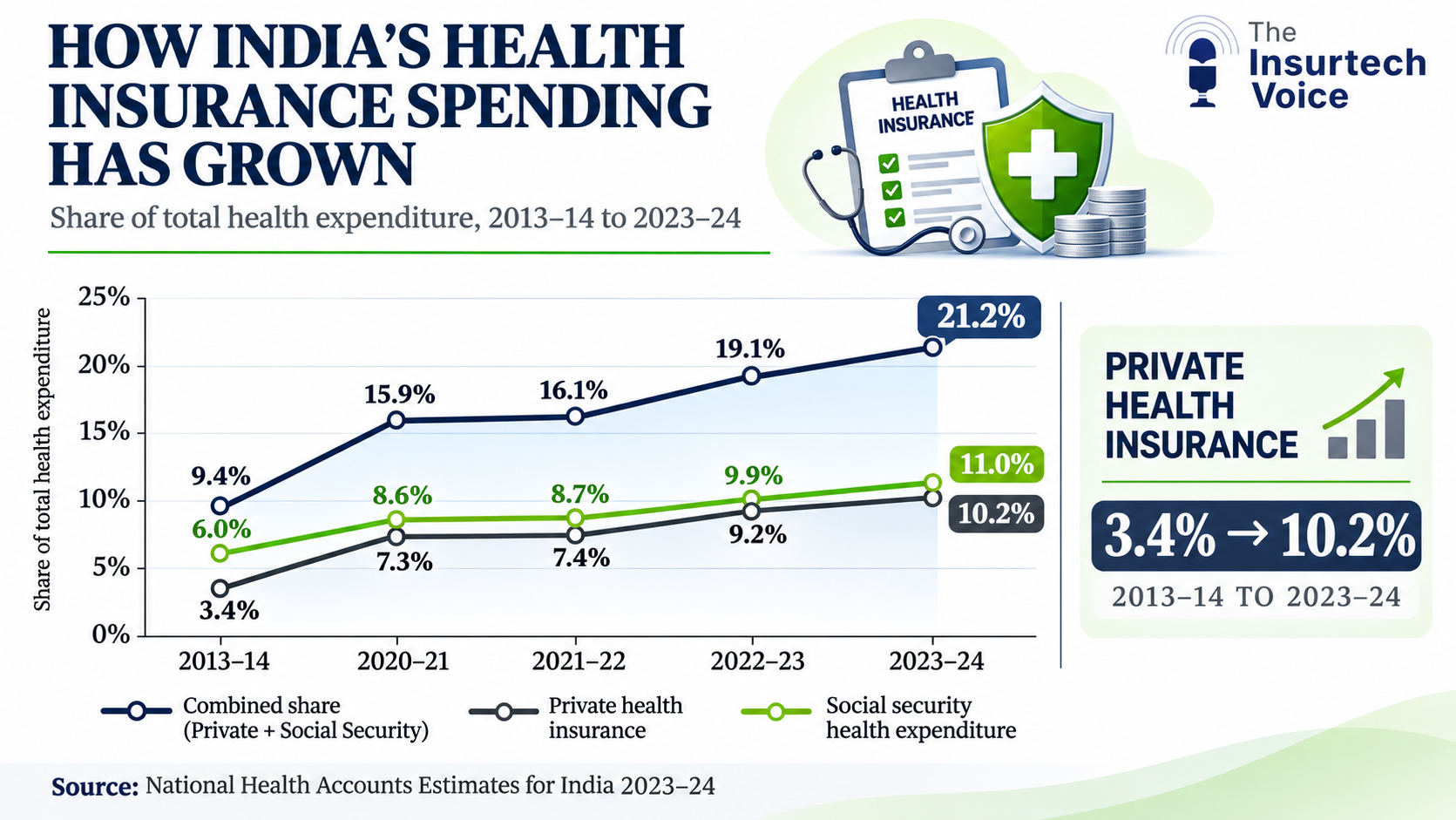
Private health insurance growth in India has been steady rather than sudden. The share was already 7.3% in 2020-21, edged up to 7.4% in 2021-22, jumped to 9.2% in 2022-23 and reached 10.2% in 2023-24.
| Year | Private health insurance | Social security on health | Combined |
|---|---|---|---|
| 2013-14 | 3.4% | 6.0% | 9.4% |
| 2020-21 | 7.3% | 8.6% | 15.9% |
| 2021-22 | 7.4% | 8.7% | 16.1% |
| 2022-23 | 9.2% | 9.9% | 19.1% |
| 2023-24 | 10.2% | 11.0% | 21.2% |
Source: National Health Accounts estimates, as compiled by Business Standard. Combined figures are our calculation.
In money terms, the NHA tables put private health insurance expenditure at about ₹97,167 crore in 2023-24. The government says the rising share reflects deepening health insurance penetration in India.
Private insurance has also grown faster than public schemes. Its share rose by 6.8 percentage points over the decade, against 5 percentage points for social security spending.
Government Schemes Reach 11%
Social security expenditure on health rose from 6% of total health expenditure in 2013-14 to 11% in 2023-24. This category covers pooled, government-supported financing, including:
- Ayushman Bharat PM-JAY and state health insurance schemes
- Social health insurance
- Medical schemes for government employees
Not all of this is insurance in the commercial sense. Some of it is reimbursement for public employees, which is worth remembering when the two categories are added together.
Out-of-Pocket Health Expenditure in India
Out-of-pocket health expenditure in India fell to 42.7% of total health spending in 2023-24, from 64.2% in 2013-14, a drop of 21.5 percentage points. It also eased from 43.4% in 2022-23.
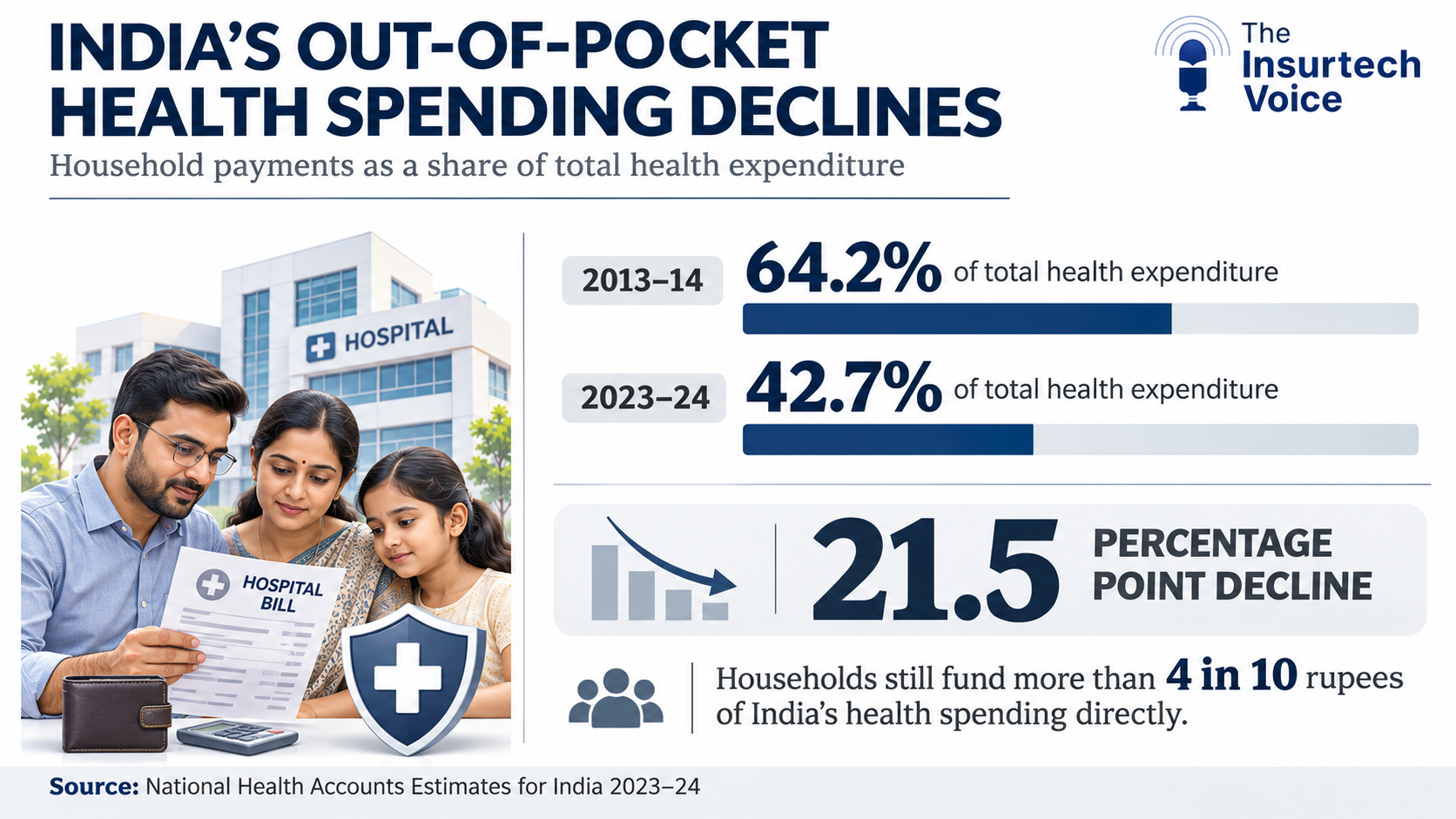
In simple terms, households still pay for more than four rupees in every ten spent on healthcare, directly at the point of care, with no insurer or scheme in between. On the NHA's figures, that came to about ₹2,901 per person in 2023-24, or 1.40% of GDP.
The trend has not been a straight line. The out-of-pocket share was 39.4% in 2021-22, rose to 43.4% in 2022-23 and then dipped to 42.7%.
There is also a measurement caveat. The NHA's out-of-pocket estimate for 2023-24 still relies on the National Sample Survey's 75th round, conducted in 2017-18, so it may not fully capture how household spending has changed since then.
Government Health Expenditure in India Has Tripled
Government health expenditure in India rose from ₹1,29,778 crore in 2013-14 to ₹4,14,196 crore in 2023-24, a more than threefold increase. Over the same decade, the government's share of total health expenditure increased by 14.9 percentage points.
Per person, government health spending rose about 2.8 times, from ₹1,042 to ₹2,959. Spending on primary healthcare reached about ₹1.53 lakh crore, which the government links to the expansion of Ayushman Arogya Mandirs.
What It Means for Insurers
For health insurers, the NHA data confirms what premium growth has suggested for several years. Insurance is becoming a mainstream way Indians pay for healthcare, not a niche product for the few.
As more care is paid for through insurance, how policies are priced, sold and serviced matters more. It also brings more policies, more claims and more medical data to process.
IRDAI chairman Ajay Seth has said average health insurance commissions are about 24%. The regulator wants them closer to 15-20%, as we reported in our coverage of his comments on insurance pricing. Product filing has also changed, with health product UINs now generated only through IRDAI's portal, as covered in our report on the IRDAI health insurance BAP portal migration.
Technology is where much of the next gain lies, in faster claims processing, reading medical documents and catching fraud. Our conversation with Pranshu Diwan on why AI's biggest wins are in distribution and claims explores that opportunity.
"A 10% share of national health spending changes what health insurance is. It is no longer a product sold to a few; it is part of how the country pays for care. That puts claims speed and fairness under the same scrutiny as public healthcare," said Hitul Mistry, founder of The InsurTech Voice.
What the Numbers Don't Show
The gains are real, but they leave gaps. Commentators have pointed to a "missing middle": informal workers who earn too much for PM-JAY but too little to buy private cover, and who still pay largely out of pocket.
The next NHA round will show whether private health insurance keeps adding about a percentage point a year. It will also show whether the out-of-pocket share keeps falling once newer household survey data feeds into the estimates.
About these figures: All numbers come from the National Health Accounts Estimates for India 2023-24, as released by the Ministry of Health and Family Welfare and reported by Business Standard, ANI and PTI. Year-by-year shares are as compiled by Business Standard. Prepared with AI assistance and reviewed by The InsurTech Voice editors. For information only.
Frequently asked questions
- What share of India's health spending came from health insurance in 2023-24?
- Private health insurance accounted for 10.2% of India's total health expenditure in 2023-24, up from 3.4% in 2013-14. Social security expenditure on health, which includes government-funded insurance schemes, accounted for another 11%, taking the combined share to 21.2%.
- What are the National Health Accounts 2023-24?
- They are the eleventh round of official estimates of how India finances healthcare, prepared by the National Health Accounts Technical Secretariat at the National Health Systems Resource Centre under the Ministry of Health and Family Welfare, using the international System of Health Accounts 2011 framework.
- How much do Indian households pay out of pocket for healthcare?
- Out-of-pocket expenditure was 42.7% of total health expenditure in 2023-24, down from 64.2% in 2013-14 and 43.4% in 2022-23.
- How much does the government spend on health in India?
- Government health expenditure was ₹4,14,196 crore in 2023-24, up from ₹1,29,778 crore in 2013-14. Per capita government health spending rose from ₹1,042 to ₹2,959 over the same period.
- What counts as social security expenditure on health?
- It covers pooled, government-supported financing such as Ayushman Bharat PM-JAY, state health insurance schemes, social health insurance and medical schemes for government employees.
- Does the NHA data show health insurance penetration rising?
- Yes. The government says the rise in private health insurance from 3.4% to 10.2% of total health expenditure reflects deepening health insurance penetration across the country. The share has risen every year since 2020-21.
- How much did Indians spend through private health insurance in 2023-24?
- The NHA tables put private health insurance expenditure at about ₹97,167 crore in 2023-24, or 10.2% of total health expenditure.
Sources
Official sources
- National Health Systems Resource Centre (NHSRC): National Health Accounts records, official home of the NHA reports
- Ministry of Health and Family Welfare release, 15 November 2026, via ANI: Government health spending triples, households' out-of-pocket expenditure share falls sharply: National Health Accounts 2023–24
Reporting
- Business Standard, 15 November 2026: Govt, private health insurance spending tops 20% of total health outlay
- Business Standard, 15 November 2026: India's health spending triples, out-of-pocket share falls to 42.7%: NHA
- ETV Bharat (PTI), 15 November 2026: India's health spending triples to Rs 4.14L Cr, out-of-pocket spending drops to 42.7%
- National Watch (Substack): The state of Bharat's health finances, with NHA 2023-24 tables
- Legacy IAS, PIB summaries, 16 November 2026: National Health Accounts 2023–24
The InsurTech Voice · An Initiative by Insurnest